
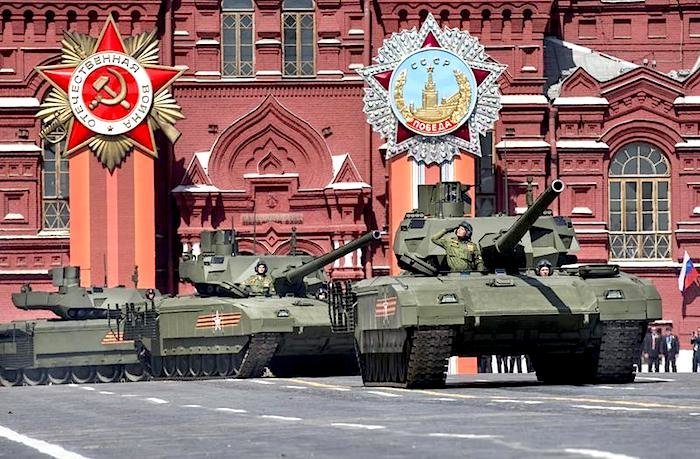
© RealClearWorldRussian Military Modernization
In October, Russia's Ministry of Finance revealed forward spending estimates that showed a 12% nominal reduction in defence spending by 2018. Figure 1 shows Russia's spending on defence (in constant 2015 currency) and as a proportion of GDP. The figures for 2009 and 2015 are particularly interesting. A full percentage point jump in 2009 is likely to have been due to operational costs of prosecuting the Russo-Georgian War in August of 2008. Similarly, the significant increase from 2014 - 15 would likely be due to Russian operations in Syria (and possibly Eastern Ukraine).
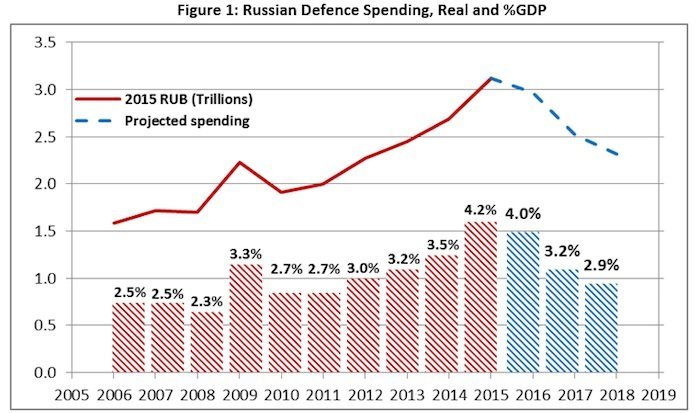
© DIO Economic Trends 2016DIO Economic Trends 2016; IMF World Economic Outlook Database Oct. 2016 Edition; IHS Jane’s (Note: Future spending adjusted to 2015 RUB using IMF CPI deflators)
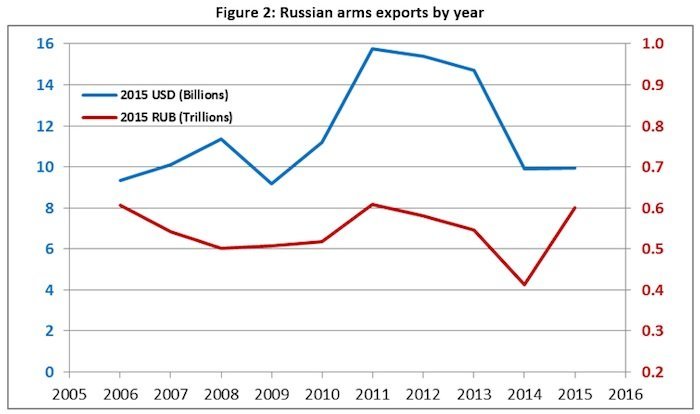
The good news for Moscow is that Russian operations in Syria have provided effective advertising for Russian military hardware. Back in March, Vladimir Putin boasted that Russian arms sales in 2015 had exceeded US$14 billion, and prospective foreign orders had reached US$56 billion. (As a caution, SIPRI's arms transfer database, which measures the value of delivered goods, lists a 2015 exports figure of less than US$10 billion).
Figure 2 shows the last ten years of Russian arms export deliveries in constant 2015 rubles and constant 2015 US dollars. The value of the ruble relative to the US dollar collapsed in 2014 - 15 as sanctions and the oil crisis started to bite. Russian arms sales in 2014 and 2015 look similar in US dollars, but the value in rubles doubled over the same period.
© SIPRI Arms Transfers Database
Arms sales alone aren't likely to improve Russia's economic prospects in the long term, but it's an indispensable source of revenue for the Russian government. And each sale has geopolitical implications: Russia's main military hardware customers over the last ten years are India (US$40b in 2015 dollars, according to SIPRI), China (US$20b), Algeria (US$12b) and Vietnam (US$7.5b). Sales in the same period to Syria (US$2.5b) and Iran (US$1.5b) are noteworthy, and the easing of sanctions on Iran has already stirred talk of major new acquisitions. Sales of military aircraft made up almost half of all arms sales (45.5%), with missiles (16.6%) and air defence systems (10.1%) the next two most popular purchases by value.
It's hard to know what—if anything—will reverse Russia's economic misfortunes. It's likely that Putin will seek rapprochement with the US under President Trump in an attempt to end the sanctions, though it's anyone's guess how successful this strategy will be. An upswing in oil prices would be a boon to Russia's export economy. And, while there are some indications that prices are stabilising, it may be years before prices return to pre-2014 levels.
On the other hand, if Moscow continues to conduct expensive operations in Syria, operational costs may result in further delays to new platforms. The Russian Navy's surface fleet plans have already been set back by the lack of Ukrainian gas turbines, the air force can currently only afford twelve units of the developmental PAK-FA fighter jet, and the Russian Army's new tanks may be delayed even further. Moscow has some hard choices to make.



Reader Comments
to our Newsletter