RTMon, 31 Oct 2016 14:54 UTC
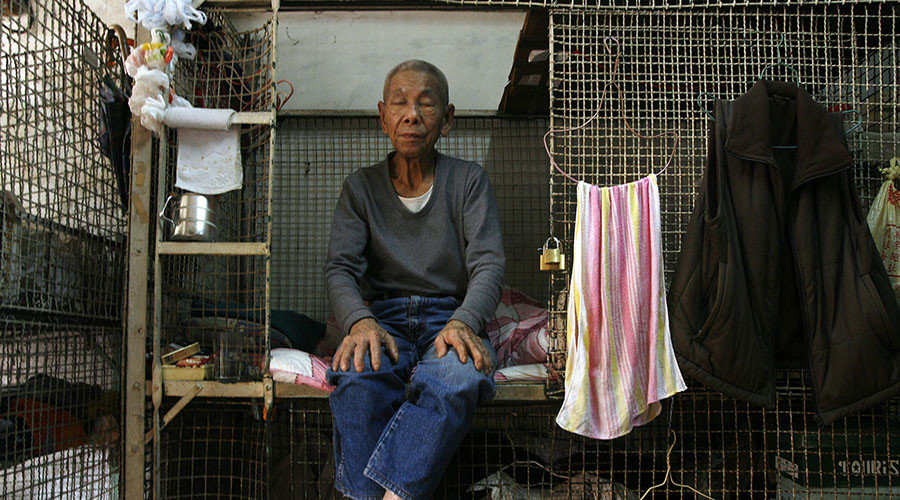
© Bobby Yip / ReutersA resident takes a nap at one of about 100 cage homes in Hong Kong.
Hong Kong is one the world's ten richest cities in terms of GDP, and has one of the highest proportions of people enslaved across Asia, according to a survey from the Walk Free Foundation charity.
The
Global Slavery Index 2016 suggests there are 45.8 million people trapped in modern slavery in the world. In Hong Kong that could be as many as 30,000 people.
The city with a population of more than seven million has become one of the worst places in Asia for its poor response to the problem, the report said. "Hong Kong has taken relatively limited action due to low level of recognition that modern slavery occurs," and is performing worse than mainland China.
The proportion of people classified as slaves in Hong Kong is the ninth-highest in Asia and 32nd in the world. Mainland China was ranked lower on its proportion of slaves, due to its much larger population; it took the 14th spot in Asia. The country with the highest estimated proportion of modern slavery by population is North Korea; 1.1 million people in a population of about 25 million.
According to the human rights group Justice Center, Hong Kong urgently needs tougher laws and a "transparent plan of action" to combat the problem.
Anti-human trafficking coordinator for the group Jade Anderson said the research came as a "shock" to the people of Hong Kong.
There were major human rights abuses that went unpunished in the city, and the number of slaves could be much higher than researchers have estimated, Anderson added.
"We believe Hong Kong needs a transparent plan of action to combat human trafficking, forced labor, or slavery-like practices, and protect victims," she said as cited by the South China Morning Post."Hong Kong must develop more comprehensive policies and laws to protect victims."
The government of Hong Kong has dismissed the organization's findings, saying the picture was incomplete as it relied on information from NGOs and lacked government verification.
Comment: Hong Kong is right to question the NGO report. Collecting this data is a tremendous task that even the US government gave up trying to collect. There are many problems with this report:
The Global Slavery Index: Helpful or Harmful?
A major weakness of the Index is the extrapolation process used to estimate prevalence and absolute numbers for the "hidden" figure of those enslaved. Since 2014, survey questions based on the possible occurrence of forced labor have been incorporated into Gallup's World Poll, but only in 25 countries (and seven of those countries' estimates reflect survey data from 2014). Survey data is then extrapolated to the remaining 139 countries, which are now grouped into twelve clusters (the number of clusters has doubled since 2014). The extrapolation process also uses some secondary sources, taking into account additional factors such as state-sanctioned forced labor and conflict.
Year over year estimates are questionable as well. In 2014, the total number of those estimated to be enslaved was roughly 36 million. In 2016, that number is now estimated to be 45.8 million. Has the number of those enslaved globally actually risen - meaning the problem is getting worse, or should we attribute this increase to a larger sample size? Either way, there is no mention of past years' results or analysis to assess the rise or fall in numbers year to year.
Another area of major contention is the stipulations in which the primary random-sample survey data was collected. Most notably, the sample size was extremely small. In the 25 countries where surveys have been administered, roughly 1000 random families were sampled in each country (with the exception of Russia and India, with 2000 and 3000 surveys, respectively). In Pakistan, where the population is roughly 182 million, the representative sample amounts to .00001 percent of citizens, which arguably is too small of a sample to be representative.



The article claims an estimated 48.5 million 'slaves' around the world.
From what I see all around me, with everyone (kids to adults) walking around with their heads bowed down to view their 'smart' phones, the widespread uncritical acceptance of the outrageously ridiculous lies from the MSM, the people's unwavering subservience to the elite's and their bloody thieving colonialist agendas, the masses' continuing acceptance of the unrelenting poisoning of their air, food and water supplies by the fascists of 'industry', and the omnipresence of ubiquitous mind-control techniques at all levels of the 'educational' systems of the world, I'd have to say the number of 'slaves' cited is slightly conservative.
I'd place the number of 'slaves' currently in existence on planet Earth at around 7.4 BILLION.......
(.......and steadily rising.)