
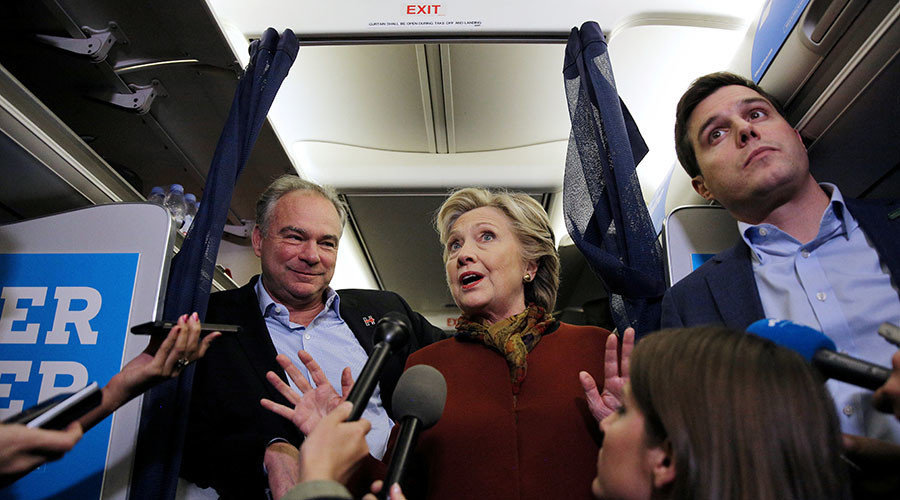
© Carlos Barria / Reuters The aide looks worried . . .
The organization has released more than 39,000 emails from Podesta's account and has pledged to bring the total number up to 50,000 before the November 8 election.
Among the revelations from Sunday's tranche of leaked emails was the Clinton campaign team's suspicions that the House Select Committee on Benghazi Chairman, Republican Trey Gowdy, was selectively leaking information from the committee.
Other emails released Sunday included a conversation between Podesta and Chelsea Clinton on 'compromised' technology during visits to China, while another chain of emails offered insight into Podesta's own doubts on Hillary Clinton's chances of securing the Democratic nomination.
Avoiding media 'gaggle'
An email from The Hill columnist Brent Budowsky dated May 21, 2015 explains the Clinton campaign's months-long avoidance of press conferences.
"What I would suggest avoiding is a format where she walks up to the gaggle, with questions virtually shouted and microphones thrust in her face, that looks like a perp walk," Budowsky wrote to Podesta. "And minimize the podium style news conference whenever possible."
He suggested a "conversational format" where Clinton would sit at a table with a score of reporters instead.
"He can be annoying, but this actually makes sense to me," Podesta wrote, forwarding the message to Deputy Communications Director Kristina Schake.
"It is definitely something we want to try," Schake replied, adding that after Iowa and New Hampshire, Communications Director Jennifer Palmieri said "we need to find a better avail [sic] set up that isn't so awful for HRC."
'Feels consistent'
On November 4, 2015, senior campaign adviser Karen Finney put out a call for an op-ed that would promote Clinton to the African-American community ahead of a MSNBC forum in South Carolina.
After many iterations, Kristina Costa proposed an introduction (co-authored by main Clinton speechwriter Dan Schwerin) saying that Clinton went into public service "to tear down the barriers that hold people back from developing their talents and achieving their dreams."
"My only concern is we keep rewriting the reason why she started in a public service. Isn't this the third variation on this?" asked pollster Joel Benenson.
"We've used this language in a number of places, feels consistent," replied Finney.
'Seems shady'
In May 2015, when longtime Clinton partisan David Brock announced he was spinning off Correct the Record into a separate superpac to work closely with the Clinton campaign, Podesta's associates at the Center for American Progress were doubtful.
"This makes zero sense to me," ThinkProgress editor Judd Legum wrote to CAP President Neera Tanden, in an email headlined simply "Why?"
"I'm not their biggest fan," Tanden replied, "But this does seem shady."
"Brock $ machine!" Podesta fired back.
"That's fine," said Tanden. "But skirting if not violating law doesn't help her."
Though federal law explicitly prohibits superpacs from coordinating with individual campaigns, Brock argued that the ban applied only to paid political advertising, citing a 2006 Federal Election Commission "internet exemption" that ruled free online content does not count as campaign expenditures.



Comment: Why does anyone still support Killary and her slimy organization?