

© University of GlasgowThe Cochno Stone, which dates back to around 3000 B.C., contains a type of artwork called "cup and ring marks."
The Cochno Stone, which measures 43 feet by 26 feet (13 by 8 meters), contains swirling decorations, also called "cup and ring marks." The stone and its decorations have been known to people in the area since at least the 19th century. Decorations similar to these swirls have been found at other prehistoric sites around the world; however, the examples incised in the Cochno Stone are considered to comprise "one of the best examples" of such art in Europe, according to a statement by the University of Glasgow, which led the new study.
The stone slab was fully unearthed in West Dunbartonshire by Rev. James Harvey in 1887. By 1965, the stone had been vandalized with graffiti and damaged by the elements, so a team of archaeologists buried it beneath the dirt in order to protect the artwork . This summer's two-week re-excavation allowed archaeologists to use modern-day surveying and photography techniques to better record the artwork.
For instance, digital-scanning and mapping experts from the Factum Foundation used cutting-edge 3D-imaging technology to make a detailed digital record of the site, according to the university statement.
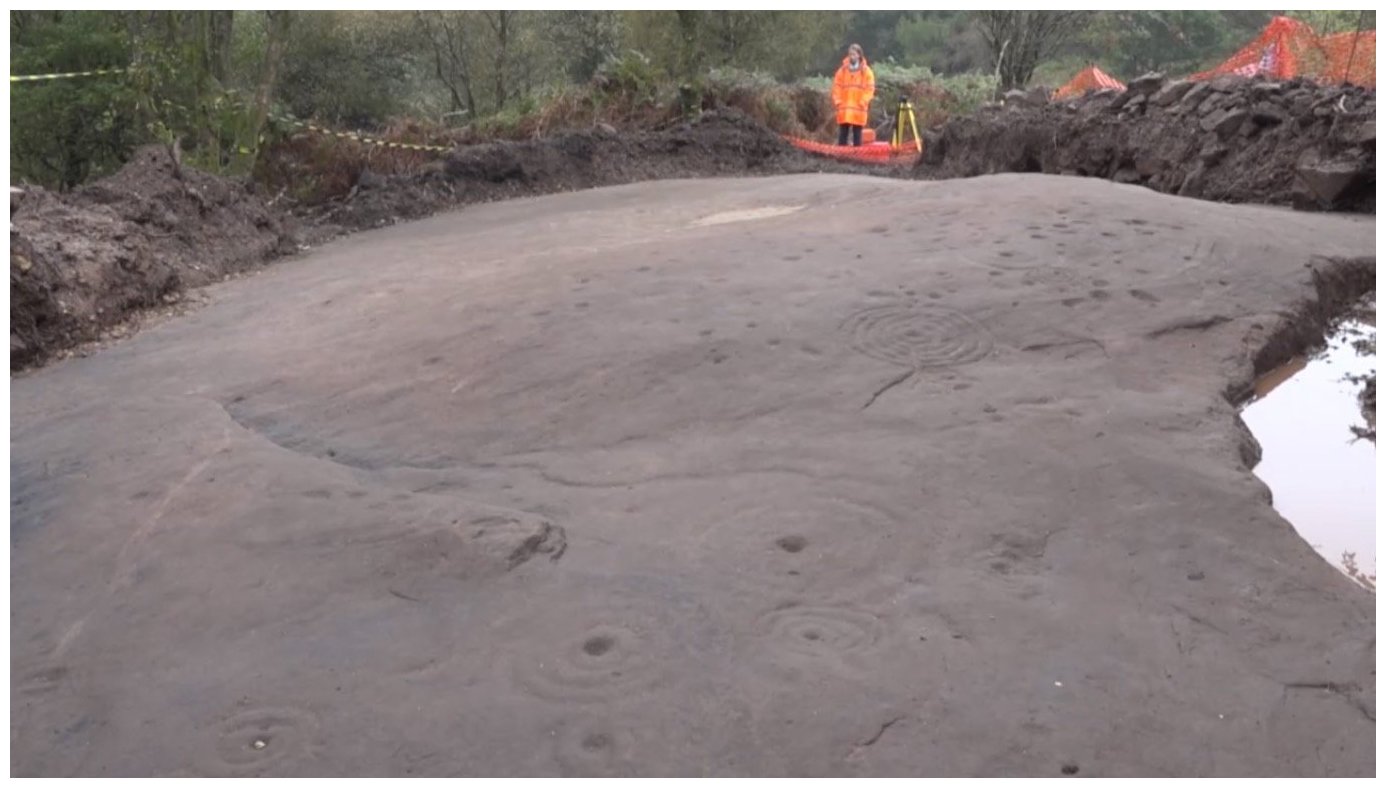
© University of Glasgow The huge stone was recently unearthed in Scotland so that archaeologists could use modern techniques to study it.
Mann "was trying to prove that the symbols could predict eclipses and were marking movements of the sun and moon in prehistory," said Kenny Brophy, an archaeologist and senior lecturer at the University of Glasgow, in a video released by the university. He said that Mann's own data ended up disproving the archeologist's theory.
The meaning of the artwork is still unknown, said Brophy, adding that the vast amount of data gathered this summer may, in time, allow archaeologists to better understand the artifact. He said that the graffiti is also of interest and will help archaeologists better understand what people who lived in the local area thought of the artwork during the 19th and 20th centuries and how they incorporated it into their lives.
While archaeologists had to rebury the swirling prehistoric artwork in order to protect it, Brophy said he hopes that one day it will be possible to create an area where the rock art can be permanently revealed for both tourists and people in the local area to see. Funding will have to be obtained to build a protective area and visitors centre so that people can view the prehistoric artwork without damaging it.
"It is emotional when you have worked on a project such as this, touched it, walked on it and closely examined it, to then rebury it. But for now, that is what we have to do to protect it from the elements," Brophy said in the statement. "Perhaps in the future, this site could be turned into a major tourist attraction in Scotland, with a visitor center — who knows?"





[Link]
It's called England Rock art, the images are fascinating. it's a rock art gallery of the UK and images captured on stone, the also make me think they nay be a glacial erratic, no stone can definitely identifies by carbon dating by my understanding.
The images are primordial, and to me strike the origins of a deep and long spiritual belief system in people throughout the world. Note the circle and also what one could be called the labyrinth which to me looks like the brain without the separation of the corpus collusum (just a medical term look it up)
when looking at the what one calls the chartres labyrinth is has a separation going down the middle of the labyrinth. In the labyrinth of pre history no separation be seen. IMO.
It makes me wonder did the ancients walk the labyrinth in the configuration of not only the brain but the circular cycle of time and nature to become as one with the cosmos, the divine circle of life and regeneration.
I