
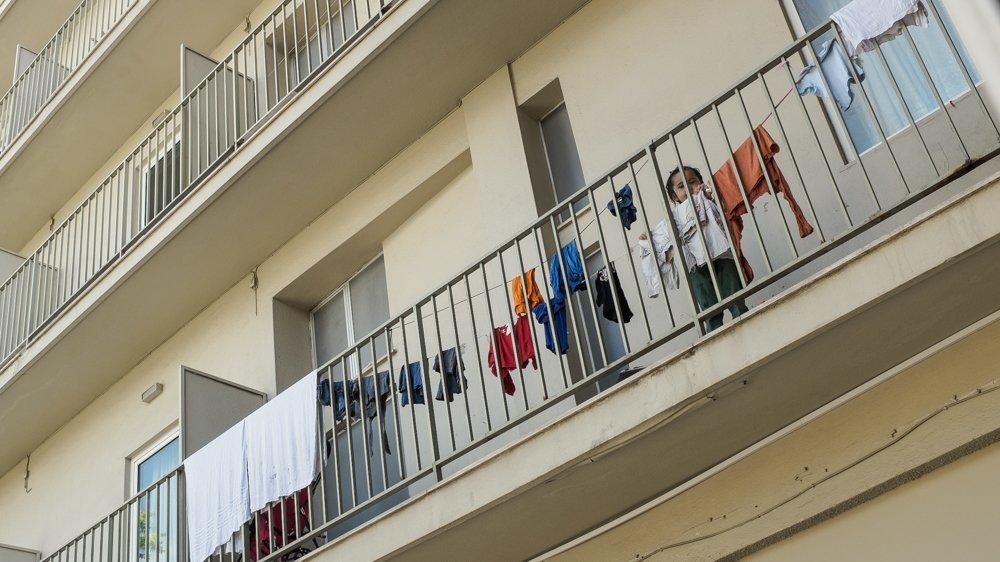
© Nick Paleologos/SOOC/Al JazeeraDecisions are made through general discussions sculpted on ideals of self-organising
The roar of children's laughter erupts as they play tag and chase one another through the corridors, while several adults prepare the tables in the City Plaza hotel's dining hall in preparation to break the fast for Ramadan, a holy month for Muslims.
Tucked away down a side street in the Greek capital, the previously deserted hotel was occupied by left-wing Greek activists and turned into a squat for nearly 400 refugees and migrants - half of them children - in late April.
Sitting in the hotel's cafe, Lina Theodorou, a 27-year-old Athens-based lawyer and member of the Solidarity Initiative for Political and Economic Refugees, explains that the activist group was inspired to take action shortly after neighbouring Macedonia sealed its borders in late March.
The closure was in response to the agreement between the European Union and Turkey to halt the flow of refugees and migrants seeking to reach Western Europe by crossing through Greece, the Balkans and central Europe.
The hotel is now home to Syrian and Afghan refugees and, to a lesser extent, families who fled Iraq, the occupied Palestinian territories and several countries across Africa. The squat is administered by the refugees themselves, as well as between 30 and 40 solidarity activists who volunteer informally on a daily basis.
"We wanted to demand this public space because the mayor tried to throw all of the refugees out of [Victoria Square]," Theodorou tells Al Jazeera, referring to an area in central Athens that has become a meeting place for those hoping to continue their journey.
"It was a gesture to reclaim the right of the visibility of refugees because we feel that [the Greek government] is trying to hide them on the outskirts of the city."Self-organised democracy
Fleeing war and economic devastation, more than 57,000 refugees and migrants have been bottlenecked in Greece since Macedonia's border closure. Stuck in refugee camps across the country's mainland and islands, most endure difficult humanitarian conditions in both formal and informal camps.
In City Plaza, families live in hotel rooms and have access to refugee-run and activist-administered healthcare, education and dining, among other services. Most residents play a role according to their own abilities.
Sculpted on principles of self-organising and democracy, decisions about the squat's operations and activities are taken when a general consensus is reached through discussion and debate between the residents and activists.
"We feel like one family here," he says as he turns on his clippers. "I contacted several NGOs and nobody helped me. They helped me a lot here [at City Plaza]. They help us and we help each other."
The City Plaza squat is one of several similar activist-led initiatives in Athens and elsewhere, most of which reject the assistance of the Greek government and humanitarian organisations.
More than one million refugees and migrants reached Europe by boat in 2015, according to the UNHCR, the United Nations refugee agency. More than 223,000 have made the trek across the Mediterranean Sea so far this year.
Theodorou argues that refugee response initiatives have to be politicised in order to make a tangible difference. "We are leftists and anarchists - and we want to change the system that creates inequalities and this kind of refugee crisis," she says.
In the capital and elsewhere, solidarity activists and refugees have also staged several demonstrations to raise awareness about the plight of displaced people who ended up in Greece.
"We are anti-capitalist; we are against imperialism and great stuff like that. We believe that if your action doesn't connect with real-life improvement ... it's an empty gesture."
'Political and humanitarian goals'
Since the EU-Turkey deal, refugees and migrants have been left with the option of applying for asylum in Greece or returning to Turkey.
With the Greek government's efforts to register asylum applicants stalling, anger and tensions have grown in the camps. In the Greek islands, more than 8,400 refugees and migrants are barred from travelling to mainland Greece without police permission until their applications are processed.
Rabee Abo Tarah, a 26-year-old Syrian, works in City Plaza as a translator for residents who don't speak English or Greek. He worked in Istanbul for a period and sent money back to his family in Damascus, but decided to move on to Europe when his father died earlier this year.
After spending a month staying with people who opened their doors in Athens, activists informed him of the City Plaza squat. "This is a good project," he tells Al Jazeera. "It is the occupation of a building towards political and humanitarian goals. I support it."
Thirty-seven-year-old Abdoulaziz Sall, a chef in the squat, left Senegal for Greece back in 2010, long before the eruption of the present refugee crisis rattling Europe.
Although he lives in the nearby Exarcheia neighbourhood - a hotbed of leftist and anarchist activism and a area for the Greek refugee solidarity movement - Sall comes to volunteer at the hotel five days a week. Sitting on a balcony, there is a steady chorus of pots and pans clanking behind him in the hotel's kitchen.
Explaining that he was inspired by a sense of solidarity with people making the same journey he made six years ago, he says: "I quit my job and now I do full-time solidarity work. For me, my project is to help as much as possible."
'Untenable business'
Seraphim Seferiades, a politics professor at the Panteion University in Athens, argues that initiatives like the City Plaza squat play a crucial role as government-run camps experience worsening living conditions and a growing number of illnesses among their residents.
"The whole refugee camp business is untenable," he says. "The general goal is to keep refugees where they are now and conceal the problem."
Seferiades concedes that managing the influx of tens of thousands of refugees and migrants is not an easy task. "But there are more than 11 million unoccupied buildings across the EU."
Back in the squat's kitchen, a group of women and men chat in Arabic and Dari as they prepare food for iftar, the meal with which Muslims break their fast. A man whistles softly while watching over a steel pot of coffee boiling on the stovetop.
Nasim Lomani, a 35-year-old member of the Solidarity Initiative who fled Afghanistan as a child 23 years ago, sits in the cafe and lights a cigarette. He says the squat's location is significant because the Greek government has tried to restrict the movement of asylum seekers, attempting to coerce them to relocate to official camps.
"The camps have two very clear-cut features: All of them are outside of the city, in the middle of nowhere, with no access to social services," Lomani says. "The other thing is that almost all of them have tents."
The activists often go to Victoria Square and other refugee transit points to inform those looking for accommodation of City Plaza and other squats.
"We wanted to set a good example of housing in order to say no to the way they are building the camps," he says. "There is an alternative - treating [refugees] like humans."


We read the activists say "we wanted to demand this public space". Only this is a huge lie. This building is not... public space! It is very much a private property.
The owner is a woman called Aliki Papahela. The hotel was built by her family. It was closed in 2010 after the person who was renting it was evicted for not paying the rent. Since then the hotel was locked and is on sale, because the taxation for owning such a big building placed in the center of Athens has come to be unbearable.
Every attempt of the owner to sell it while negotiating a decent price has run into "strange" problems, ranging from bureaucracy to vandalism. You see, real-estate vultures have been running wild in Athens, trying to devaluate prices and seize huge parts of the city's center for future building projects.
Here enter the "leftist anarchists". Not only they broke into the private building by breaking the locks, but since then they have been openly intimidating and threatening the owner. She is not even allowed to enter. They went as far as publishing on their website all her personal information (family status, home address etc.) to make their... point. This is what mafia does, not a supposed solidarity group.
So, the unfortunate owner has been left with a huge tax debt and the risk of foreclosure or even imprisonment. She is dealing with a dead-end situation: With things as they are, she will soon lose the property or worse. Then some "investor" will buy the hotel in some midnight state auction, who will then of course call the police removing both "anarchists" and refuges, thus having at the end claimed another valuable property in Greece's capital city for pennies in a dollar. And corrupt Greek politicians will continue to enjoy their plundering of EU's money for refugees without having to spend it, since activists seemingly take care of refugees.
But who are these "anarchists" that can decide who has right to his/her property or not? What if your own house was "chosen" for "anti-capitalist" occupation and you were not even allowed to enter it, while at the same time facing even going to prison because you are the... owner and you are over-taxed for it? Isn't also strange that some of these are the same "anarchists" who throw petrol-bombs during massive protests, thus allowing the riot police to use violence and tear-gas that eventually disperse the whole peaceful rally? Who benefits from their behavior?
Of course refuges in Greece are in great need for more decent living conditions than the concentration camps most are living at the moment. And it is not like there is no money available for their care. As the owner Aliki Papahela said, the state could simply rent her empty hotel (one of many similar) even without paying any actual cash. She would gladly settle for the rent being deducted from her current tax debts, giving her some breathing space.
These so called "anarchists" in Greece are a dubious group. Their supposed "anti-systemic" rage, after removing the hype, has curiously mostly served the system in very critical times by providing either diversion, distraction or provocation for suppression.
In this case, their actions in City Plaza hotel (and other similar "building occupations" they run) happen to perfectly serve the interests of real-estate vulture investors. The fact that they are using a few hundred tortured refugees who find shelter in City Plaza as a human shields should not distract from their selective disrespect for law and property, and mostly from their sinister threats and intimidations towards the owner.
P.S For those who want to read more of the owner's side of the story, Google Translate an interview of hers in a Greek website:
_[Link]