
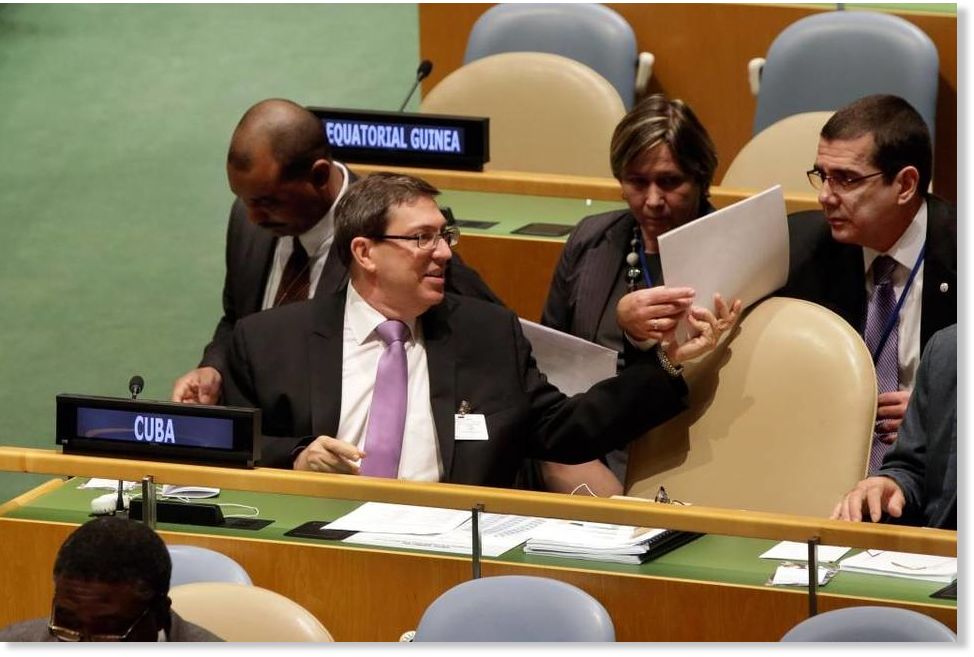
© Richard Drew/APCuba's Foreign Minister Bruno Rodriguez, left, sits in his delegation's seat in the United Nations General Assembly, Tuesday, Oct. 27, 2015. Cuba submitted its annual draft resolution calling for an end to the U.S. embargo against the island.
The only drama was how the United States would vote.
In its statement, the United States said that it couldn't support the resolution because it failed to take into account "the significant steps in the spirit of engagement" undertaken by the United States, and it was disappointed that Cuba had chosen to bring forth a resolution "almost identical" to those of years past.
The United States had to balance its developing relationship with Cuba and President Barack Obama's declaration that he wants to work with Congress to lift the embargo against an awkward and unprecedented stance of not standing in opposition to a resolution contrary to U.S. law.
In his remarks, Cuban Foreign Minister Rodríguez did acknowledge the new relationship with the United States. But he said that "the facts show crystal clear" that the blockade, as Cuba refers to the embargo," is still being "fully and completely implemented."
The new rules on trade and travel undertaken by Obama using his executive authority, "only modify in a very limited way" the implementation of the blockade, said Rodríguez.
The vote has become an autumn ritual at the United Nations. Last year for the 23rd year in a row, the international body overwhelmingly passed the resolution condemning the U.S. embargo against the island by a vote of 188 to 2. The United States and its ally Israel were the only nations to vote against the resolution.
This year Israel also joined the United States in voting no.
Three small Pacific island nations — Micronesia, the Marshall Islands and Palau — abstained last year. But just as the 70th General Assembly session — the first attended by Cuban leader Raúl Castro — opened, Palau and the Marshall Islands both established diplomatic ties with Cuba. Earlier in September, Micronesia established diplomatic relations during the Forum of the Pacific Islands in Papua, New Guinea.
This year they changed their votes to favor the resolution.
Comment: So even 3 US "yes men" have voted against the US despite their historical record of never opposing them. It sure looks like even US allies are finally gaining the strength to stand up to the US. Russia's actions in Syria do seem to be having a ripple effect around the world.
Many speakers during the debate on the resolution acknowledged the renewal of diplomatic ties between the United States and Cuba and the island's removal from the U.S. list of state sponsors of terrorism. They said they welcomed the actions.
But some speakers said the steps taken by the United States were still limited and that the embargo remained unchanged or had even been tightened since the historic rapprochement was announced last December.
María Emma Mejía Vélez, Colombia's permanent representative, said her country was optimistic that Obama's "political will" to work with Congress to lift the embargo will serve as a basis for its end. But she said, "The embargo runs counter to international law."
Speaking on behalf of CARICOM, Courtenay Rattray, the permanent representative of Jamaica, noted that "Cuba is the most popular state of the Caribbean." He said the embargo wasn't only punitive against Cuba, "but an impediment to our shared regional development."
In the U.N. Secretary General's report, The Necessity of Ending the Economic, Commercial and Financial Blockade of the United States Cuba, Cuba puts a price tag of $833.75 billion for accumulated damages caused by more than a half century of the U.S. policy of economically isolating Cuba.
That figure not only includes the cost of Cuba not being able to sell its products in the largest market in the world, but also the additional cost of dealing with more distant markets, and commercial losses in trade with other nations fearful of running afoul of U.S. sanctions against Cuba.
Despite the new relationship with the United States announced Dec. 17 and resumption of diplomatic relations on July 20, Cuba contends there was an intensification of the financial and extraterritorial aspects of the embargo, including millions of dollars in fines against third-country banks and financial institutions for using the U.S. dollar in transactions with Cuba.

Reader Comments