
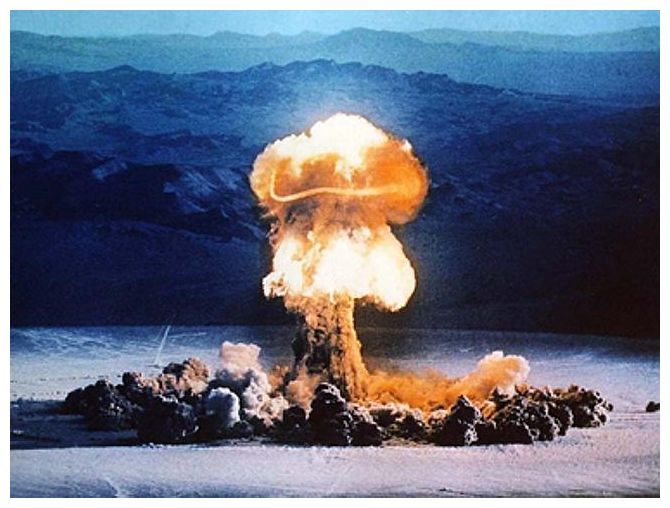
© news.com.au Blast effect ... Forget the shock wave. The change in weather induced by billions of tons of ash and dust in the atmosphere from even a “small” nuclear war between India and Pakistan will kill 2 billion people, a new study says.
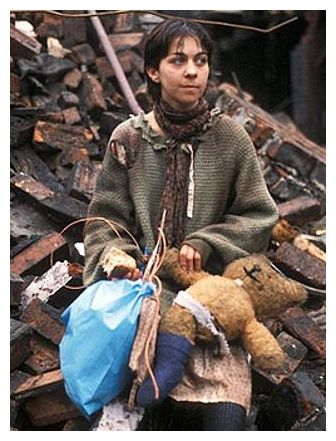
© news.com.auGrim reality ... The morbid, confronting scenes of the movie “Threads” sets an accurate scene for the effects of a “small” nuclear war.
Others have been brutally confronting (Threads, 1984, and The Road, 2009).
All have simply speculated about the fate of life on Earth after an apocalyptic nuclear exchange.
Now, a team of US atmospheric and environmental scientists have taken a detailed look at exactly what all that dust, ash and debris in the air means.
Specifically, they ran computer models on a fight between Pakistan and India through advanced climate predicting software developed to study pollution-based climate change.
The outcome?
It's bad.
Even for this "limited, regional nuclear war", it means a one-to-two degree plunge in global temperatures and a nine-per cent cut in worldwide rainfall.

© news.com.auDusty truth ... The cold, dusty scenes as depicted in the novel and film adaptation of The Road could result from even a “regional” nuclear conflict.
A separate study last year matched similar conditions to a projected death toll: We're talking 2 billion lives lost.
And that's the result of a little nuclear spat.
Not a big one between the likes of China and Russia.
The researchers based their calculations upon the detonation of 100 nuclear warheads. These were set at roughly the size of the atomic bomb dropped on Hiroshima.
"A limited, regional nuclear war between India and Pakistan in which each side detonates 50 15 kt weapons could produce about 5 megatons of black carbon," the report states.
"This would self-loft to the stratosphere, where it would spread globally, producing a sudden drop in surface temperatures and intense heating of the stratosphere."
The resulting "nuclear winter" would last at least 25 years - almost double that of previous estimates.
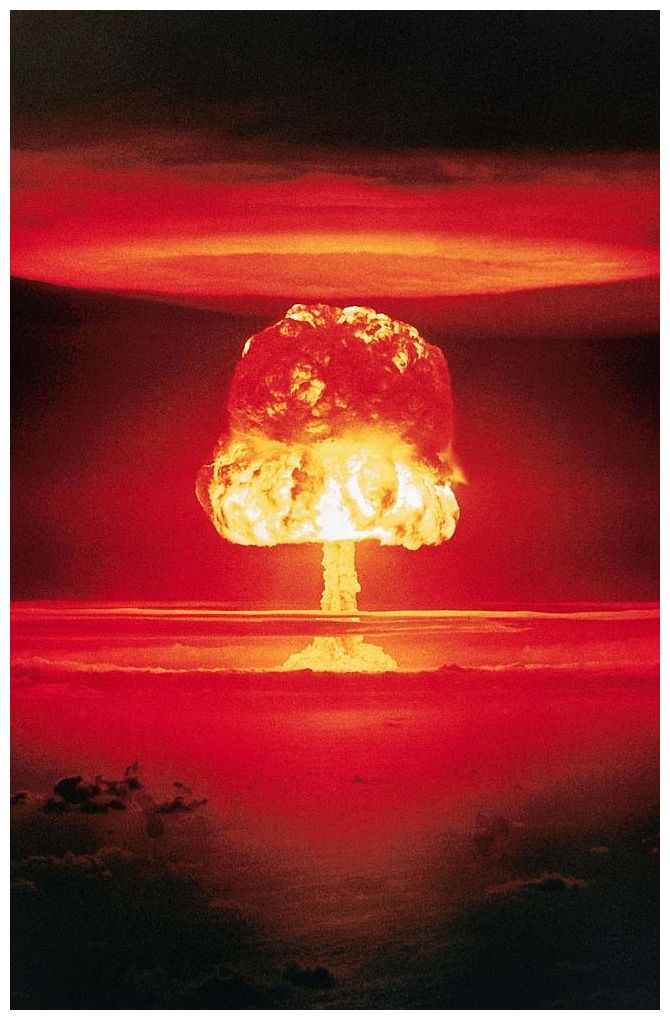
© news.com.auNo flash-in-the-pan ... This mushroom cloud is rising from the detonation of a 11-megaton nuclear device bomb 'Romeo' over Bikini Atoll in Marshall Islands during the 1950s. The explosion of 100 such devices would cause a 25-year nuclear winter, a new study reveals.
Other side-effects include a 20 to 50 per cent loss in the density of the ozone layer over populated areas. Such levels would be unprecedented in human history, the report says, causing widespread damage to agriculture and natural ecosystems - not to mention human skin cancer.
So much for a "limited" nuclear war.
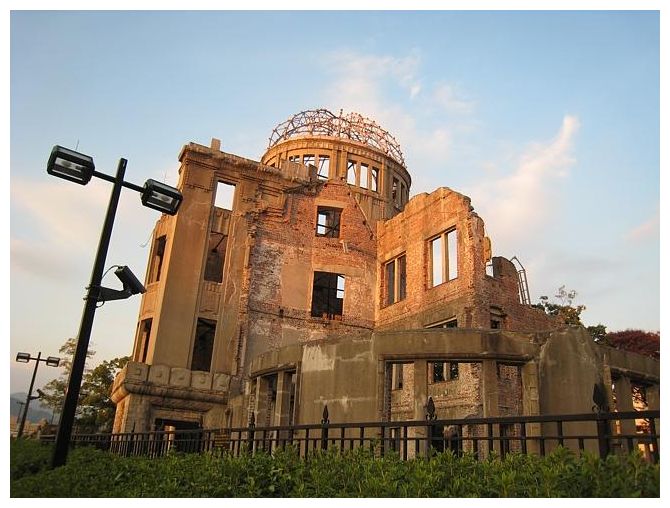
© Melissa MathesonLest we forget ... Hiroshima's Atomic Bomb “Peace Dome” which was directly below the detonation of an atomic bomb in 1945.
An exchange between these big players would likely produce far worse effects.
The scientists are confident in the accuracy of their assessment.
The computer model they plugged the data into takes into account atmospheric chemistry, ocean dynamics and even the interaction of sea ice and land masses with the air.
"Knowledge of the impacts of 100 small nuclear weapons should motivate the elimination of more than 17,000 nuclear weapons that exist today," the researchers write.



Reader Comments