

© polarportal.dkMap of the surface mass balance on Saturday (in mm water equivalent per day).
On August 14, the surface contribution to the mass balance on the Greenland Ice Sheet was +0.6 gigatons per day. One gigaton (Gt) corresponds to one cubic kilometer of water and the 0.6 Gt on Wednesday is a rather modest contribution in this context. But the surface mass contributions have remained positive since then and on Saturday, a big snowfall over West Greenland gave a positive contribution of 4 Gt. These days mark the beginning of the end of the melt season: The Sun is no longer as high in the sky and climatologically, it is typically in these weeks that the surface budget of the ice sheet changes sign. During the summer, more mass is lost to melting than is gained from snowfall. In winter, it is the other way around, and the transition typically occurs in August.
That we have now seen a couple of days with positive surface mass balance does not mean that it will just keep piling up from now on. It can easily happen that the weather changes and melting dominates again for a while. But the Sun is lower in the sky here at the end of the season, and intense melt events as we have seen earlier this summer are unlikely to occur again this season.
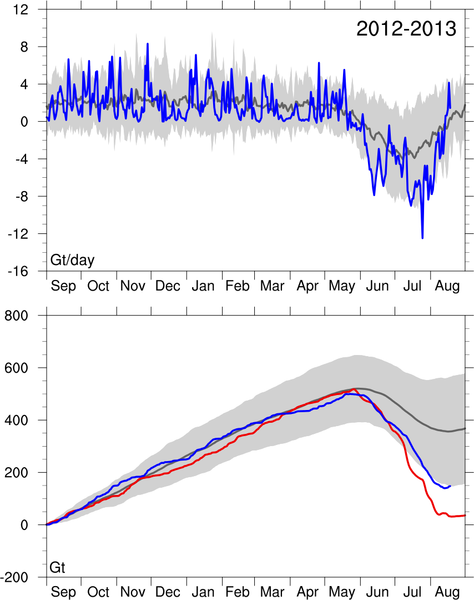
© dmi.dkTop: The total daily contribution to the surface mass balance from the ice sheet (blue line, Gt/day). Bottom: The accumulated surface mass balance from September 1 to August 18 (blue line, Gt). The dark grey line shows the corresponding average number from the period 1990-2011 along with two standard deviations on each side (light grey). In the bottom panel, we also show the season 2011-12 (red) which had very high summer melt in Greenland. One Gt (1 Gigaton = 1,000,000,000,000 kg) is equivalent to 1 km3 of freshwater.
The two periods of intense melt have brought the accumulated surface mass balance for the 2013 season very close to the lower edge of the normal band for the period 1990-2011. Now, near the end of the melt season, we are thus about 200 Gt below the average. Although this is not as alarming as last year's record melt, it is nevertheless a substantial loss in the total mass budget for the ice sheet. Keep an eye on the Polar Portal to see what the impact is when the season's budget is finally determined.


wrong tab.... this report is interesting after reading about the melting coming from below, ie the mantle, and not the proclaimed 'global warming' hypothesis Mr. Gore and the 'in-crowd' fancied.
iceagenow.info/2013/08/greenland-ice-melting/