
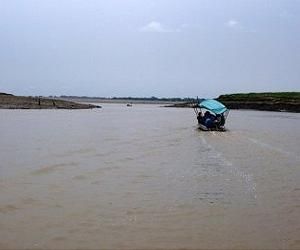
© AFPA motorized canoe travelling between protruding sandbars due to the low water level affecting the Amazon River.
The waterway's depth at Manaus, the main city in the Amazon region, was just 19.34 meters (63.45 feet) -- well below its average of 23.25 meters (76.28 feet), the country's Geological Service told AFP.
The last time the river was at such a low level was in 1963.
Scientists say it appears Brazil is headed for its worst drought since that year. Final data to be collected up to October were expected to confirm that.
The withering of the Amazon has produced unusual scenes of children playing football in the dried-up riverbed of a tributary, the Quarenta, that crosses Manaus.
Worse, seven remote towns upstream that rely on water traffic as their main link to civilization have been cut off as their own tributary has all but disappeared.
"There are towns inaccessible by foot, and we need helicopters," the mayor of one of the towns told the Folha de Sao Paulo newspaper.
Some residents who lived through the 1963 drought said they were not so hard up this time, as they have mineral water and water trucks available.
"The drought is affecting river traffic, but today we can take a plane if we have to," said resident Joao Texeira, 74.


Comment:
UPDATE:
State of emergency declared in Brasilia due to drought
September 21, 2010
An unprecedented drought has prompted the imposition of a state of emergency in Brazil's capital Brasilia. The last time it rained in the city 117 day ago.
This is the reason why wildfires have become more frequent in the region. A fire ravaged 10,000 hectares of vegetation in the National City Park last weekend.
The water level in the artificial Lake Paranoa has dropped to the permissible minimum.The city has acquired a different look because of burnt-out lawns and flowerbeds. The nearby farmsteads expect to reap only half their usual harvest size due to the lack of water.