
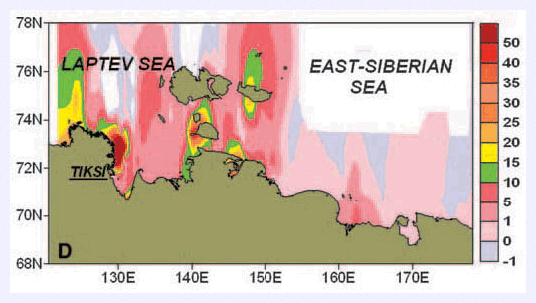
© Science/AAASFluxes of CH4 venting to the atmosphere over the East Siberian Arctic Shelf.
The discovery creates "an urgent need" for further research to understand the methane release and its possible impact, researchers say in the new issue of Science.
In order to make this discovery, Natalia Shakhova from the Russian Academy of Sciences, along with colleagues from the University of Alaska and Stockholm University, traveled on Russian ice-breaker ships each year from 2003 to 2008 to survey the waters above the remote East Siberian Arctic Shelf; they also made one helicopter survey and an over-ice winter expedition to the region. After more than 5000 painstaking observations at sea, the researchers found that 80% of the bottom water and more than 50% of the surface water over that continental shelf is supersaturated with methane originating from the permafrost below.
After water vapor and carbon dioxide, methane is the third most important greenhouse gas in the atmosphere, and the researchers warn that this unforeseen flux of the gas into the atmosphere could alter the global climate in unexpected ways.
Ocean-bottom permafrost contains vast amounts of carbon, and many experts are concerned that its release as methane gas would create a dangerous feedback loop in which increased greenhouse gas concentrations in the atmosphere would lead to warmer temperatures, which in turn would lead to further melting of permafrost, further releases of methane, and further atmospheric warming.

© Igor Semiletov, University of Alaska Fairbanks, Science/AAASThe sea surface above the East Siberian Arctic Shelf is full of ice and bubbles. Sonar is the only way to detect the vast clouds of methane bubbles rising from the seafloor.
Because the methane flux over the East Siberian Arctic Shelf now seems to be on par with estimates for all the oceans combined, these researchers recommend that their data be taken into consideration immediately to assess how the Arctic climate might warm in the near-future.
"While the oceanic methane flux should be revised, the current estimate is not alarmingly altering the contemporary global methane budget," Shakhova writes. "There remains substantial uncertainty regarding several aspects of the methane release from the East Siberian Arctic Shelf... To discern whether this extensive methane venting is a steadily ongoing phenomenon or signals the start of a more massive methane release period, there is an urgent need for expanded multi-faceted investigations on these inaccessible but climate-sensitive shelf seas north of Siberia."


Reader Comments
to our Newsletter