
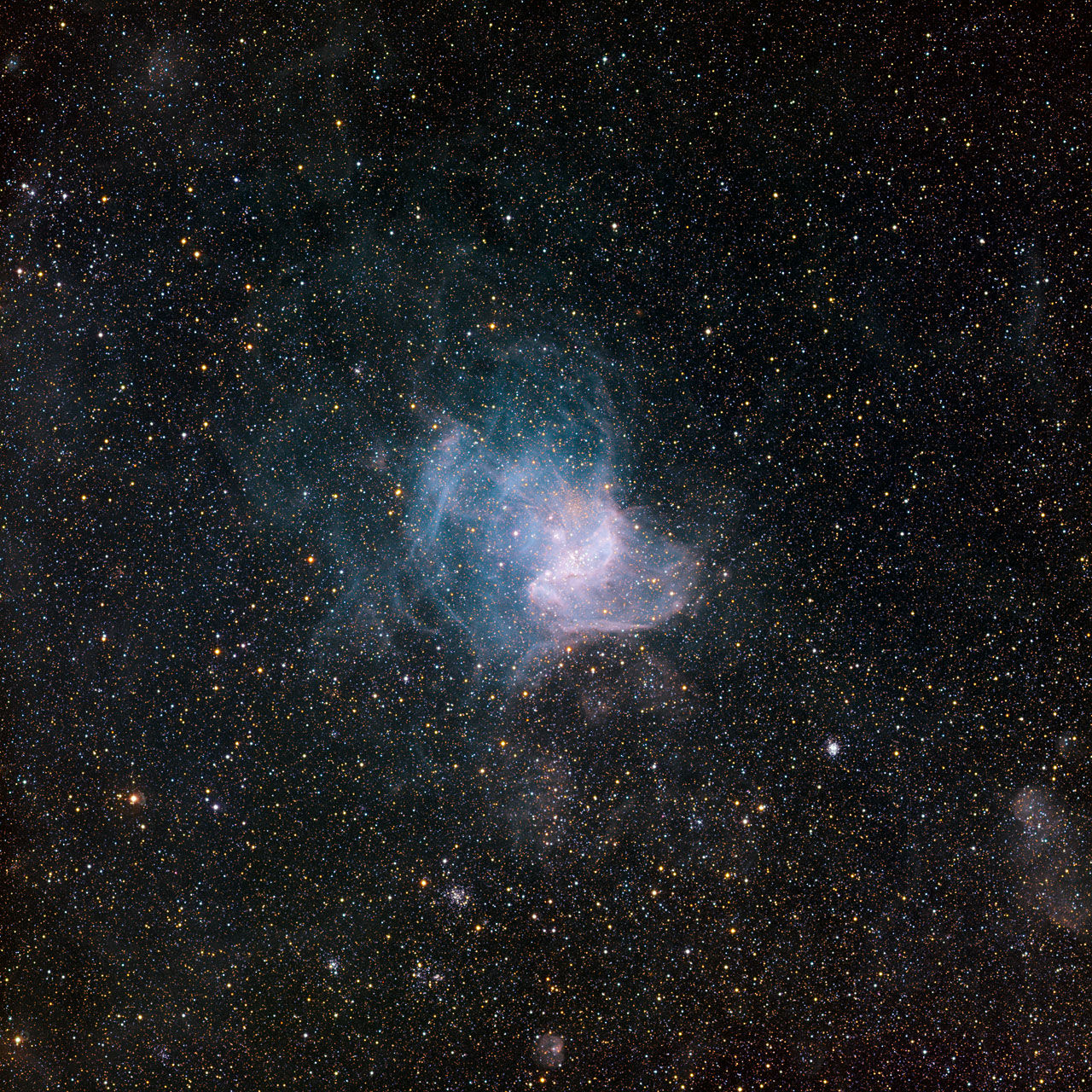
© ESOStar-forming region NGC 346
NGC 346 spans approximately 200 light-years, a region of space about fifty times the distance between the Sun and its nearest stellar neighbours. Astronomers classify NGC 346 as an open cluster of stars, indicating that this stellar brood all originated from the same collapsed cloud of matter. The associated nebula containing this clutch of bright stars is known as an emission nebula, meaning that gas within it has been heated up by stars until the gas emits its own light, just like the neon gas used in electric store signs.
Many stars in NGC 346 are relatively young in cosmic terms with their births dating back only a few million years or so (eso0834). Powerful winds thrown off by a massive star set off this recent round of star birth by compressing large amounts of matter, the first critical step towards igniting new stars. This cloud of material then collapses under its own gravity, until some regions become dense and hot enough to roar forth as a brilliantly shining, nuclear fusion-powered furnace - a star, illuminating the residual debris of gas and dust. In sufficiently congested regions like NGC 346, with high levels of recent star birth, the result is a glorious, glowing vista for our telescopes to capture.
NGC 346 is in the Small Magellanic Cloud, a dwarf galaxy some 210 000 light-years away from Earth and in close proximity to our home, the much larger Milky Way Galaxy. Like its sister the Large Magellanic Cloud, the Small Magellanic Cloud is visible with the unaided eye from the southern hemisphere and has served as an extragalactic laboratory for astronomers studying the dynamics of star formation.
This particular image was obtained using the Wide Field Imager (WFI) instrument at the MPG/ESO 2.2-metre telescope at the La Silla Observatory in Chile. Images like this help astronomers chronicle star birth and evolution, while offering glimpses of how stellar development influences the appearance of the cosmic environment over time.


I thinkmost of it is fluctuating, electro-magnetic plasma, and i guess half of the matter in the universe is what we cvall "normal" and the other half is what we think of as "anti-"matter.
They can exist in the same "vicinity" because plasma creates bi-layer barrieres, so they don't just crash and leaves a flash of x-rays. But, colliding anti-particles could account for these bursts of exstreme energy we asometimes observe...
But, until we have nmore hard evidencve, i refrainm from anything but mere speculation.
I am, however, not satisfied with current cosmology, and the common hypotheses about the development of the "Universe" from an exploding "Singularity" about 14-15 billion years ago, and the creatrion of solar systems from accretion of particles, and so on.
It's boring to think gravity is the main force playing in this space, and absordities, like space can be "bent". especially, as we almost know nothing about what "gravity" really is, and it beeing such a weak force, and...
One can speculate forever. But , i think we should observe the phenomena we can observe, without to many preconceptions, and without believing it all shall fit into neat mathematical formulas.
This ranting is not Science, but Einsteins rantings, after the photo-voltaic theory, wasn't much better?
Does E=mc^2 really count as Science? Has it any criterion of falsification, like Popper demanded, - or is it "anything goes" like Feyerabend and Lakatos said, - or is all determined by your "Paradigm", as Kuhn called it...
I don't know, so i should probaly shut up...