
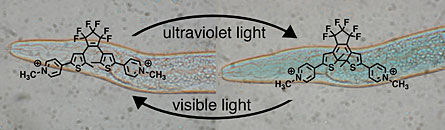
© Neil Branda, Simon Fraser UniversityA nematode that has ingested a particular compound turns blue and stops in its tracks when exposed to ultraviolet light. The reaction is reversed with visible light and could provide a new tool for probing cell circuitry.
The work may add to the growing toolbox of molecules that biologists employ to study cells. By using light to trigger changes in molecules, scientists can spy on a cell's activity, witnessing what happens when messenger molecules speak with their target cells. "Light-driven reactions can be a powerful tool for studying biological processes," comments neuroscientist Ehud Isacoff of the University of California, Berkeley. Such approaches are already shedding light on the biochemistry underlying addiction, Parkinson's and other diseases in which brain circuitry goes awry.
Typical approaches "cage" a compound of interest, such as calcium, or tether it to a molecule that changes shape when energized by light. The shape change allows the compound to break out of the cage and do work, or to reach a target cell such as a nearby nerve. Though nothing was caged in this work, the molecule might be harnessed in such a way in the future.
In the case of the tiny, transparent C. elegans, the scientists don't know exactly how the compound paralyzed the worm, says study leader Neil Branda of Simon Fraser University in Burnaby, Canada. The team incubated the nematodes in dishes laced with a version of dithienylethene that is colorless and has an open ring at its center. When exposed to ultraviolet light, this center ring closes, altering the way the molecule's other parts stick out. After a few minutes of ultraviolet light, the worms that had eaten the open-ring version began to turn blue and showed signs of paralysis. In many of the worms, exposure to visible light reversed the paralysis and hue, though some worms died.
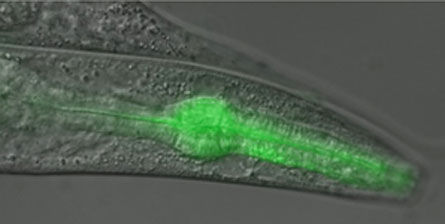
© Neil Branda, Simon Fraser UniversityWorms incubated with light-sensitive dithienylethene fluoresce after 10 minutes in ultraviolet light, establishing that the worms have taken in the shape-changing compound.
If the researchers can figure out what cells or molecules the dithienylethene interferes with and the mechanism of its action, the compound could be a useful probe and powerful tool, Isacoff says. "It's just begging for an explanation."



Reader Comments
to our Newsletter