
© K. Johnston, J. Bullock
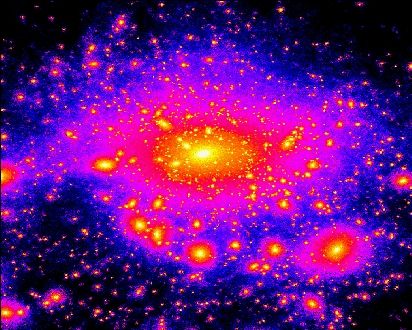
It is now believed that about 95% of the Galaxy is composed of dark matter, which does not seem to interact with the rest of the Galaxy's matter and energy in any way except through gravity. The dark matter halo is more than ten times as much mass as all of the visible stars, gas, and dust in the rest of the galaxy. While the luminous matter we see in the night skymakes up approximately 90,000,000,000 solar masses, he dark matter halo is believed to include around 600,000,000,000 to 3,000,000,000,000 solar masses of dark matter.
The Milky Way's dark halo is believed to outweigh the galaxy's normal matter by around a factor of 20. While the inner edge of the luminous hypothesized outer ring that surrounds the spiral disk of the Milky Way may be around 120,000 light-years across, the dark halo encompasses and permeates even the enormous luminous halo of scattered individual stars and globular clusters, extending some 300,000 to 400,000 light years out from the galactic center in radius.
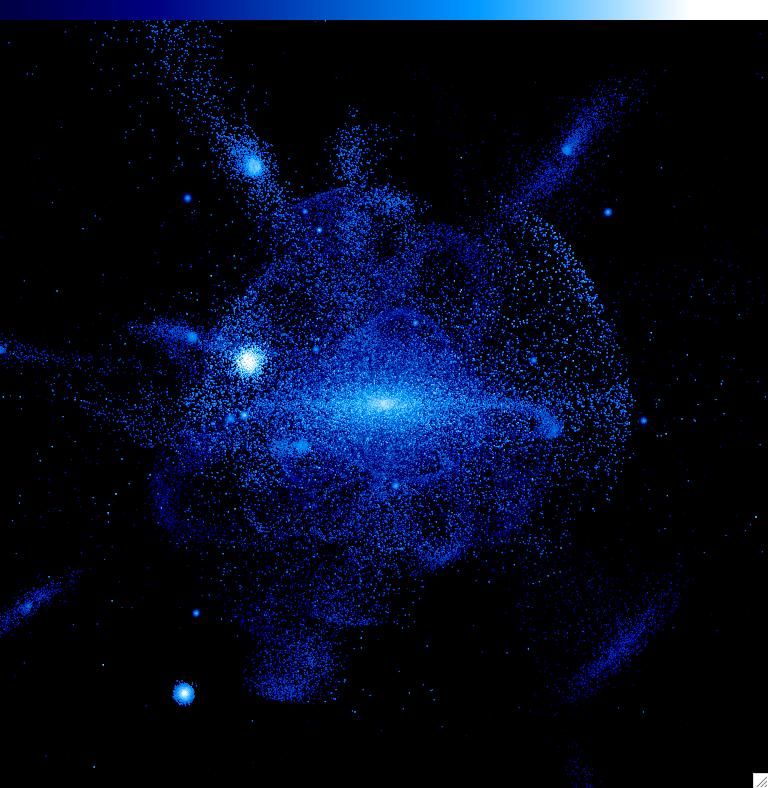
© K. Johnston, J. BullockA theoretical model of a galaxy like the Milky Way, showing trails of stars torn from disrupted satellite galaxies that have merged with the central galaxy.
Astronomers have detected evidence that dwarf galaxies are disturbing the cocoon of dark matter around the Milky Way and causing its disk to warp. In 1957, astronomers surveying galactic hydrogen gas discovered that the Milky Way is not flat but warped near its edges like a fedora hat, with one side of its spiral disk curving as much as 20,000 light years above the main galactic plane and the other dipping a little less below it.
While some researchers suspected the warp was caused by the two Magellanic Clouds (nearby satellite galaxies that orbit the Milky Way every 1.5 billion years), subsequent calculations showed they alone were not massive enough to produce the disk's warp.
In January 2006, a team of researchers discovered evidence that the Magellanic Clouds can account for the warp but only because their motion around the Milky Way generates a powerful gravitational wake within the massive dark halo. As the Magellanic Clouds orbit the Milky Way, computer simulations indicate that the galactic disk ripples over time and its edges ruffle "like a table cloth in the breeze."
On January 9, 2007, astronomers announced that new measurements of the velocities of the Megallanic Clouds through space suggest that the Milky Way's combined dark and visible mass must be twice as much as originally thought if the Clouds are truly orbiting satellites of the galaxy.



Reader Comments
to our Newsletter