
When I questioned who told her mercury was out of vaccines, she qualified her question by saying, "except the flu shot" and left it at that. I can only suspect that she was once told something like this:
"Since 2001, all routinely recommended vaccines (except for the flu vaccine) currently being made for administration to young children in the U.S. contain no thimerosal or only trace amounts."A quick read of this statement might lead someone to that mercury had been removed from all vaccines (except flu of course) in 2001. But this does not say that mercury containing vaccines were no longer being used, it only states that mercury reduced versions of the basic vaccine schedule given to children age 0 to 6 were currently being made and had become available as a choice. Note that the qualifier "young children" also leaves out booster shots, and some brands of meningococcal and tetanus vaccines recommended for children over age six still contain preservative level mercury TODAY.
By asking the question the way she did, prior to the qualification on the flu shots, she implied that all vaccines were mercury free. If she had gone to the FDA website (here) she would have seen that many vaccines still contain mercury. Note as well that this list only give the vaccines "currently licensed for manufacture". It does not list the vaccines that were manufactured with mercury up until the publication date of the table. For example, the Energix Hepatitis B vaccine from GlaxoSmithKline shows it to be mercury free. This vaccine was not licensed for manufacture until January 2008. This means that many of the Hepatitis B vaccines given to babies this very day in hospitals around the U. S. still contain up to 600 parts per billion of mercury because they were manufactured prior to 2008. Parents should know that peer reviewed studies show that concentrations of less than 10 ppb kills brain neurons and negatively affects many other systems in the body.
Another fact frequently misrepresented through loaded questions centers around just when preservative level infant vaccines were no longer in routine use. Only recently have we seen some reporters let go of the infamous "since 1999" only to replace it with 2001, which was actually the year in which Thimerosal reduced vaccines were first licensed and available for purchase. Watch the first minute of this YouTube video where the Immunization Director of the Minnesota Department of Health testifies to a legislative committee that preservative level infant vaccines in the Vaccines for Children Program did not expire until 2003. Mercury containing vaccines were still available for sale and most certainly administered up until their stocks were used up or expired.
Ensuring Mercury-Free Vaccines Hearing in MN Part 2
The other part of the reporter's question dealt with the rates of autism still going up after the supposed removal of mercury. As the question was asked, it was "loaded" with the implication that all diagnoses of autism after 2003 were in children born after 2003.
© Laura Kasemodel
Though a small unknown percentage of these children might not qualify for a medical diagnosis of autism, it is important to note that they do have enough social and/or cognitive deficits to qualify for school services. We are not talking about neuro-typical children getting services they do not need.
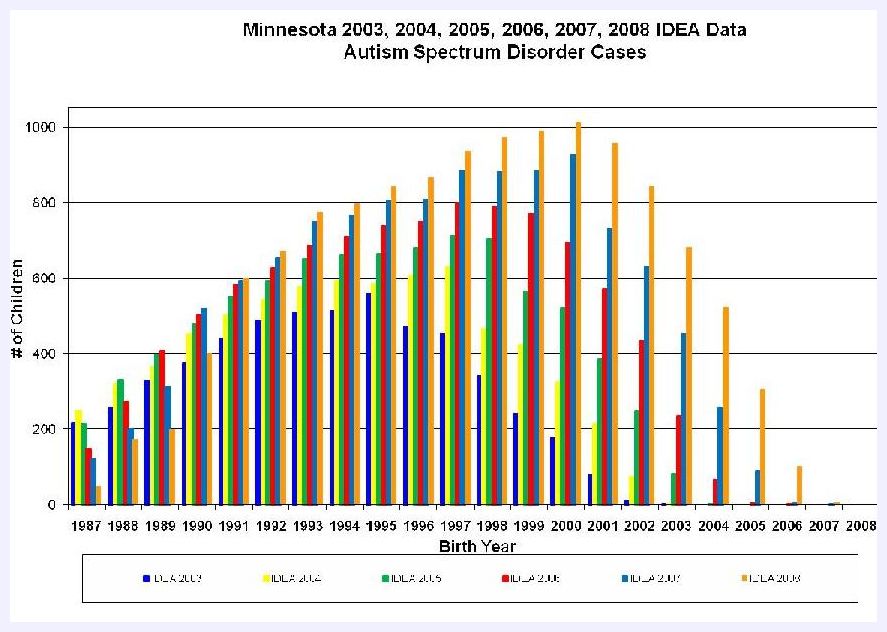
Looking at the multi colored bar graph above labeled Autism Spectrum Disorder Cases and you will notice the six colors for each birth year corresponding to individual years of IDEA data. For instance, for children born in 2000 (now nine years old) less than 200 accessed school services by age three (blue 2003 IDEA line), but over 1,000 children had accessed services by age eight (orange 2008 IDEA line). As noted above, the vaccines with 50,000 pbb concentration of mercury (preservative level) were in use through 2002.
This graph is loaded with information once you understand how to look at it. Start with the dark blue column in 2000 birth year which is the number of children who qualified for services by age three, most likely the children most severely affected. The yellow line in the 2001 cohort, green in the 2002 cohort, red in the 2003 and light blue in the 2004 cohort and are all the number of that birth year qualifying by three years old. The graph is limited by the IDEA year 2003 however. We cannot go back to see how many children born earlier were diagnosed at the younger ages - the blue column for the 1993 birth cohort represents children qualifying by age 10.
For me this graph also raises many questions. For instance, why are there half as many children qualifying by age 18 as age 10, when they had 8 extra years to diagnose them? The number of children qualifying by ages 4, starting with the 1999 cohort, rise sharply through the 2004 birth year, as does those qualifying by 5 (starting 1998) and by age 6 (starting 1997). Why do the number of children qualifying by age 3 starting with the 2000 cohort nearly level off? Could it be that it represents the slow decline in the use of preservative level infant vaccines? So many questions.
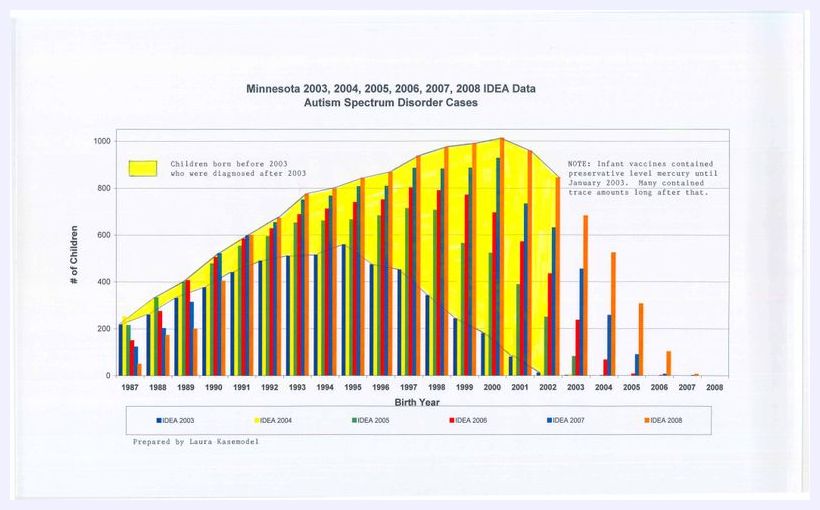
Let's go back to the reporter's question implying that rates of autism have continued to rise after the supposed removal of mercury from vaccines. I added the yellow shaded area between the blue line marking 2003 data and the orange line marking 2008 data in the graph below to best represent the amount of children born before 2003 but who were given an educational diagnosis after 2003. I did this to make it clear that the vast majority of autism diagnosis since 2003 have been in the age groups that received preservative level infant vaccines. It is also a great visual of the tsunami of children soon to become adults. What are we going to do as a society now that over 800 children with autism become adults each year, in Minnesota alone? Great proportions of these adults are moderately to severely affected by autism and will require significant support services. Society at large has too long ignored this oncoming wave, which as you can see below, is now upon us.
© Laura Kasemodel
Some preschool children qualify for school services under the category of developmental delay. In Minnesota, the developmental delay category can no longer be applied after age six. As they enter grade school these children then need to be classified under a different classification, one of which is ASD. This explains the jumps in autism numbers that each birth cohort has after age six. It is important to note as well that there has been a huge effort to diagnose children earlier, which may explain the high numbers of three and four year olds in the 2004 and 2005 cohorts, but we cannot know for sure. It is only reasonable to say right now that we will not know the rate of autism for children born during the period of "reduced" mercury use (but increased vaccine use) after 2003 until those age groups reach ages seven and beyond. This means waiting for the data to be published for the 2010-2011 school years in 2012.
It is legitimate to question the ability to determine the rates of autism in younger children, those born after the "reduction" of thimerosal in vaccines in 2003. For instance, read what the Minnesota Department of Health has to say about it. In their study Autism Spectrum Disorders Among Preschool Children Participating in the Minneapolis Public Schools Early Childhood Special Education Programs they report:
"Current statistics accurately characterizing baseline ASD prevalence in populations of preschool children were not available for Minnesota or the U.S. Therefore, the MDH determined that a reanalysis of the MPS dataset using epidemiological methods and definitions was a necessary first step toward better understanding the occurrence of ASD among children attending MPS preschool programs.".
If the Minnesota Department of Health, with the assistance of the CDC, could not receive accurate statistics on the autism rates of preschool children, those born after the reduction of mercury in vaccines, how could anyone else? How could a reporter be hoodwinked into even asking such a ridiculous question? Because the CDC carefully parses their words so they are not incorrect, but too often results in the reader leading themselves to the wrong conclusion.
I hope you will sit back and fully absorb this information. You have just read and listened to words of trusted government officials and agencies that directly contradict what most of America and the world have been led to believe about autism and vaccines. Then next time anyone implies that they know the rate of autism has risen in children who got less mercury exposure, send them this article. The fact is, we do not yet know what their rates will eventually be.



Reader Comments
to our Newsletter