
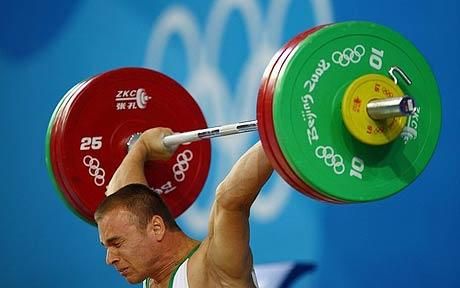
© Getty Hungarian weightlifter Janos Baranyai begins his attempt to snatch 148kg in his third lift in the men's 77-kg division
The findings, by an international team of researchers, suggest muscular strength is as important as staying slim and eating healthily when it comes to protecting the body against deadly tumours.
The scientists who came up with the findings are recommending men weight train at least twice a week, exercising muscle groups in both the upper and lower body.
In recent years, experts have recommended a healthy diet and lifestyle - including regular aerobic exercise such as jogging or cycling to reduce the risks of the disease.
But the latest study, published in the journal Cancer Epidemiology, Biomarkers and Prevention, suggests it may be just as important to build up muscle strength.
A team of experts, led by scientists from Sweden's Karolinska Institute, tracked the lifestyles of 8,677 men aged between 20 and 82 for more than two decades.
Each volunteer had regular medical check ups that included tests of their muscular strength.
Between 1980 and 2003, researchers monitored how many developed cancer and subsequently died from it.
The results showed men who regularly worked out with weights and had the highest muscle strength were between 30 and 40 percent less likely to lose their life to a deadly tumour.
Even among volunteers who had excess tummy fat or a high body mass index, regular weight training seemed to have a protective effect.
In a report on their findings the researchers stressed keeping a healthy weight was still crucial for avoiding premature death.
But they added: "In the light of these results, it is equally important t to maintain healthy muscular strength levels.
"It's possible to reduce cancer mortality rates in men by promoting resistance training involving the major muscle groups at least two days a week."
A spokesman for Cancer Research UK said resistance exercise might have some benefit but it was more important to regularly do some cardiac exercise.
Health information officer Jessica Harris said: "There's no need to become a body builder. Just 30 minutes of moderate exercise five times a week that leaves you warm and slightly out of breath can have a positive effect."





[Link]
--
One of the primary reasons exercise works to lower your cancer risk is because it drives your insulin levels down. Controlling insulin levels is one of the most powerful ways to reduce your cancer risks.
How to Round Out Your Exercise Routine, and Why You Should
I highly recommend finding a personal trainer to help you reach your fitness goals, but if you cannot afford it or live in an area without access to one, you can still reap the benefits of exercise if you focus on varying your routine. So along with your strength training program, make sure you also incorporate the following into your exercise routine:
1. Aerobic: Jogging, using an elliptical machine, and walking fast are all examples of aerobic exercise. As you get your heart pumping, the amount of oxygen in your blood improves, and endorphins, which act as natural painkillers, increase.
Meanwhile, aerobic exercise activates your immune system, helps your heart pump blood more efficiently, and increases your stamina over time.
2. Interval (Anaerobic) Training: Research is showing that the BEST way to condition your heart and burn fat is NOT to jog or walk steadily for an hour. Instead, it’s to alternate short bursts of high-intensity exercise with gentle recovery periods.
This type of exercise, known as interval training or burst type training, can dramatically improve your cardiovascular fitness and fat-burning capabilities.
For example, intermittent sprinting produces high levels of chemical compounds called catecholamines, which allow more fat to be burned from under your skin within the exercising muscles. The resulting increase in fat oxidation increases weight loss. So, short bursts of activity done at a very high intensity can help you reach your optimal weight and level of fitness, in a shorter amount of time.
3. Core Exercises: Your body has 29 core muscles located mostly in your back, abdomen and pelvis. This group of muscles provides the foundation for movement throughout your entire body, and strengthening them can help protect and support your back, make your spine and body less prone to injury and help you gain greater balance and stability.
Exercise programs like Pilates and yoga are great for strengthening your core muscles, as are specific exercises you can learn from a personal trainer.
---------------