
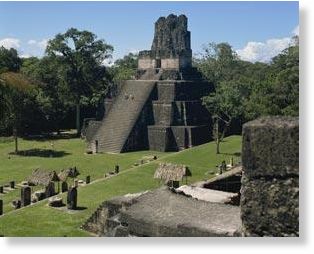
© Doug Traverso / Robert Harding / Rex FeaturesTemple II at Tikal, Guatemala, Central America. New evidence suggests that the Mayan civilisation collapsed because of a lack of resources rather than other factors such as disease or warfare
Researchers led by David Lentz, a palaeoethnobotanist at the University of Cincinnati in Ohio, sampled wooden beams and lintels from all six major temples and two palaces within the ancient city of Tikal. The first three temples, built before AD 741, used only large, straight logs of the sapodilla tree - a particularly strong wood that is nevertheless easy to carve with ceremonial inscriptions.
But after that date, large sapodilla logs were almost entirely replaced in temple construction by logwood, a smaller, gnarly tree that is almost impossible to carve. "It's definitely an inferior material," says Lentz, who reasons that the temple-builders would only have accepted logwood if they had run out of suitable sapodilla trees to harvest (Journal of Archaeological Science, DOI: link).
Earlier studies of pollen deposits have suggested that deforestation and soil erosion were increasing in the region as Mayan civilisation neared its collapse. But the temple timbers of Tikal are the first to show that ecological overexploitation directly affected Mayan culture.


Reader Comments
to our Newsletter