

© USGS/JPL/NASAInvestigators suspect the domed feature detailed above is an ice volcano, or cryovolcano, seen in infrared light through the hazy atmosphere on Saturn's moon Titan.
Titan's exterior, where the temperature is around -180 °C, is thought to be mostly water-ice, but it may be a different story deep down. Variations in the moon's rate of rotation suggest an ocean could lurk below.
An area of Titan called Hotei Arcus appears to fluctuate in brightness on timescales of several months, and in 2005 Robert Nelson of NASA's Jet Propulsion Laboratory in Pasadena, California, and colleagues, suggested this might be the result of "cryovolcanic" eruptions of water from below. Others argued that the flickers were caused by the moon's hazy atmosphere.
The cryovolcanism idea was bolstered in 2008, when observations of Hotei Arcus by a radar instrument aboard NASA's Cassini probe revealed structures that resembled lava flows. Some opponents of the idea still argued these might be deposits of sediment, carried by a flow of methane in the past.
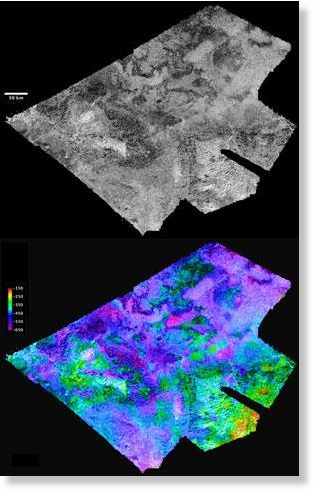
© VIMS Team/U. Arizona/ESA/NASAThis pair of images covers part of Hotei Arcus, an infrared-bright and possibly time-variable feature that has been hypothesized to be cryovolcanic, based on the presence of flow-like features in the radar images. The data shows that these flows are 100 to 200 metres (300 to 600 feet) thick.
If slush volcanoes have been erupting recently, Titan would join a select group of solar system objects - Earth and Io - known to be volcanic at present.
The idea of any life surviving in the erupted water is "pretty much out of the question", Kirk says, as it would freeze. As for the ocean below: "Who knows?" he says. "It's conceivable life could be going on down there."
Jeff Moore of NASA's Ames Research Center in Moffett Field, California, says it's still not obvious that the structures flowed. "We haven't seen any unambiguous evidence [of volcanism] yet."


Reader Comments
to our Newsletter