Storms
S


Cloud Precipitation

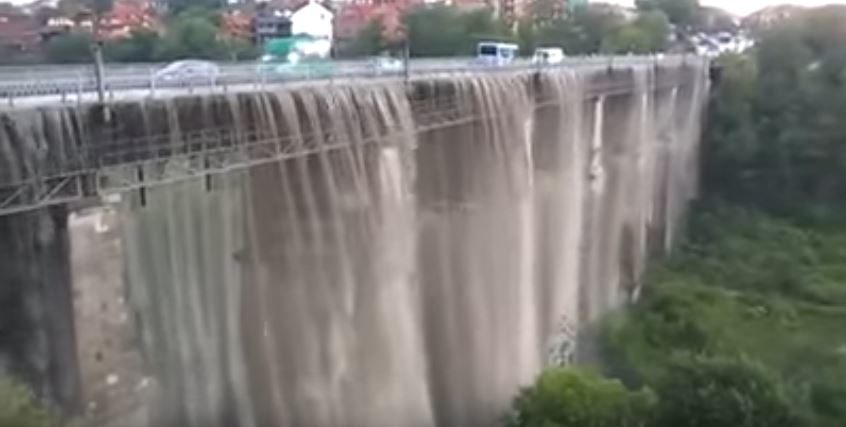
Intense storm turns bridge into a giant waterfall in Ukraine

Flooded Novoplanovsky bridge in Ukraine
© YouTube/3849 comua (screen capture)
An intense storm engulfed Kamenetz-Podolsk, a city on the Smotrych River in western Ukraine, on June 26. After just 15 minutes of heavy rain and strong winds, the Novoplanovsky bridge turned into a giant waterfall:


Large apricot sized hail was also reported with abnormally strong winds:
Tornado2

2 Tornadoes, 75-mph 'microburst' confirmed in New Jersey says NWS (VIDEO)

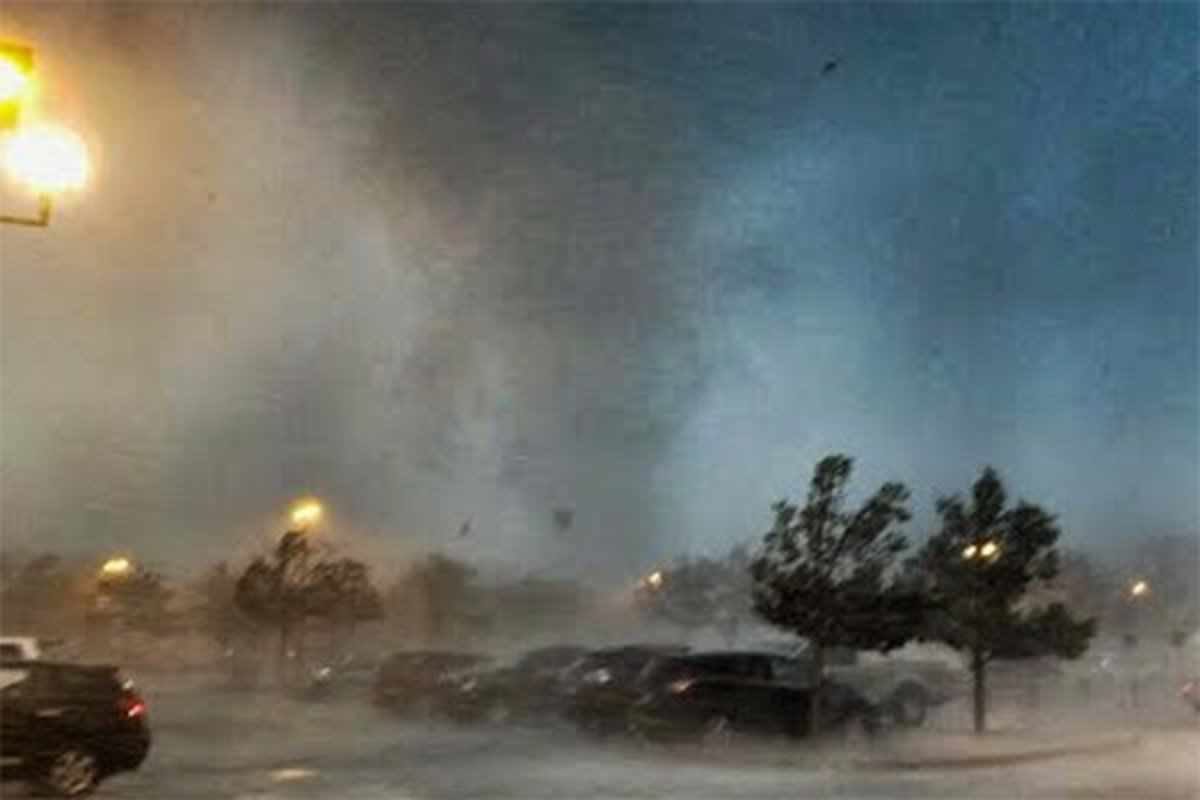
tornado in Howell, NJ
© BRETT DZADIKA tornado rips through the parking lot of a Home Depot on Route 9 in Howell, NJ on Saturday morning.
Two tornadoes and a 75-mph microburst were in New Jersey this week, the National Weather Service has confirmed

Those bursts of high-speed winds that knocked over trees were as bad as you thought. In fact, two of them were actually tornadoes.

Two tornadoes and a 75-mph microburst were in New Jersey this week, the National Weather Service has confirmed. Both left destruction in their paths.

The weather service said the first tornado was the one seen in the now widely circulated video taken by Brett M. Dzadik at a Home Depot in Howell. That tornado touched down at 7:21 a.m., had wind speeds of up to 75 mph and a path of about 40 yards wide for about a half-mile, the service said.

The second tornado touched down at 7:27 a.m. and also had maximum winds of 75 mph, the weather service said. That tornado caused the damage seen at Oak Glen Park, also in Howell, and traveled about three-tenths of a mile with a path about 25 yards wide, the service said.

Comment: On average the Garden State has two tornadoes annually in the past 20 years, said Sarah Johnson, a meteorologist with the National Weather Service's Mt. Holly office.


Windsock

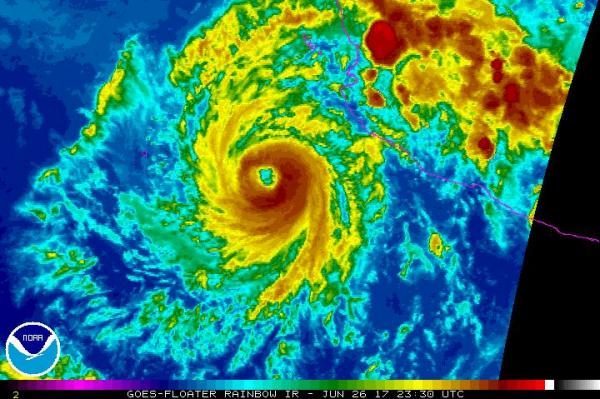
Hurricane Dora forms off Mexico, first of 2017 season

Hurricane Dora
© NHC/NOAA Hurricane Dora on Monday became the first official storm of the 2017 hurricane season, which started in mid-May and runs through the end of November. Dora is swirling southwest of Mexico in the Pacific Ocean.
The National Hurricane Center said Dora became the first hurricane of the 2017 season when it formed early Monday, and is expected to produce heavy rains and potentially life-threatening conditions.

The NHC said Hurricane Dora, which has maximum sustained winds of 90 mph, is about 225 miles southwest of Puerto Vallarta.

The NHC said in its Monday afternoon advisory that the storm system is moving west-northwest -- further out into the Pacific Ocean -- at a speed of 13 mph.


Cloud Lightning

Lightning strikes kill 47 people and 50 cattle in six months across Cambodia

lightning
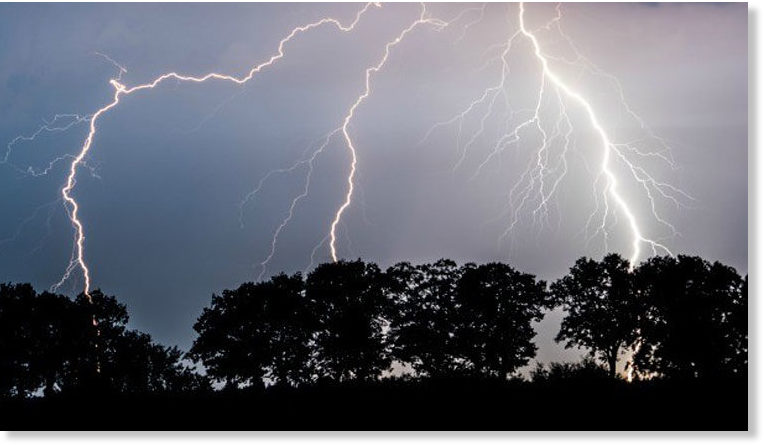
Forty-seven people were killed by lightning in the first six months of the year, down from 60 in the same period last year, according to a report from the National Committee for Disaster Management.

The report, published yesterday, said 48 people were also injured while 50 cattle were killed by lightning since January.

A total of 113 rainstorms in more than 20 provinces damaged 2,763 houses during the same period, destroying 351 homes completely. The roofs of 25 school buildings were also blown off.

The report added that rainstorms killed three people and injured 47.

Disaster management committee spokesman Keo Vy said more than 130 people died and nearly 300 were injured in accidents caused by natural disasters across the country last year.

Cloud Lightning

Five killed by lightning strikes in Madhya Pradesh, India

lightning
Five people were killed and two were injured after being struck by lightning in separate incidents in Chhindwara and Mandsaur districts since yesterday morning, as the monsoon got active in parts of Madhya Pradesh. Draupadi Bobde (55), Rajni Bobde (35) and Shanti Paradkar (45) died and Devnath and Manku sustained injuries when lightning struck them at Umrikhurd in Pandhurna tehsil of Chhindwara district yesterday, police said.

The victims were working in a field. Another woman, Surekha (22), was killed by lightning strike while working in a field at Janbhi in Amarwara tehsil of the district last evening. Richhalal Muha (60) died due to lightning strike while working in a field in Bhaugarh area of Mandsaur district last night, said police sub-inspector Gaurav Laud.

India Meteorological Department's Bhopal Centre Director Dr Anupam Kashyapi told that monsoon has reached some parts of the state, and it will cover south-east and central Madhya Pradesh soon.

Source: Press Trust of India

Snowflake

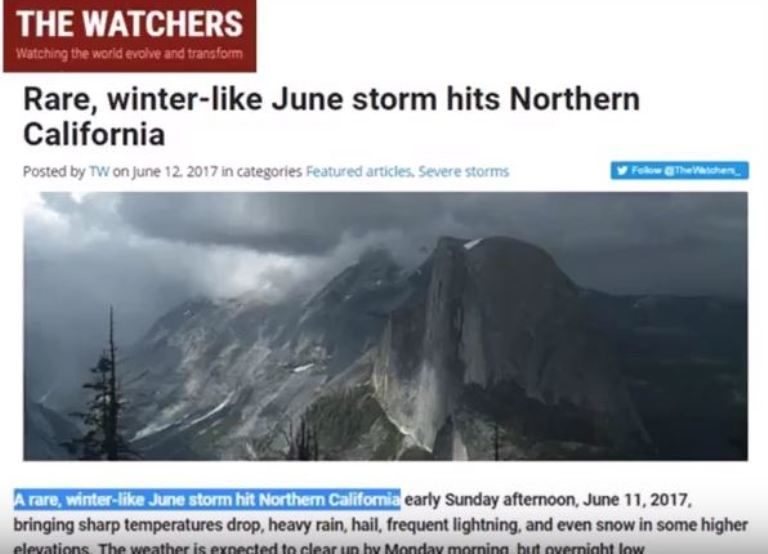
Snow, heat, shifting jet stream & cosmic rays twist weather

rare California winter storm
© YouTube/Adapt 2030 (screen capture)
The media is having a wondrous time reporting on the "heat" in desert areas of the USA and globally in summer, reporting that its extra hot. They overlook the snow storms in Russia this week, the out of season snowstorms in California and the ravaging early snowstorms across South America. All of this is expected and is easily explained by shifting Inter-tropical Convergence Zone air flows. It happens like clockwork with every grand solar minimum. Its happening again, but the media wont touch that with a 10 foot pole.


Tornado2

Thunderbolts Space News: Tornadoes - The Electric Model

tornado
© YouTube/Thunderbolts Project (screen capture)
The EU2017 Conference: Future Science -- Aug 17 - 20, Phoenix: https://www.thunderbolts.info/wp/2017...

The most violent type of weather storm on planet Earth is a tornado. Meteorologists tell us that the unstable air in a thunderstorm produces updrafts and downdrafts, which interacts with a wind shear to ultimately create a tornado vortex. But many scientists acknowledge that the exact processes that cause a tornado remain mysterious. In recent Space News episodes, Thunderbolts contributor Andrew Hall has explored the electrical genesis of lightning and other earthly weather phenomena. Today, Hall offers his own thesis on the electrical genesis of tornadoes on Earth.

Andy's original Thunderblog: https://www.thunderbolts.info/wp/2017...


Comment: Study: Tornado outbreaks are increasing - but scientists don't understand why. A coauthor of this paper states "What's pushing this rise in extreme outbreaks is far from obvious in the present state of climate science."

The climate scientists have not considered the importance of atmospheric dust loading and the winning Electric Universe model in their research. Such information and much more, are explained in the book Earth Changes and the Human Cosmic Connection by Pierre Lescaudron and Laura Knight-Jadczyk.
The accumulation of cometary dust in the Earth's atmosphere plays an important role in the increase of tornadoes, cyclones, hurricanes and their associated rainfalls, snowfalls and lightning. To understand this mechanism we must first take into account the electric nature of hurricanes, tornadoes and cyclones, which are actually manifestations of the same electric phenomenon at different scales or levels of power.
Increasing cometary and volcanic dust loading of the atmosphere (one indicator is the intensification of noctilucent clouds we are witnessing) is accentuating electric charge build-up, whereby we can expect to observe more extreme weather and planetary upheaval as well as awesome light shows and other related mysterious phenomena.

Tornado2

Video shows dust devil turning into a fire tornado at Russian gas field

red sky
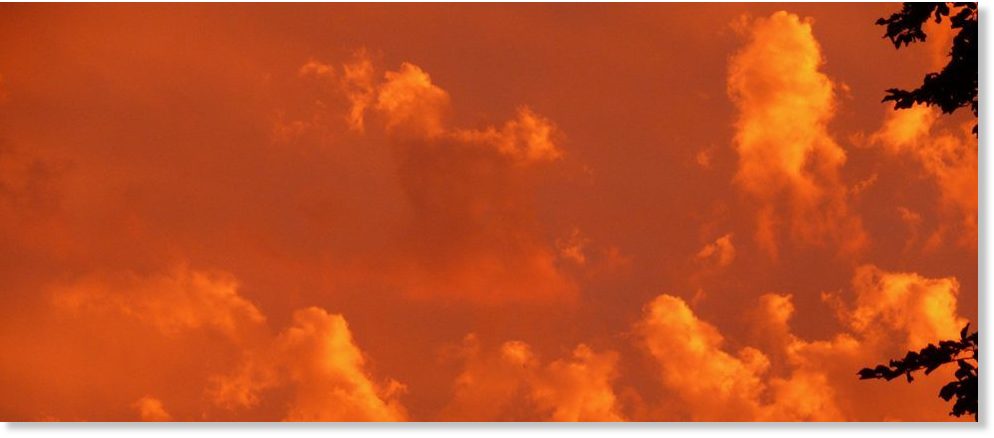
There's no shortage of entertaining videos from Russia, and while most of them involve balls of fire shooting through the sky, this one is a bit different: a dust devil made its way over to an open flame and transformed into a fire tornado. Thanks to a witness who was quick with their camera, the entire process was caught on video (vertically, that is, but it works well in this case).

The video was recently posted by Storyful on its YouTube page, where it simply attributes it to 'Anonymous.' According to the video description, the dust devil formed on a Russian gas field where an open flame was present on one of the pipes. The dust devil — which was pretty big to start with — made its way over to the fire, eventually encasing it.

The results are predicable — the fire was pulled up into the swirling wind, forming a twisting funnel of fire. After seemingly playing with the fire for a minute, the dust devil eventually backs off, going from clear and flaming to dusty and huge. It's quite satisfying, and even better that no one was hurt.


Airplane

Mother Nature speaks: 2 US 'Doomsday planes' knocked out of commission by tornado

E-4 doomsday plane
© Keith Allison / WikipediaThe Boeing E-4 Advanced Airborne Command Post.
Two US E-4B aircraft, otherwise known as 'Doomsday Planes', which are designed to survive an electromagnetic shockwave in the event of war, were damaged and left grounded by a fast-moving tornado at an airbase in Nebraska, local media report.

A heavy storm packing driving rain, high winds, and two tornadoes ripped through the US Air Force's Offutt base in Nebraska last weekend. The extent of the damage to the facility was reported by local media on Saturday.

Ten aircraft, including the two E-4B Nightwatchers, were damaged by the tornado, said Air Force Captain Mark Graff, as cited by Stars and Stripes.

Tornado2

At least three tornadoes and a microburst hit Quebec in one day; 'It's quite unusual' says Environment Canada

Quebec tornadoes
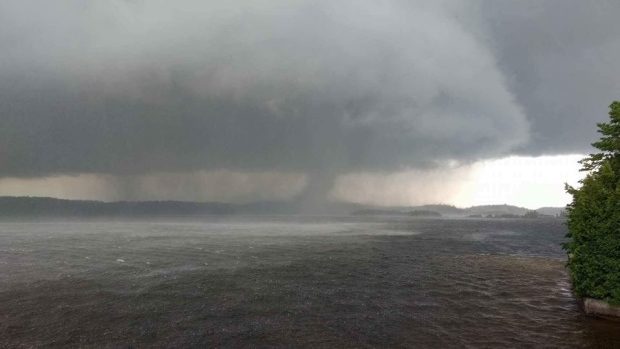
© Peter Rodgers/Facebook The tornado that hit the Saguenay region Sunday on Lac Kénogami travelled as fast 180 kilometres an hour and hit a class 2 on the Fujita scale, according to Environment Canada meteorologist Marie-Ève Giguère.

Cyclones carved kilometres-long paths near Lac St-Jean and Mont-Laurier


Three tornadoes touched down in Quebec last weekend — all in one day.

Environment Canada confirmed in a statement that "at least three tornadoes and a microburst affected the province" Sunday.

"It's quite unusual," meteorologist Marie-Ève Giguère told CBC News Wednesday.

"On average in Quebec, we confirm about six tornadoes every summer, so three on the same day is definitely a rare occurrence."

The tornadoes carved paths several kilometres long in the Lac St-Jean and the Mont-Laurier regions, as well as the Laurentides Wildlife Reserve between Quebec City and the Saguenay.

Two of the tornadoes - the ones in Lac St-Jean and near Mont-Laurier - hit Class 2 on the Fujita scale, meaning their winds reached 180 kilometres per hour.