Persistent sightings have some calling for an expedition to determine how many of the predatory creatures exist in Canadian waters.
VANCOUVER - When British Columbia's hake fleet sets off to trawl the deep ocean off the West Coast later this month, the crews will be on alert for a strange, voracious squid that is invading the north Pacific.
The Humboldt, or jumbo squid, is usually found off Mexico, but there is a heightened alert on the B.C. fishing grounds this year because the species has been making its way up the coast of North America, devastating hake stocks as it goes.
"I don't know much about them but they sound like quite a predator," said Brian Mose, director of the Deep Sea Trawlers Association of British Columbia.
Mr. Mose is sending a message to all fleet members, asking them to report any encounters they have with the large squid, which has been expanding its range both north and south.
The United Nations Food and Agriculture Organization (FAO) warned in March that Iran had detected a new highly pathogenic strain of wheat stem rust called Ug99.
The fungal disease could spread to other wheat producing states in the Near East and western Asia that provide one-quarter of the world's wheat.
The sighting of two rarely seen tropical birds in Hong Kong could be down to climate change, bird experts said Saturday. The birds - a great frigate and the white-tailed tropicbird - were both spotted around Po Toi, Hong Kong's southern most island, over the last month.
It was the first time the white-tailed tropic had ever been spotted in Hong Kong and only the fourth sighting of the frigate.
Both birds are usually seen in more tropical climates such as the Pacific and Indian Oceans.
Commercially managed bee hives continue to suffer from a mysterious loss across the country, though local beekeepers say the situation in Vermont is stable.
A survey released this week by the Apiary Inspectors of America found that the nation's beekeepers lost about 32 percent of their hives since last year.
Bees play an important role in pollinating fruit trees and bushes and hive operators travel with their bees to commercial growers around the country when flowers are in bloom.
A fish virus new to Ontario has been identified as one cause of the carp die-off that littered area lakes with 12,000 to 24,000 fish last summer.
John Cooper, of the Lake Erie fisheries management unit for the Ministry of Natural Resources (MNR), said extensive testing by the University of Guelph and the federal fish health labs confirmed finding a new fish virus to Ontario - the koi herpesvirus.
The mysterious Colony Collapse Disorder, which has led to the loss of millions of bees and in a worst-case scenario could be a threat to the food chain that humans depend on for life, has made its way to Utah.
Gary Dutson is being confronted by the malady firsthand. He has had to sell off 500 acres of farmland that's been in his family for two generations - largely because he's lost so many of his honeybees.
Dutson, who lives outside Delta in eastern Utah, had built up his bee operation to 4,000 hives by last fall when colonies began dying off for no apparent reason. Within months, he lost half his bees in an inexplicable disaster not seen since his father began beekeeping more than 70 years ago.
Until recently, Utah beekeepers seemed to be dodging the mysterious ailment, which has been killing off honeybees in other parts of the nation for the past two years. In 2007 alone, beekeepers lost 30 percent of the 2.5 million managed colonies to diseases, according to the U.S. Department of Agriculture.
Martin Cassidy
BBCThu, 08 May 2008 17:49 UTC
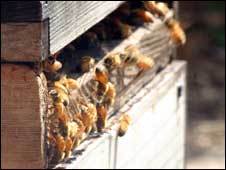
Bees are usually the hardest workers in County Armagh orchards, pollinating the apple blossom - but this year fruit growers complain that many bees have simply not turned up.
Bee-keepers, too, are worried about the crash in numbers and some are describing the problem as colony collapse disorder.
|
| ©BBC
|
| Some hives are lying empty
|
Investigations continue into the cause of a mysterious illness that has resulted in the deaths of thousands of bats since March 2008. At more than 25 caves and mines in the northeastern U.S, bats exhibiting a condition now referred to as "white-nosed syndrome" have been dying.
The U.S. Geological Survey (USGS) recently issued a Wildlife Health Bulletin, advising wildlife and conservation officials throughout the U.S. to be on the lookout for the condition known as "white-nose syndrome" and to report suspected cases of the disease.
USGS wildlife disease specialist Dr. Kimberli Miller advises that "anyone finding sick or dead bats should avoid handling them and should contact their state wildlife conservation agency or the nearest U.S. Fish & Wildlife Service field office to report their observation."
Jack LaDuke
WCAX NewsThu, 08 May 2008 15:02 UTC
Crews in New York started to cleanup a massive fish die-off on Lake Champlain Monday. The state sent in some prisoners to help with the really smelly job of getting rid of thousands of dead fish.
Richard Black
BBC NewsWed, 07 May 2008 21:04 UTC
Declining fish stocks could be partly responsible for algal blooms in the oceans, researchers have found.
Scientists found that the fall in cod stocks in the Baltic Sea in recent decades increased numbers of the tiny marine plants that produce the blooms.