It is the winter that refuses to go away in northern Manitoba and most of the eastern Arctic.
Prolonged cold snowy conditions in the Hudson Bay area are expected to obliterate the breeding season for migratory birds and most other species of wildlife this year.
According to Environment Canada, the spring of 2009 is record-late in the eastern Arctic with virtually 100 per cent snow cover from James Bay north as of June 11.
May temperatures in northern Manitoba were almost four degrees C below the long-term average of -0.7, and in early June, temperatures averaged three degrees below normal.
National Oceanic and Atmospheric Administration images confirm snow and ice blanket all of northern Manitoba, part of northern Ontario and almost all of the eastern Arctic as of June 12. U.S. arieal flight surveys confirm the eastern Arctic has no sign of spring so far.
"I have lived in Churchill since the 1950s, and this the latest spring I have ever seen here," said local resident Pat Penwarden. "The spring of 1962 was almost this bad."
Six-foot snowdrifts blocked Churchill-area roads. A thick blanket of snow, in places three- and four-feet deep, coated 90 per cent of the local taiga in northern Manitoba. Ecotourists, who normally flock to northern Manitoba every June to see birds and other wildlife, cancelled their plans this June "in droves," according to local ecotourist specialists. Snowy conditions are largely to blame.
"It is like a winter landscape," said Ruth Baker, a Michigan tourist who spent June 9 to 12 at Churchill. "I couldn't believe the snowdrifts, like mountains of snow".
Researchers confirm that the lateness of the spring of 2009 dooms local birds to a virtually complete reproductive failure.
Comment: This is a very good article until the last five paragraphs. The worldwide global warming psychological conditioning cannot be threatened by any piece of evidence that may counter the chosen agenda.
Recent late springs in the Hudson Bay area have been more frequent than normal: 2004, 2002, 2000 and 1997.
It should be pointed out that the data shows the planet has been globally cooling for at least 7 years and possibly as much as 10-11 years. (
Link), (
Link), (
Link).
The possibility and even high probability given the data that what lies ahead is more frequent delayed springs in the north due to cooling is not even mentioned.
But, dut da da dah... Global Warming is the cause of course!
According to NOAA scientists, although the Arctic is warming, more frequent annual oscillations in temperature are likely to occur, often resulting in late springs.
Of course. And if there were less snow and earlier springs it would be of course - you got it - global warming. And it would be expected regardless.
"Such major oscillations are part of a bumpy ride toward global warming," said Thomas Karl of the National Climate Center. "For awhile at least this will be the shape of things to come."
If such oscillations increase and spread south and crops fail and there are fuel shortages, it will be because of global warming.
"People often confuse climate with weather, and this spring is a weather phenomenon," said an Environment Canada spokesperson.
This last paragraph is just plain insulting. How are the people to understand anything when the spokes people are so utterly wrong?
We will have to see what the next few years bring us.

© unknownJellyfish Swarms Spell Trouble
The dramatic proliferation of jellyfish in oceans around the world, driven by overfishing and climate change, is a sure sign of ecosystems out of kilter, warn experts.
"Jellyfish are an excellent bellwether for the environment," explains Jacqueline Goy, of the Oceanographic Institute of Paris. "The more jellyfish, the stronger the signal that something has changed."
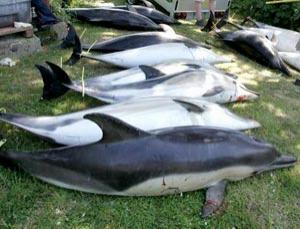
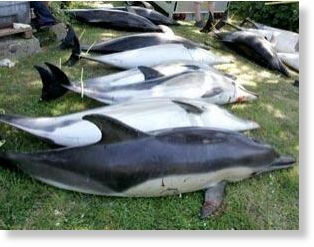
© Adam Gerrard/SWNS.COMTwenty-six common dolphins became stranded in estuarine waters they are not normally known to frequent.
An investigation into the UK's largest ever mass stranding of common dolphins has identified military activity as the most probable cause - although no single activity can be definitively linked to the stranding.
Twenty-six common dolphins died after becoming stranded in the Fal Estuary in Cornwall, southwest England on 9 June, 2008, while a similar number were refloated by volunteers. An
investigation into the cause of their deaths by Paul Jepson at the Zoological Society of London and his colleagues has ruled out a lengthy list of possible causes.
However, documents obtained under the UK Freedom of Information act have provided researchers with unprecedented access to military records of navy activity in the area. While there is no evidence of physical injury to the dolphins caused by sonar, "what we are left with is a mass stranding and a naval exercise - we have ruled out pretty much everything else," Jepson says.
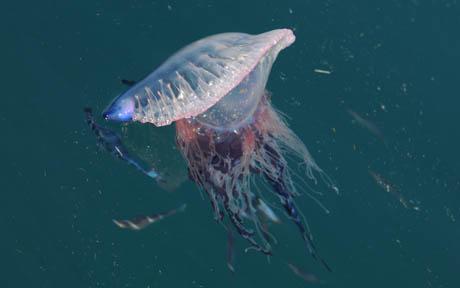
© Jim Simmen Portuguese Man-of-War Jellyfish
Holidaymakers are being warned to be vigilant when they take to the water and beware of the stinging menace in the shallows.
For the first time in a decade the potentially deadly Portuguese Man o' War, which are not strictly jellyfish but floating colonies of microscopic hydrozoans, has been spotted close to the beaches of the Costa del Sol.
With tentacles sometimes more than 30 yards long, which are barbed with a sting 10 times stronger than an ordinary jellyfish, it presents a more dangerous threat than the annual jellyfish invasion of Mediterranean beaches.
In extreme cases, the sting can cause heart failure in victims who are allergic to it.
Scientists fear the creatures could spread along the coast of Spain and invade waters around the Balearic Islands after venturing away from its north Atlantic habitat and through the Strait of Gibraltar.
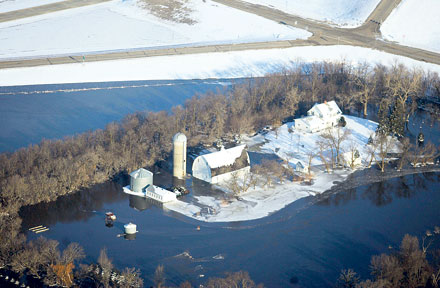
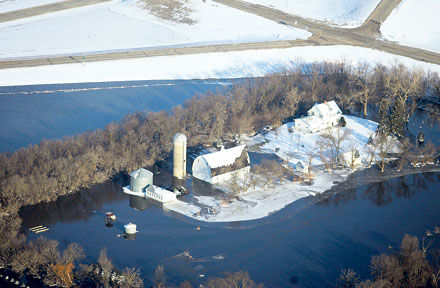
© ReutersWaterworld: Floodwater surrounding a farm near Fargo, North Dakota, in March 2009
Our politicians haven't noticed that the problem may be that the world is not warming but cooling, observes Christopher Booker.
For the second time in little over a year, it looks as though the world may be heading for a serious food crisis, thanks to our old friend "climate change". In many parts of the world recently the weather has not been too brilliant for farmers. After a fearsomely cold winter, June brought heavy snowfall across large parts of western Canada and the northern states of the American Midwest. In Manitoba last week, it was -4ºC. North Dakota had its first June snow for 60 years.
Bullhead City, Arizona - Biologists have determined that a carp die-off in Lake Mohave is being caused by a virus.
Several thousand dead carp have washed up on the shore of the reservoir along the Colorado River in recent weeks. Arizona Game and Fish Department spokesman Zen Mocarski says it appears the Koi herpes virus has now spread downriver and is killing carp in Lake Havasu.
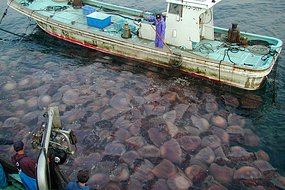
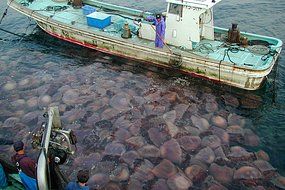
© Y.Taniguchi/Niu Fisheries CooperativeNomura jellyfish are the biggest in the world and can weigh 200kgs.
Giant jellyfish are taking over parts of the world's oceans due to overfishing and other human activities, researchers say.
Nomura jellyfish are the biggest in the world and can grow as big as a sumo wrestler. They weigh up to 200 kilograms and can reach 2 metres in diameter.
Dr Anthony Richardson and his colleagues from CSIRO Marine and Atmospheric Research says jellyfish numbers are increasing, particularly in South East Asia, the Black Sea, the Gulf of Mexico and the North Sea.
Over 10,000 pigeons have died due to a suspected bacterial infection in the last one month in Singtam in East Sikkim, according to animal husbandry officials. The number of dead birds could be more since the figure was an estimate given to the officials by local residents, the officials said.
The officials who visited the spot earlier this month have ruled out bird flu but suspect that a bacterial infection caused the deaths. Samples taken from the dead birds were being tested. The residents of the town are worried that the infection could spread to poultry birds if not controlled quickly.
Many claimed that insects had come out when the carcasses were dipped in disinfectant.
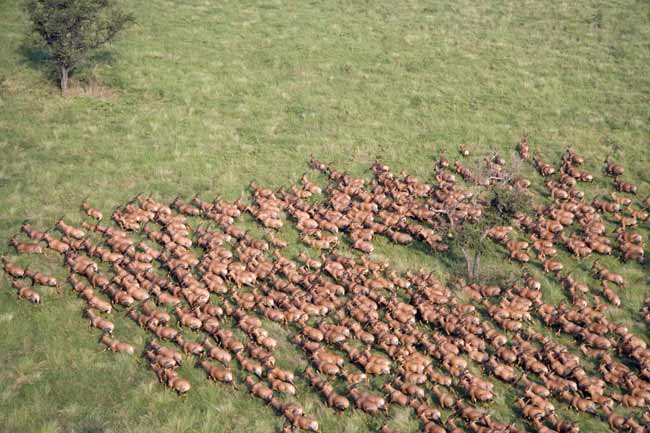
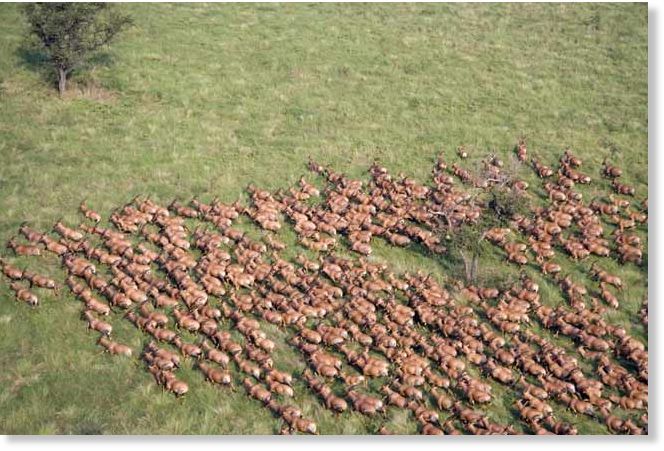
© P. Elkan, Wildlife Conservation Society/National GeographicTiang herd in the Southern sector of Boma National Park.
Africa is home to spectacular migration events. Large mammals ranging from Grant's gazelles to blue wildebeests pound their hooves across vast tracts of land as the seasons change. New research suggests, however, that migrations across the continent might be going extinct.
For the first time, scientists have compiled and analyzed data on all of the world's largest and definitive migrating land mammals. The researchers looked at the migration history for a group of ungulates, all of them hoofed mammals, weighing more than 44 pounds (20 kg). The data suggest that one-quarter of these mammals no longer migrate, and human development is responsible for the decline, said Grant Harris, co-author of the study.
Rod Nickel
ReutersMon, 08 Jun 2009 19:35 UTC
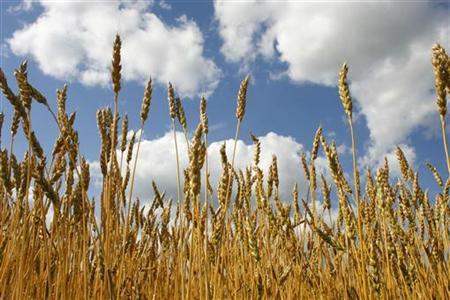
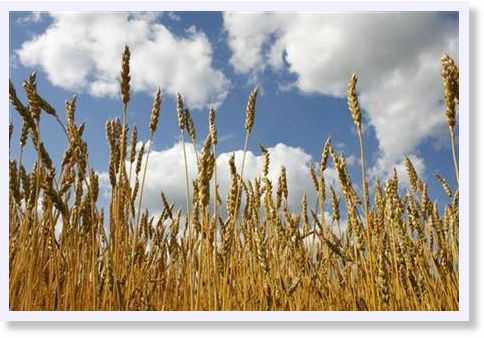
© Reuters / Shaun BestCanadian wheat grows in a field near Teulon, Manitiba, July 26, 2006.
Winnipeg, Manitoba - Cool weather has pushed growth of Western Canada's wheat and barley crop at least 10 days behind schedule, the Canadian Wheat Board said on Monday.
"You're pushing development into a period with better likelihood of getting a (pre-harvest) frost," said Bruce Burnett, director of weather and market analysis for the Canadian Wheat Board. "It's not particularly what we need at this moment. It's just too cool."
There's little relief in forecasts for the Prairie region. Southern Manitoba, parts of which are still seeding, will have cool, wet weather through Wednesday, according to Environment Canada. Daily low temperatures of just above freezing are also forecast for much of Saskatchewan and Alberta.
The Wheat Board, which has a government-granted marketing monopoly on Western Canada's wheat and barley, releases its planting and production estimates on Thursday.











Comment: This is a very good article until the last five paragraphs. The worldwide global warming psychological conditioning cannot be threatened by any piece of evidence that may counter the chosen agenda. It should be pointed out that the data shows the planet has been globally cooling for at least 7 years and possibly as much as 10-11 years. (Link), (Link), (Link).
The possibility and even high probability given the data that what lies ahead is more frequent delayed springs in the north due to cooling is not even mentioned.
But, dut da da dah... Global Warming is the cause of course! Of course. And if there were less snow and earlier springs it would be of course - you got it - global warming. And it would be expected regardless. If such oscillations increase and spread south and crops fail and there are fuel shortages, it will be because of global warming. This last paragraph is just plain insulting. How are the people to understand anything when the spokes people are so utterly wrong?
We will have to see what the next few years bring us.