Animals
S


Arrow Down

Australia's Tasmanian devil declared endangered

Tasmanian devil
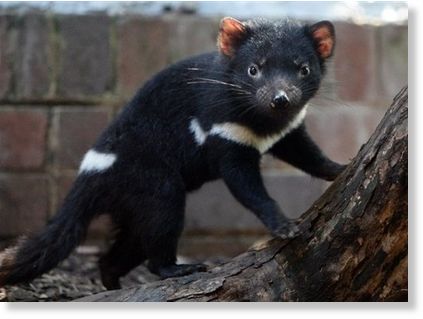
© Agence France-Presse/Torsten BlackwoodAustralia's Tasmanian devil, the world's largest surviving marsupial carnivore, will be listed as endangered because of a contagious and deadly cancer, the government said
Australia's Tasmanian devil, the world's largest surviving marsupial carnivore, will be listed as endangered because of a contagious and deadly cancer, the government said.

"This disease has led to the decline of about 70 percent of the Tasmanian devil population since the disease was first reported in 1996," Environment Minister Peter Garrett said in a statement.

Devil facial tumour disease, which is spread through biting, kills the animals usually within three months by growing over their faces and mouths, preventing them from eating.

Bug

U.S.: Destructive Ants Marching on San Antonio

Crazy Ant
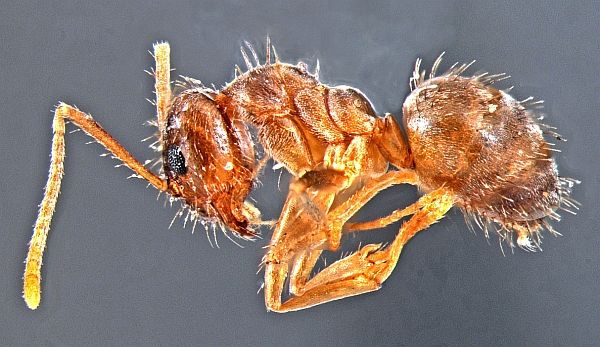
© UnknownClose-up view of a Raspberry crazy ant. Entomologists say the public must learn about the destructive Rasberry crazy ant and help prevent them from spreading.
A destructive menace is heading west on Interstate 10 toward San Antonio.

It's the crazy Raspberry ant that was first spotted in Houston in 2002. No one knows where it came from or how to control it, but it reproduces faster than any insect experts have ever seen.

"This is an alien species," says Sam Houston State University Entomologist Dr. Jerry Cook. "This is in higher densities than any other insects I've ever seen. They number in the billions and cover everything around them."

"Where you'll have 200,000 ants in a big fire ant mound, you'll have billions of crazy ants in one area, in that one group. They form a carpet of ants over acres that is several inches thick."

Better Earth

Blue whales return for the first time in 40 years

Image
© Mike JohnsonBlue Whale
Decades after a ban on hunting the world's largest animals, the creatures have made their way back to waters off Alaska and Canada

Blue whales - thought to be the largest animals ever to have inhabited the Earth - have returned to the seas off Canada and Alaska for the first time since hunting them ceased more than four decades ago. New research suggests that they appear to have rediscovered an old migration route that they abandoned at the height of the slaughter.

The research, by US and government scientists and a private research institute focussing on marine mammals, comes as whales face their greatest ever danger in over 20 years, as key governments threaten to breach the international moratorium on commercial whaling.

It has so far spotted 15 of the blue whales, which can weigh up to 200 tons, in the Gulf of Alaska and off British Columbia, and identified four of them as having been previously seen off southern California. Long ago, before commercial whaling began, they used to migrate between the two areas, heading north in summer in search of food - they can each consume four tons of tiny crustacean krill a day. But they were hunted close to extinction, with their numbers reduced from some 200,000 world wide to between 5,000 and 12,000.

Bizarro Earth

Japanese fruit farmers stung badly by bee shortage

From Yamagata to Kagoshima prefectures, farmers are bemoaning a shortage of Western honeybees --crucial in the pollination of melons, cherries, strawberries and other crops.

According to the farm ministry's Animal Health Division, imports of Western honeybees ground to a halt last year after an outbreak of a contagious disease was confirmed in 2007 among beehives from Australia.

Honeybees from Australia accounted for about 80 percent of imports to Japan. Moreover, mass bee deaths have been occurring in Europe and the United States.

Bell

US: Bat Illness Spells Trouble For Farmers

Harrisburg, Virginia - Although they are largely misunderstood, bats are considered among the most beneficial animals in the United States.

So the recent discovery of a rapidly spreading fatal disease called White-Nose Syndrome in Virginia bats, possibly including those in Endless Caverns near New Market, has biologists and elected officials scrambling to save the small-winged mammals.

The syndrome takes its name from the ring of white fungus that often appears on infected bats' snouts and other body parts. Bats infected with the disease also typically have low body fat, dehydration and demonstrate abnormal behavior.

Scientists don't know what's causing the disease that has wiped out hundreds of thousands of bats since first showing up in the northeast about three years ago. They also don't know how the disease is spread or how to stop it from infecting more bats, which, in most cases, are disease resilient.

Bizarro Earth

Mystery worms turn on northwest China herdsmen

Beijing - An invasion of unidentified worms has forced 50 herdsmen and their families from their grassland homes, taking 20,000 head of livestock with them, in northwest China's Xinjiang region, state news agency Xinhua said Friday.

The worms are packed up to 3,000 per square meter and chew through the grasslands like lawnmowers, leaving only brown soil in their wake, Xinhua said.

The agency described it as the worst plague in three decades in Usu, about 280 km (175 miles) west of the Xinjiang capital Urumqi.

Local experts could not identify the 2-cm (1 inch) long, thorny green worm with black stripes and samples had been sent to Xinjiang Agricultural University, Xinhua said.

Bizarro Earth

Brazil's other big forest in dire straits

Image
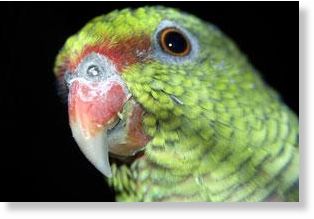
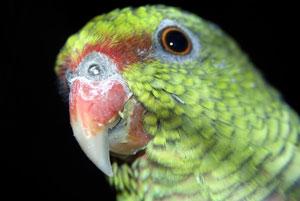
© Andre Seale / SplashdownDirect / Rex FeaturesVinaceous Amazon, a critically endangered parrot found only in the South American Atlantic Forest.
The ongoing degradation of the Amazon rainforest has obscured the plight of its smaller sibling: the Atlantic forest in Brazil, which is a biodiversity hotspot. Once covering about 1.5 million square kilometres, the rainforest has been reduced to about one-tenth of its original area in the past 500 years, a new study has shown.

The Atlantic forest supports more than 20,000 species of plants, 260 mammals, 700 birds, 200 reptiles, 280 amphibians and hundreds of unnamed species.

Unless the damage is halted, monkeys and birds unique to the region will go extinct, including iconic species such as the golden lion tamarin (Leontopithecus rosalia) and the northern woolly spider monkey (Brachyteles hypoxanthus), both among the most endangered of all the world's monkeys.

"Unfortunately, the forest is in very bad shape," says Jean Paul Metzger at the University of São Paulo in Brazil. "Species extinctions will occur more rapidly and, since 30 per cent of the species are endemic to the region, they will disappear forever."

Frog

Newly Discovered Frogs in Madagascar

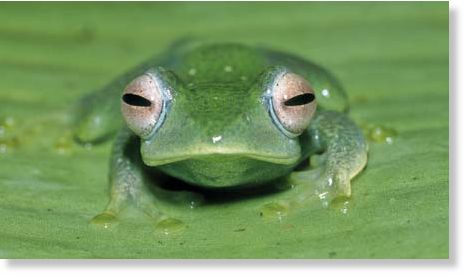
All green frog
© Reuters
An all green frog of the new species Boophis aff. elenae is seen in this undated picture released by the Spanish Scientific Research Council this week. Scientists have found more than 200 new species of frogs in Madagascar.

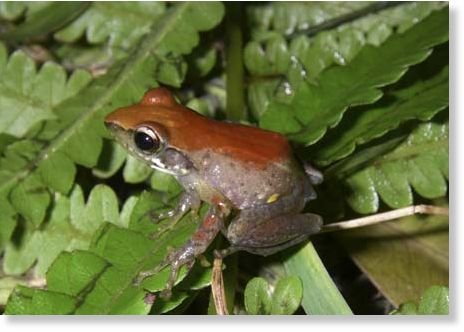
Red-back frog
© Reuters
A red-backed frog of the new species Guibemantis liber. is shown in this image released by the Spanish Scientific Research Council.

Info

Australia: Spider invasion in Bowen

Whistling Spider
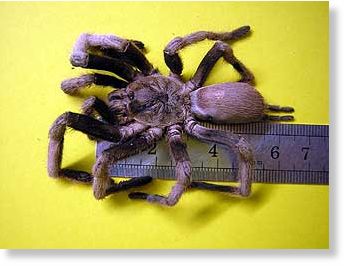
© UnknownA bird-eating spider found at a Bowen business
In a scene that could almost be out of a B-grade monster movie, giant spiders have invaded Bowen.

For about six weeks, residents have reported seeing huge bird-eating spiders crawling around their backyards and gardens.

Amalgamated Pest Control Bowen pest technician Audy Geiszler took this incredible photo of one of the spiders he caught wandering across the garden of a restaurant near the town's centre.

Mr Geiszler estimated its body alone was 5cm long, a specimen declared 'especially large' by the Queensland Museum. Most grow to be the size of a man's hand.

Info

Two Brown Bear Populations In Spain In Danger of Extinction Have Been Isolated For Past 50 Years

Image
© Raphael Quinet/Creative CommonsThe situation of bears in the Iberian Peninsula is critical.
The situation of bears in the Iberian Peninsula is critical. Researchers from the University of Oviedo (UO) and the Superior Council of Scientific Research (SCSR) have performed a genetic identification based on the analysis of stools and hair of brown bears (Ursus arctos) from the Cantabrian mountain range, gathered between 2004 and 2006.

The non-invasive analysis of 146 samples has allowed for the identification of 39 bears in the western sub-population, and 9 in the eastern one, so as to show the genetic structure of the population. In order to obtain the individual genotypes of the bears, scientists have employed 18 micro-satellite markers in a joint fashion, and a sex marker with high-class genetic technology.