Animals
S


Bizarro Earth

US: Millions of Dead Fish in California: Volunteers Needed to Help Clean up Redondo Beach Dead Fish

Image
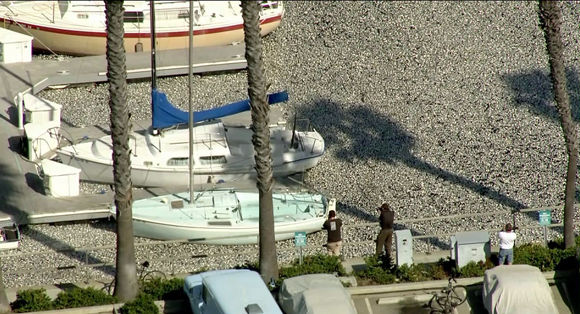
© KTLA-TVMillions of dead fish coat the water's surface in King Harbor in Redondo Beach, March 8, 2011.
Officials say the fish died from oxygen deprivation in the marina.

Heal the Bay, one of Southern California's leading ocean advocates, is looking for volunteers to help clean up millions of dead fish that washed up in King Harbor near Redondo Beach on Tuesday.

City public works crews cleaned up 35 tons of fish with skimmers and bulldozers on Tuesday, but much more work remains to be done.

The dead fish, mostly sardines along with anchovies and mackerel, floated up to the surface from the ocean floor.

About 200 city workers and 75 volunteers are working to get the fish out of the harbor. Redondo Beach officials estimate that the clean-up will cost at least $100,000.

Volunteers are working daily from 9 a.m. to 6 p.m.. "No experience or supplies are required -- only enthusiasm," Heal the Bay said in a statement on their website Wednesday.

Heal the Bay also said they are analyzing ocean conditions along with the Redondo Beach SEA Laboratory and the University of Southern California.

Question

Labrador, Canada: Dead seals mystery not solved by scientists' tests

Image
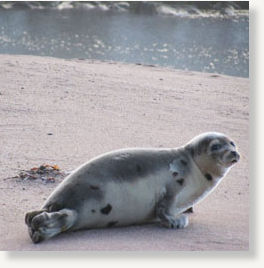
© Derrick LettoA young seal on a beach near the southern Labrador community of L'Anse au Clair in early January.
Scientists say they've been unable to solve the mystery of dead seals that washed ashore in Labrador between December and January.

More than 200 harp seals turned up dead across remote beaches along the coast of the province.

"It's really one that's got us baffled," said Dr. Garry Stenson, a biologist with Fisheries and Oceans Canada.

When Stenson received reports of seals turning up dead, he flew into towns in northern Newfoundland and Labrador to collect their frozen carcasses.

Blackbox

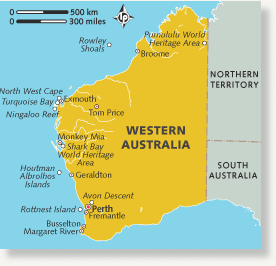
Western Australia: Fish kills reported on coast

Image
© Unknown
Washington's extended spell of hot, still weather and warm ocean temperatures is believed to be the cause of fish kills along the Mid West coast and out at the Abrolhos Islands.

Department of Fisheries Senior Fish Pathologist Dr Brian Jones said he expected the natural phenomena would continue while coastal water temperatures remained high. "Fish are cold-blooded, so when the water gets either too hot, or too cold, they suffer," Dr Jones said.

"We have had reports of fish dying recently in the Moore River, along various sections of the coast up to the Mid West and the still, hot conditions have played a significant role in the mortalities.

Jones said there had also been reports of abalone losses on reefs near Greenough and fish and lobster deaths at the Abrolhos Islands. He said the advent of some coral spawning at the Abrolhos Islands had also sapped oxygen from the water.

Magnify

Flamingos Drop From Siberian Sky: Locals Mystified

We're in Siberia, shivering. It's November, November 11, 2003, and two boys, Kolya and Maksim Muravyev, are ice fishing along the Lena River, where it's 13 below zero. All of a sudden, up in the sky, they see what looks like a flamingo. "We thought it was a swan or a stork," Kolya says, a flamingo being so preposterously improbable.
russian flamingos
© Illustration by Maggie Starbard/NPR

It was large, and made ever lower circles in the sky. It seemed to be losing energy until finally it fell and lay quietly on the snow. The two boys ran over, called their father, Vasily, who picked up the bird and took it home. It was still alive. "[This is the] first time I see a bird like this," he told a TV reporter.

They fed the flamingo fish and buckwheat saturated in water (not normally flamingo food) and pretty soon it was up, active and knocking around the Muravyev's apartment. Here it is, head in a feeding bucket.

Blackbox

US: Millions of fish found dead in California marina

Redondo Beach - Millions of dead fish were found Tuesday floating in a Southern California marina.

Boaters awakened to find a carpet of small silvery fish surrounding their vessels, said Staci Gabrielli, marine coordinator for King Harbor Marina on the Los Angeles County coast.

California Fish and Game officials believe the fish are anchovies and sardines.

Experts had yet to determine what happened, but Gabrielli said the fish appeared to have moved into the harbor to escape a red tide, a naturally occurring bloom of toxic algae that can poison fish or starve them of oxygen.

High winds overnight might then have trapped the fish in the harbor, crushing them against a wall where they used up the oxygen and suffocated, she said.

The dead fish were so thick in some places that Garbrielli said boats can't get out of the harbor.

Fish and Game authorities arrived and began taking samples of the fish.

"We have no idea how they got here," said spokesman Andrew Hughan. "There are thousands and thousands and thousands of fish."

Additional pictures here.

Comment: Update: Fox News footage of the fish floating in King Harbor:


Bizarro Earth

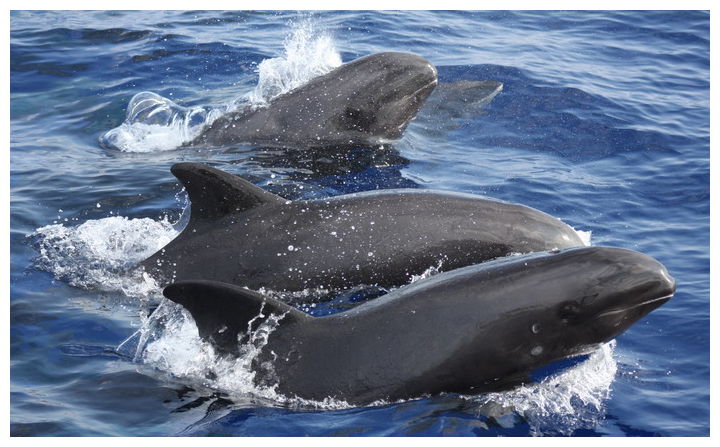
Japan: 50 Melon-Headed Whales Stranded on Ibaraki Shore; 22 Rescued

Melon Headed Whales
© Robin W. BairdThree melon-headed whales.

Mito - About 50 melon-headed whales were found to have beached on the shore in Kashima, Ibaraki Prefecture, in eastern Japan Friday night and 22 were rescued and returned to the sea on Saturday by authorities and local volunteers.

About 200 people, including staff at Oarai Aquarium in the same prefecture, city government officials and local residents and surfers near the Oritsu coast tried to save the beached whales by keeping them hydrated while they tried to refloat them, but 30 of them died, according to the city government.

It took about eight hours to return the surviving whales to the sea, the officials said, adding they have buried the carcasses of the dead whales on the nearby shore.

Melon-headed whales are commonly seen offshore around the area in the early spring and they may have been drawn into the shallow waters while following their food, said Masayuki Shimada, chief of the marine animal exhibition section of the aquarium.

Bizarro Earth

Bumblebees: Gone with the Wind? A Major Disappearance

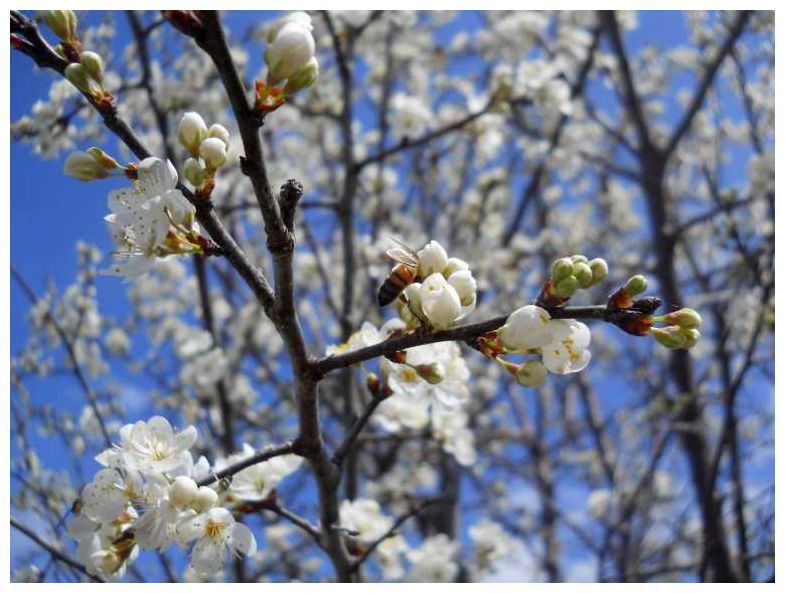
Bumble Bees
© Earth Times

Bumblebees, also known as Bombus terristris, are the pollinating cousins of wasps and hornets. They are the number one pollinator for wild growing plants as well as commercial agriculture; you may have seen them flitting around your Gran's tomato plants on summer evenings, busy at work. However, these popular and beloved buzzing insects that help bring us all kinds of food-- from coffee beans to fresh apples -- bring alarming news.

In the past few decades scientific studies have found that increasing numbers of bumblebee colonies are disappearing. It's possible that Bombus affinis, one of the many bumblebee subspecies native to North America, have all but died out. Between 1976 and 2006, there was a huge loss in the number of wild bumblebee colonies; they are now almost completely gone. Not only North America is suffering from this bumblebee disappearance; in the UK, over the past 70 years 3 out of 24 native bumblebee species have gone extinct.

Why are bumblebees suddenly taking leave of their duties as master pollinators? Well, it appears that no one person can agree on a single cause. Scientific evidence strongly suggests that the combination of insecticides and disease from imported bees, bred in greenhouses, are two main causes of bee deaths. One highly dangerous group of insecticides, called neonicotinoids, have been used since the 90s in North America on a wide variety of crops.

Bizarro Earth

S. Korea Confirms Additional Bird Flu Outbreak

South Korea confirmed an additional bird flu case at a duck farm in the central part of the country on Saturday.

Tests showed that the 12,400 birds at a poultry farm in Cheonan, 92 kilometers south of Seoul, were infected with the virulent H5N1 strain of the avian influenza (AI), the National Veterinary Research and Quarantine Service (NVRQS) said.

This is the second case of the highly pathogenic avian influenza reported in the country this month as the number of AI cases has started to fall off in recent weeks. It is also the first AI confirmation in Cheonan in 33 days.

All ducks on the farm will be culled with quarantine authorities asking nearby farms to be vigilant on protecting their birds.

Bizarro Earth

West Bank: 2,000 Turkeys Diagnosed with Bird Flu Near Jenin

Bird Flu
© Ma'an News Agency
A flock of 2,000 turkeys has been diagnosed with the H5N1 "bird flu" virus in the northern West Bank village of Silat Al-Harithiya near Jenin, government officials said.

The veterinary department of the Palestinian Authority Agriculture Ministry said it had managed to prevent an epidemic.

Director of the department in Jenin Jamil Makhamra told Ma'an that government and private vets examined the flock on Feb. 27 after many of the birds died.

Samples were examined at the veterinary medicine center in Ramallah, where it was confirmed that the birds had influenza A subtype of H5N1, also known as "bird flu."

Bizarro Earth

Bangladesh: 2,000 Chickens Culled in Gazipur, Noakhali

Dhaka, - Around 2,000 chickens have been culled in Gazipur and Noakhali following the detection of H5N1 virus, commonly known as bird flu.

Gazipur Sadar Upazila livestock officer Mohammad Shamsur Rahman on Saturday told bdnews24.com that the bird flu infection was confirmed by the Central Diseases Investigation Laboratory in Dhaka.

Some 1, 137 chickens were executed around 10pm on Friday, when 205 eggs were also destroyed.

Apart from this, in the last two days, over 13,000 chickens were executed in the district.

The official said the district livestock department on Friday sent a sample tissue of a dead chicken to the laboratory for tests after some of the chickens of Bushra Poultry Farm in Taratpara area died on Thursday.

A direction was immediately passed to the Upazila livestock department to cull the infected chickens in a bid to stop the infection spread in the surrounding areas.