Animals
S


Eye 2

Symbolic? French reptile warehouse destroyed in blaze near Toulouse

Image
As many as 30,000 snakes, iguanas, lizards and turtles perished as a blaze ripped through a warehouse in a town in the south of France. It is not clear how the fire started.

The blaze swept through the warehouse in the early hours of Sunday morning and according to local media reports killed between 20,000 to 30,000 animals who were being stored there.

The warehouse, situated in the town of Saint-Sulpice-La-Point, not far from Toulouse belonged to the company Savannah, one of the main wholesalers of reptiles and turtles in France.

According to firefighters the blaze started at 2am and quickly destroyed the 4,000 square metre depot, where numerous species of snakes, iguanas, turtles and other reptiles were being stored.

A video from France TV showed that the roof of part of the warehouse had collapsed.

Only a few turtles were said to have survived the inferno.

Authorities are still investigating the cause of the blaze and have not ruled out arson.


Attention

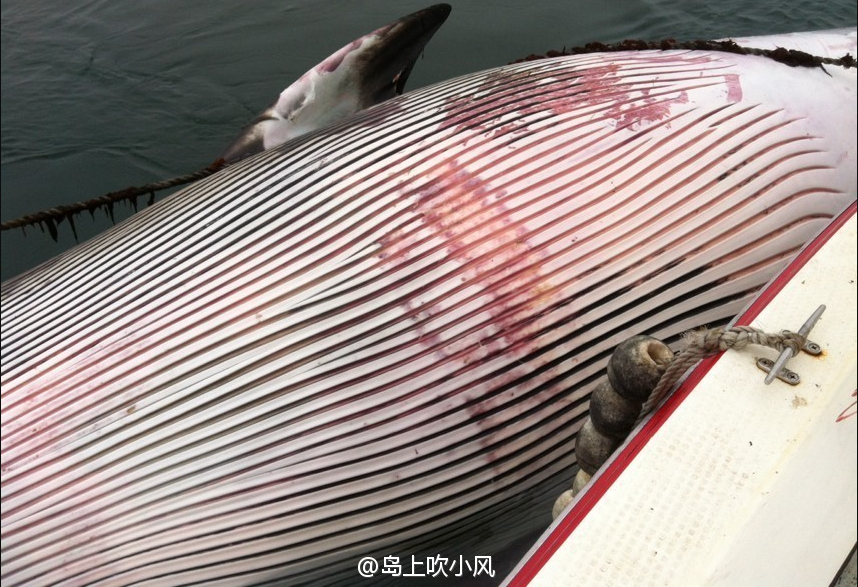
Large whale carcass found in Dalian sea, China

Image
© Sina Weibo
A dead whale measuring over four meters long was found floating belly-up in the sea area off Changhai County, Dalian, Liaoning Province, on April 19, a netizen said on his Sina Weibo account on Saturday. The whale was most likely killed by unexpected strikes, judging by the bruises on its belly.

Ice Cube

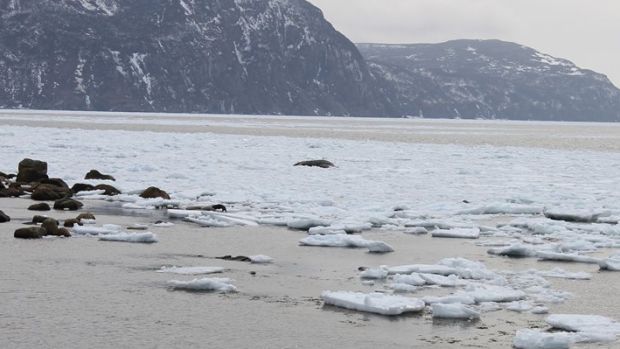
Another report of dead whales stranded by ice off Newfoundland

Image
© Kayla KendallKayla Kendall tweeted this photograph on Saturday of a whale stranded at Rocky Harbour because of ice.
The Canadian Coast Guard has issued a new report of dead whales off western Newfoundland.

Mariners have been warned about four whale carcasses at different locations at the entrance to Bonne Bay.

It has not said what kind of whales have died.

Earlier this month, at least nine blue whales died in ice in the Gulf of St. Lawrence.

In March, dozens of dolphins were killed when they were crushed by ice near Cape Ray, on Newfoundland's southwest coast.

Fish

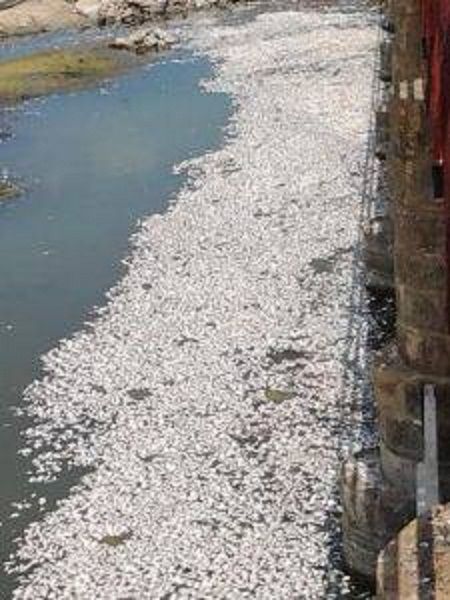
Millions of dead fish found floating in Thondamanaru lagoon, Sri Lanka

Image
A shoal of fish, may be a couple of million - our reporter lost count of it, were seen dead floating and lying in the shores of Thondamanaru and around the Barrage area located in the Valvetiturai Kankesanthurai Road.

Mysteriously all those dead fishes found in Thondamanaru Lagoon area were almost one kind which in Tamil called "Thirali," a typical edible small fish found solely in Palk Strait area.

These fishes were said to be dead and floating and were seen in heaps in the shore from last Thursday and Friday.

As the dead fishes started polluting the Selva Sannathi Temple area, Karaveddy Divisional Secretary K. Sivasri, Valvetiturai Urban Council Chairman N.Anandarajah and representatives of the Fisheries Societies visited the area and took measures to remove dead fishes.

Asian Tribune learnt the Sri Lankan Army personnel were also involved in the cleaning operation along with workers of Valvetitural and Valikamam East Pradesha Sabhas.

Three tractor loads of dead fishes were collected and taken and buried around the sea shores in Thondamanaru.

It remains mysterious why particularly Thirali fish only died.

According to an opinion, due to very warm atmospheric conditions prevailing these days, the sea water must have evaporated to a great leve and the water might have turned more brackish and fishes would not be able to bear up saltiness newly developed in the sea water.

Bug

Insect population in Louisiana marshlands declining four years after BP oil spill

marshland oil
© Julie DermanskyWeathered oil found coating the surface of the marsh in Bay Baptiste, Louisiana on April 9, 2014
Louisiana State University entomologist Linda Hooper-Bui has been studying the impact of the BP oil spill on insects and spiders for almost four years. She started her study shortly after the Macondo well blew out on April 20, 2010, before any oil washed up on shore. Her work documents the dwindling of the insect population in areas directly hit with the oil.

On April 9th, she returned to Bay Jimmy and Bay Baptiste, areas that were heavily impacted by the oil spill in Plaquemines Parish, Louisiana.

"Insects are the basis of the food chain. They are like nature's Twinkies," Hooper-Bui says.

Her studies also monitor fish and birds, since they eat insects. She sweeps areas designated for her study by walking back and forth waving a net, catching whatever insects are present. She then empties the net into alcohol, preserving the insects for testing. She takes note of the wind speed and temperature at each location and collects a sample of sediment to be tested for hydrocarbons.

Attention

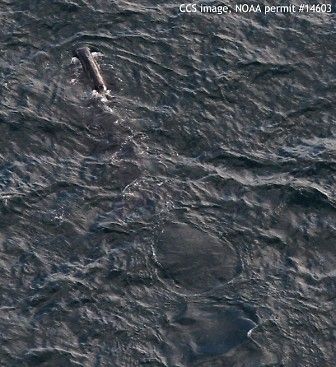
Rare Arctic Bowhead whale seen in Cape Cod Bay - only the second in recorded history

Image
© NOAAA bowhead whale was spotted feeding with right whales in Cape Cod Bay last week
Experts call the sighting rare and remarkable

It is a remarkable sighting, according to experts from the Center for Coastal Studies (CCS) in Provincetown. Last Friday marks only the second time in recorded history that a bowhead whale has been seen so far south in the waters of the Atlantic. The whale was spotted swimming and feeding with right whales on Cape Cod Bay on April 11, according to a CCS release.

The first time a bowhead was spotted in our waters was two years ago, when one was observed by CCS researchers off the Outer Beach in Orleans in August 2012.

Snowflake Cold

Ice Age Cometh: Record mid-April hard freeze kill Great Plains wheat

Image
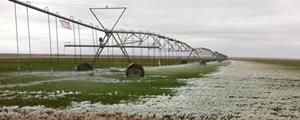
Last Tuesday, April 15, was the coldest "Tax Day" nationwide on record. Hard freezes extended as far south as northern Texas. Mid-April snows were seen throughout the Corn Belt states. Columbus, Ohio had nearly four inches of the white stuff on Tuesday, its heaviest snowfall ever for so late in the spring season. Traces of snow were reported in the Texas Panhandle, Arkansas and Tennessee. Even northern Louisiana had a few flakes. Detroit, Michigan set a seasonal snowfall record on Tuesday.

A hard freeze in the southern Great Plains on Tuesday produced temperatures between 21 and 24 degrees at Amarillo, Dalhart, Perry and Lubbock, Texas. Near Gage, Oklahoma, one rancher reported 18 degrees. Ponca City, Oklahoma dipped to a record low of 21 degrees for April 15.

In Kansas, the nation's leading wheat producing state, already plagued by winterkill this harsh winter of 2013-14 that refuses to end and parching drought, there were reports of morning lows near 15 degrees both Monday and Tuesday. It was a frigid 13 degrees at Valentine, Nebraska.

Jointing wheat was damaged by the record cold early this past week in Kansas, Oklahoma and Texas, especially in those areas where the mercury plunged into the teens and lower 20s for several hours. Any wheat heading out can be at risk even at readings near 30 degrees. Fortunately, there was very little wheat heading out despite recent 90 degree temperatures in the southern Great Plains.

Attention

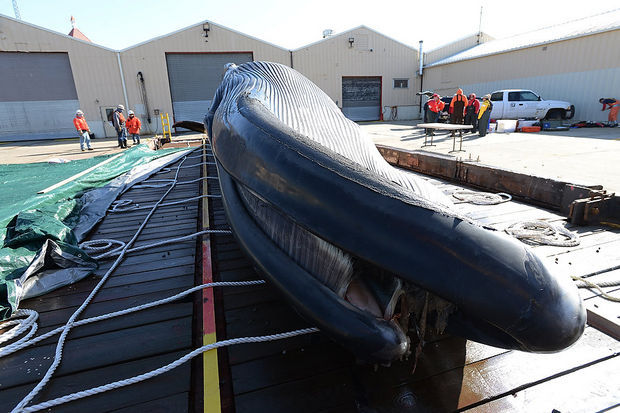
Whale found dead in Port Elizabeth harbor to be brought to Jersey City for necropsy

Image
© Reena Rose Sibayan/The Jersey JournalA whale that was found dead in New York Harbor was transported to the U.S. Army Corps of Engineers facility at Caven Point Marine Terminal in Jersey City where marine veterinarians performed a necropsy to find out the cause of death, on April 16, 2014.
A 30- to 35-foot whale found dead in the water in the area of Port Elizabeth will be brought to Caven Point Terminal in Jersey City tomorrow where a necropsy will be performed, a spokesman for the Army Corps of Engineers said.

The Army Corps of Engineers was notified on Monday by the National Oceanic and Atmospheric Administration that the dead whale had been spotted, Corps spokesman Chris Gardner said today. The Corps has lashed the whale to one of its barges used to collect drifting debris in the harbor in order to keep the whale from disrupting ships' navigation, Gardner said.

Gardner said the whale will either be towed or lifted by a drift collection vessel and brought to Jersey City where it will be placed on land for the necropsy. He said he did know what type of whale it is but said officials have it narrowed down to several possible species.

The spokesman said he did not know if the whale had any visible signs of injury such as from a boat propeller and said that will be determined tomorrow. Gardner said the whale was not brought ashore today due to the rainy weather because the necropsy will be performed outdoors. Moving the whale tomorrow will be contingent on the weather as well.

Necropsy is another word for autopsy and is used with reference to animals.

Attention

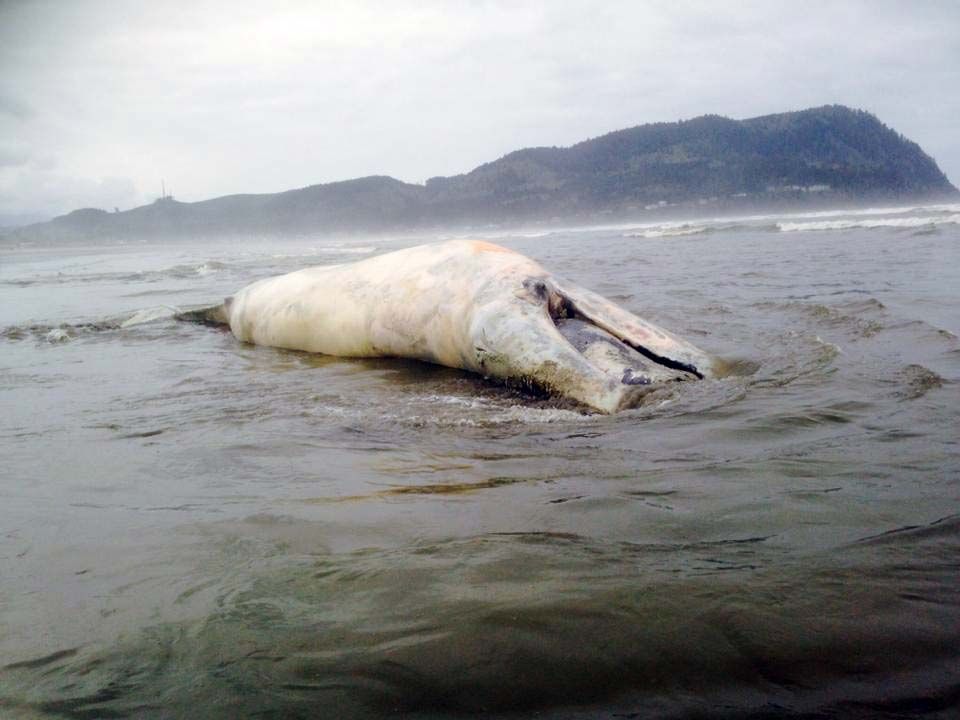
40-Foot gray whale washes up on Oregon Coast

Image
© Matt FletcherA dead gray whale washed ashore on the Oregon Coast on Tuesday.

A dead, decomposing 40-foot gray whale washed ashore in the Oregon Coast town of Seaside on Tuesday morning, and marine experts advise staying away from the massive carcass because it's "really nasty."

Keith Chandler, a marine mammal expert from the Seaside Aquarium, said the whale has been dead for "quite some time."

"It's really smelly. We're quite a ways from it and I can smell the whale," Chandler said.

Dr. Debbie Duffield from Portland State University will collect samples on the dead whale and try to determine its cause of death.

Once marine experts have finished collecting all the data they need, the city of Seaside will likely bury the whale. Chandler said it will be a challenge.

Attention

Dead pilot whale washes up near Coopers Beach, Southampton

Image
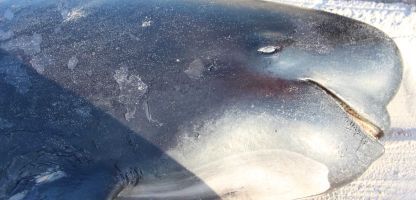
© Riverhead FoundationA 15-foot dead pilot whale was discovered Sunday, April 13, 2014 on a beach in Southampton near Cryder Lane, according to the Riverhead Foundation for Marine Research and Preservation, which returned to the beach Monday to conduct a necropsy on the whale.
A 15-foot dead pilot whale was discovered Sunday on a beach in Southampton near Cryder Lane, according to the Riverhead Foundation for Marine Research and Preservation.

Robert DiGiovanni, the foundation's executive director and senior biologist, said researchers took a few samples Sunday, and that he was headed back to the beach Monday morning with a crew to conduct a necropsy on the whale.

"We'll do as much of a necropsy as we can, but it's going to have to remain on the beach," he said.

DiGiovanni said the Southampton Highway Department was able to move the animal further up on the beach, so it wouldn't wash away, but the whale is too large for researchers to take to the foundation's necropsy lab in Riverhead.

The team will look first for any external injuries, and then take more samples before disposing of it, DiGiovanni said.

DiGiovanni said the foundation usually sees one to two pilot whales wash ashore each year.