Volcanoes
S


Airplane

Iceland lowers alert for erupting volcano and reopens airspace

Iceland Bardarbunga volcano
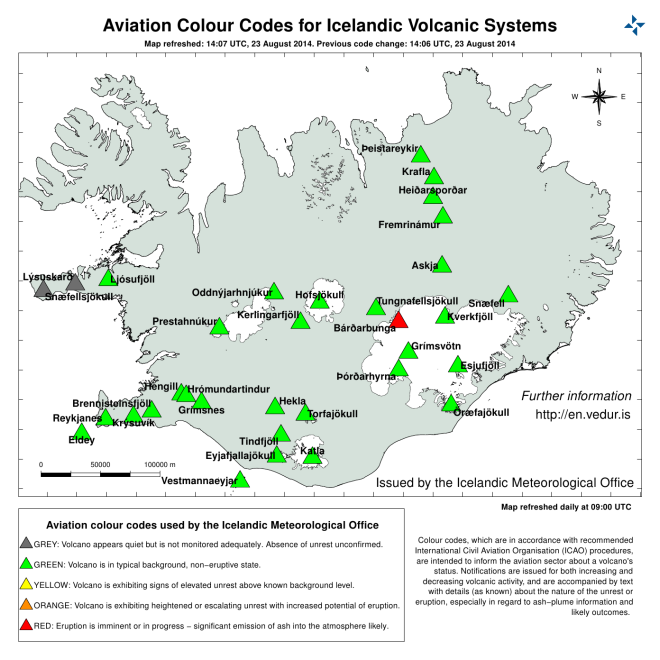
The Icelandic Met Office has lowered its aviation warning from red to orange near the Bardarbunga volcano, which saw an eruption begin overnight.

The new alert, the second-highest, means that aviation authorities can now decide if planes may travel over the volcano's airspace.

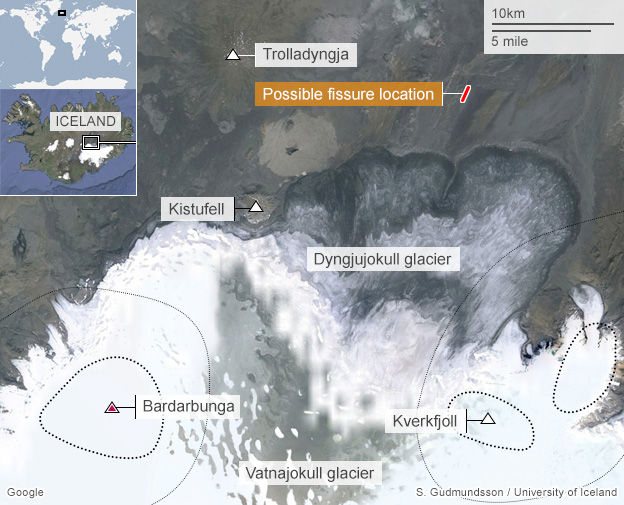
Scientists said a fissure eruption 1km (0.6 miles) long started in a lava field north of the Vatnajokull glacier.

The volcano has been hit by several recent tremors.

The Icelandic Met Office confirmed to the BBC that since no ash was detected in emissions from the volcano's eruption, it was now possible to downgrade the earlier alert level.

Civil protection officials said Icelandic Air Traffic Control had closed the airspace above the eruption up to a height of 5,000ft (1,500m), but now some aircraft will be able to pass over the volcano if aviation authorities give airliners the go-ahead.

The fissure eruption took place between Dyngjujokull Glacier and the Askja caldera, according to a statement from the Department of Civil Protection.

Attention

Sub-glacial eruption of Iceland's Bardarbunga volcano forms deep 'cauldrons' of melted ice

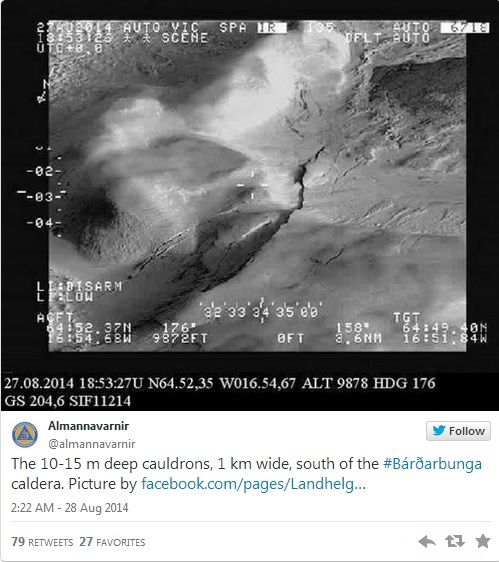
Icelandic volcano activity increased on Wednesday, with scientists detecting 10-15 meters deep cauldrons of melted ice at the Vatnajökull glacier, prompting fears of an imminent eruption.
Image
© Reuters / Sigtryggur Johannsson

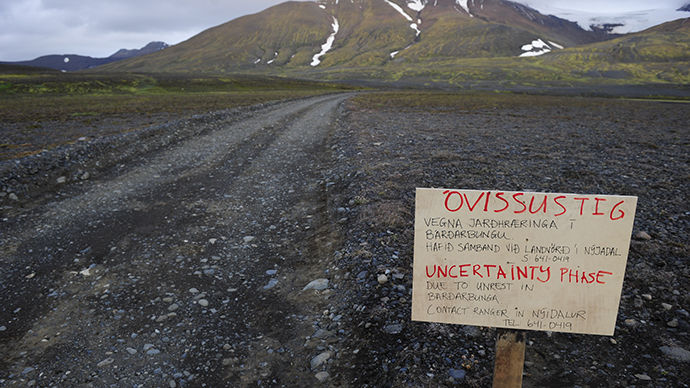
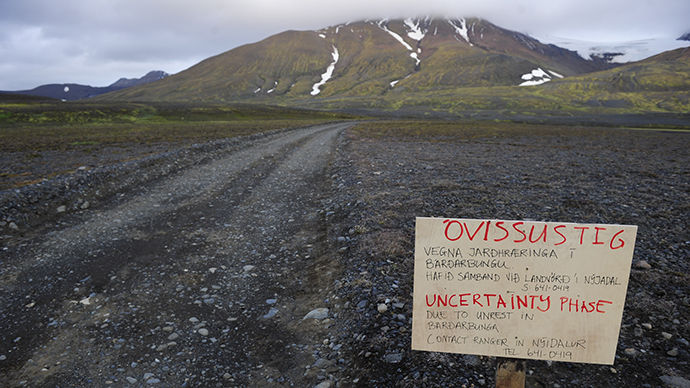
A warning sign blocks the road to Bardarbunga volcano, some 20 kilometres (12.5 miles) away, in the north-west region of the Vatnajokull glacier August 19, 2014.
Icelandic scientists have detected a series of 10-15m deep cauldrons at Bardarbunga volcano glacier. They apparently are a result of melting following a sub-glacial eruption, the Icelandic Civil Protection Scientific Advisory Board reported. A surveillance flight over the surface of Vatnajokull has shown the cauldrons to be 1 km wide, located in a straight line some 4-6 kilometers south of the Bardarbunga caldera.
The 10-15 m deep cauldrons, 1 km wide, south of the #Bárðarbunga caldera. Picture by https://t.co/ZiKocZlLJSpic.twitter.com/lSLWDJZnEO
- Almannavarnir (@almannavarnir) August 28, 2014
"The cauldrons have been formed as a result of melting, possibly a sub-glacial eruption, uncertain when," country's Meteorological Office said, pointing out that the data is still being analyzed.

"During the night (Wednesday) we have had three larger events, two of them in the Bardarbunga caldera. Those were 5.2 and 5.3, and very similar to the events that we have seen there before," Palmi Erlendsson, a geologist at the Met Office told the country's RTE news.

At the same time, scientists have registered more than 1,300 earthquakes since midnight Wednesday. Meanwhile 50km to the north, a 4.5 magnitude quake shook the Askja volcano, presumably because magma from Bardarbunga crater is traveling in that direction.

Comment: Earthquakes, volcanic eruptions, sinkholes and flooding all in one: Iceland examines Bardarbunga volcano 'cauldrons'


Bizarro Earth

Earthquakes, volcanic eruptions, sinkholes and flooding all in one: Iceland examines Bardarbunga volcano 'cauldrons'

barbarbunga cauldrons
Scientists in Iceland say they are examining several 'cauldrons' found near Bardarbunga volcano, which could potentially be a sign of an eruption.

The cauldrons, depressions in the volcano's surface, each between 10-15m (49 ft) deep and 1km (0.6 miles) wide, were seen during a flight on Wednesday.

Iceland's Met Office said they were formed "as a result of melting, possibly a sub-glacial eruption."

Bardarbunga volcano has been hit by several recent tremors.

The area experienced a magnitude 5.7 earthquake on Tuesday. Experts say these earthquakes are caused as magma flows beneath the ground, cracking the rocks as it moves.

The Met Office has kept its aviation warning level - indicating the potential threat of volcanic activity to air travel - at orange, its second-highest.

Comment: Iceland's Bardarbunga volcano: Magma moving towards new volcanic system


Attention

Iceland's Bardarbunga volcano: Magma moving towards new volcanic system

monitoring volcano
The University of Cambridge is monitoring the area with 70 seismometers
The magma from Iceland's Bardarbunga volcano could be moving towards another large volcanic system.

Data recorded by a team from the University of Cambridge suggests that 50 million cubic metres of molten rock has moved in the last 24 hours.

If it continues on a northern trajectory it could feed into the Askja volcanic system, potentially triggering a large eruption.

Prof Bob White said: "It's headed straight for it."

But he cautioned that volcanoes were hard to predict.

"It's moving at about 4km a day towards Askja, and if it keeps going it will get there in a few days," he told BBC News.

"We know there is a lot of molten rock sitting under the ground beneath Askja, which is a major volcanic system. If this molten rock hits that, we know it is likely to trigger it to erupt.

"But who knows, it may just stop. It is still at 5km-depth, and it is possible it could freeze there and not a lot more will happen. That is perfectly plausible."

Comment: Click Play below to see the volcanic activity around the world map for the month of August. The Ring of Fire is active as well as the "usual suspects" in Europe:


Attention

Major seismic event imminent? Strange glowing lights seen by pilots over part of the Pacific Ring of Fire

Image
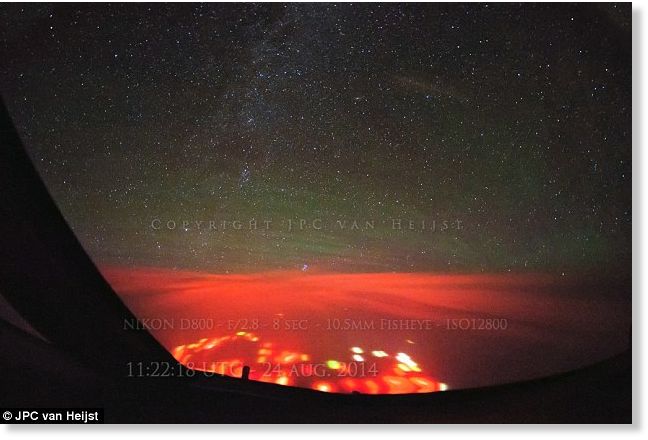
Strange lights have been spotted near the Russian peninsula of Kamchatka (image by Dutch pilot JPC van Heijst). The sighting was made by pilots flying from Hong Kong to Alaska. The glow came about 20 minutes after a vertical lightning bolt was seen
* Strange lights have been spotted near the Russian peninsula of Kamchatka

* The sighting was made by pilots flying from Hong Kong to Alaska

* The glow came about 20 minutes after a vertical lightning bolt was seen

* Dutch pilot van Heijst ruled out squid-fishing-boats as the origin

* He says the cause may have been an underwater volcano

* An ongoing investigation is taking place to find out what happened


A pilot and his co-pilot have spotted a mysterious orange and red glow over the Pacific Ocean.

The strange lights were spotted south of the Russian peninsula Kamchatka during the flight of a Boeing 747-8 from Hong Kong to Anchorage, Alaska.

And while no explanation has yet been given, it's thought that they may have originated from the explosion of a huge volcano under the surface of the ocean.

Comment: Note that the pilots saw "an intense flash of light like a lightning bolt, directed vertically up in the distance". While there was no thunderstorm in the area, this does not preclude some form of electrical discharge event, which can and have occurred in virtually cloudless skies. A photo of a 'blue jet', or sprite, was photographed above Australia a few days later.

What could the red blobs be then?

Note that they occurred at the same time as the string of strong earthquakes hit the western side of the Americas (California, Peru, and Chile, on August 24th). So these lights may be another form of 'earthquake lights' that appear with episodes of subterranean stress, pockets of illuminated plasma between charged layers of the atmosphere.


Bizarro Earth

Small lava-eruption detected under Dyngju­jök­ull glacier, near Bárðarbunga

Bárðarbunga
© mbl.is/Á​rni Sæ­bergBárðarbunga
A small lava-erupti­on has been detected und­er the Dyngju­jök­ull glacier. Dyngju­jök­ull is a part Vatna­jök­ull, not far from Bárðarbunga.

The Icelandic Co­ast Guard airpla­ne TF-SIF is flying over the area with representati­ves from the Civil Protecti­on and experts from the Icelandic Met Offic and the Institu­te of Earth Sciences. Data from the equip­ment on bo­ard is expected later today.

Data from radars and webca­meras are being recei­ved, show­ing no signs of changes at the surface.

The estima­te is that 150-400 meters of ice is abo­ve the area.

The aviati­on col­or code for the Bárðarbunga volcano has been changed from orange to red.

Comment: See: Icelandic Bárðarbunga volcanic eruption begins


Bizarro Earth

Iceland's Bardarbunga volcano erupts, airlines put on high alert

Eyjafjallajokull volcano
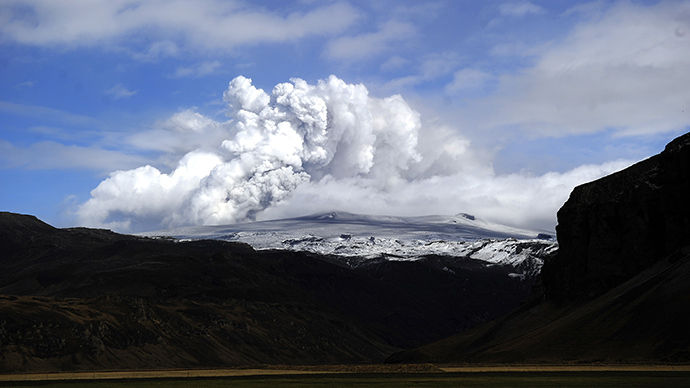
© Agence France-Presse/Emmanuel DunandArchive Photo: Smoke and ash bellow from Eyjafjallajokull volcano as it is seen from Asolfsskali, Iceland, on April 23, 2010
Iceland's Bardarbunga volcano began a small volcanic eruption as lava burst out underneath the Europe's largest glacier. In response, the government closed the airspace around the volcano, triggering fears of air chaos.

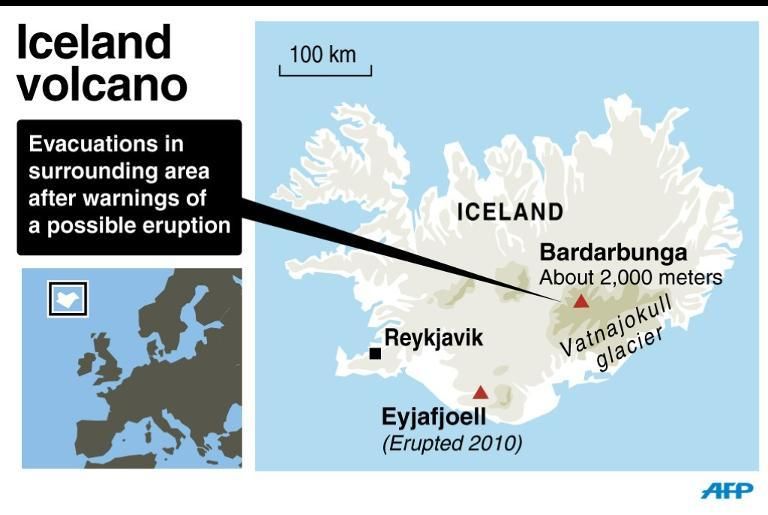
Iceland has issued aviation red alerts for Bardarbunga and authorities have evacuated the remote area 320 kilometers (200 miles) east of the capital of Reykjavik.

Following conflicting reports, the Icelandic Met Office confirmed the eruption under the Dyngjujökull glacier icecap in the northern part of Vatnajökull glacier.

The local authorities are keeping the country's airspace open, but have declared a no-fly zone of 100 nautical miles by 140 nautical miles around the eruption zone.

But, the no-fly zone could be expanded if the eruption melts the ice and spews volcanic ash.

Comment: This is the latest data point showing an intensification geological activity all over our Big Blue Marble:
  • Earthquake 'swarm' observed at remote Aleutian volcano - 5 volcanoes in Alaska are now simultaneously active
  • Authorities report volcanic eruptions and earthquakes intensifying in Kamchatka
  • Russian volcano Klyuchevskoy sends pillar of fire 1,000 meters into the air
  • Underwater Antarctic Volcanoes Discovered in the Southern Ocean
You can also check out earthquakes and volcanic activity over the past year below:


Bizarro Earth

Icelandic Bárðarbunga volcanic eruption begins

From the Icelandic Met Office

It is believed that a small subglacial lava-eruption has begun under the Dyngjujökull glacier. The aviation color code for the Bárðarbunga volcano has been changed from orange to red. Image follows.

Volcanic Eruption
© Icelandic Met Office

Blue Planet

Iceland's Bardarbunga volcano alert raised to red after signs of eruption

Image
© AFPMap showing Iceland where residents close to the Bardarbunga volcano have been evacuated after warnings of a possible eruption
Iceland raised its alert over the nation's largest volcano to red on Saturday, banning all air traffic in the area, after detecting a small eruption.

A major explosion at the Bardarbunga volcano could signal a replay of the global travel chaos triggered when another peak blew four years ago, creating a massive ash cloud across Europe.

"There is an ongoing eruption beneath the glacial surface, probably a small eruption which has not been able to melt the ice cap," Met Office official Theodor Hervasson said.

The authorities earlier this week evacuated tourists and hikers from the area around Bardarbunga, which kicked into seismic action on Monday with the biggest earthquake registered since 1996.

Comment: We'll find out soon enough... Gigantic Icelandic Volcano Could Plunge Europe Into Immediate Ice Age...


Alarm Clock

Iceland evacuates area near Bardarbunga volcano amid eruption fears

Bardarbunga volcano
© Reuters / Sigtryggur JohannssonA warning sign blocks the road to Bardarbunga volcano, some 20 kilometres (12.5 miles) away, in the north-west region of the Vatnajokull glacier August 19, 2014
Tourists were evacuated from around Iceland's Bardarbunga volcano, as seismic activity has increased in the area. The possibility of the volcano waking up has evoked memories of the 2010 aviation chaos, caused by another eruption in Iceland.

Seismic activity in the Bardarbunga vicinity has not been decreasing, the Icelandic Meteorological Office reported on Thursday.

"The highest magnitude during the last 24 hours was about 3.8, measured at 23:38 last night (20th August)", the agency's statement said.

There were around 1,000 small earthquakes detected in the area Wednesday that prompted the evacuation of about 300 tourists.

"The area is now closed and has been evacuated," Iceland's Civil Protection Authority said on its website. "These actions were taken following seismic activity around the Bardarbunga caldera in the last few days."

The agency also said it would carry out further air patrols over the volcano to make sure no one was left there.

If the volcano doe start to erupt, it would lead to the Vatnajokull glacier which sits over it melting.