On June 4, 2025, the Morning Midas — a cargo ship loaded with over 3,000 vehicles, including approximately 800 electric and hybrid models — was left adrift in the Pacific Ocean after catching fire 300 miles southwest of Alaska's Adak Island. Thankfully, all 22 crew members were safely evacuated. But the fire, reportedly starting on the vehicle deck, overwhelmed the vessel's onboard suppression systems and forced a total abandonment. The ship, flagged under Liberia and en route from China to Mexico, now floats like a ghost vessel — a monument to the hazards of our increasingly electrified obsession.
This latest incident is more than just a maritime mishap. It's a warning. A costly one, literally and figuratively, about the technological delusions driving climate-centric energy policies.
Let's not mince words: the proliferation of electric vehicles (EVs) is a politically engineered phenomenon. It's not market demand but bureaucratic fiat, massive subsidies, and regulatory cudgels that are flooding global supply chains with lithium-ion batteries. And when these batteries go up in flames, they don't just emit smoke — they torch the narrative that this energy transition is safe, sustainable, or rational.
After an unusually warm May, June has taken a sharp turn, bringing winter-like conditions to much of Iceland. Snow, strong winds, and poor visibility have prompted weather warnings across the country, and authorities are urging caution — especially for those traveling through mountainous areas.
As seen in accompanying photos from Þverárfjall and Fljót, the weather is far from what one might expect in early June.
Visibility has already dropped significantly on many roads and is expected to worsen. The National Commissioner of Police, in coordination with police departments across Northwestern, Northeastern, Eastern, and Southern Iceland, has declared a public safety uncertainty phase as of 10:00 a.m. yesterday evening. The decision follows forecasts of strong northerly winds set to persist over the next 24 hours.
Snowfall occurred on June 1 in the Ak-Say and Arpa valleys of Naryn region
A heavy snowfall was registered in Naryn region yesterday, June 1. The press service of the Ministry of Emergency Situations of Kyrgyzstan reported.
According to it, the 112 service received a message that a shepherd got stuck on Arpa pasture due to a sharp change in weather and heavy precipitations. Six more people were on Ak-Sai pasture at the time. All of them received first aid from rescuers and border guards.
The head of Kazybek village delivered hay for the animals to the herders.
The ministry reported that snow also fell on the 537-544th kilometers of Bishkek-Naryn-Torugart highway on June 1. The snow cover reached 15-20 centimeters, which created difficulties for transport. A grader was used to clear the road.
While parts of Massachusetts received several inches of rain on Thursday, up in New Hampshire, there was snow on the summit of Mount Washington.
The Mount Washington Observatory shared photos on their Facebook, adding that more than 4 inches of snow fell on the summit. Ten inches of snow fell on Friday and by the end of the weekend, the snow total could reach close to a foot.
Photos from the observatory show a New Hampshire State Parks truck and Mount Washington State Park sign covered in ice and snow.
According to a new study (Li et al., 2025), 98% of the Central Eurasia study area (40-65°N and 50-130°E) experienced significantly declining temperatures from 2004-2020.
Specifically, the region cooled by nearly -2.0°C - a rate of -1.425°C per decade - from 2004 to 2018.
The authors attribute the cooling trend to a 5.38% per decade increase in snow cover percentage (SCP) across the study area.
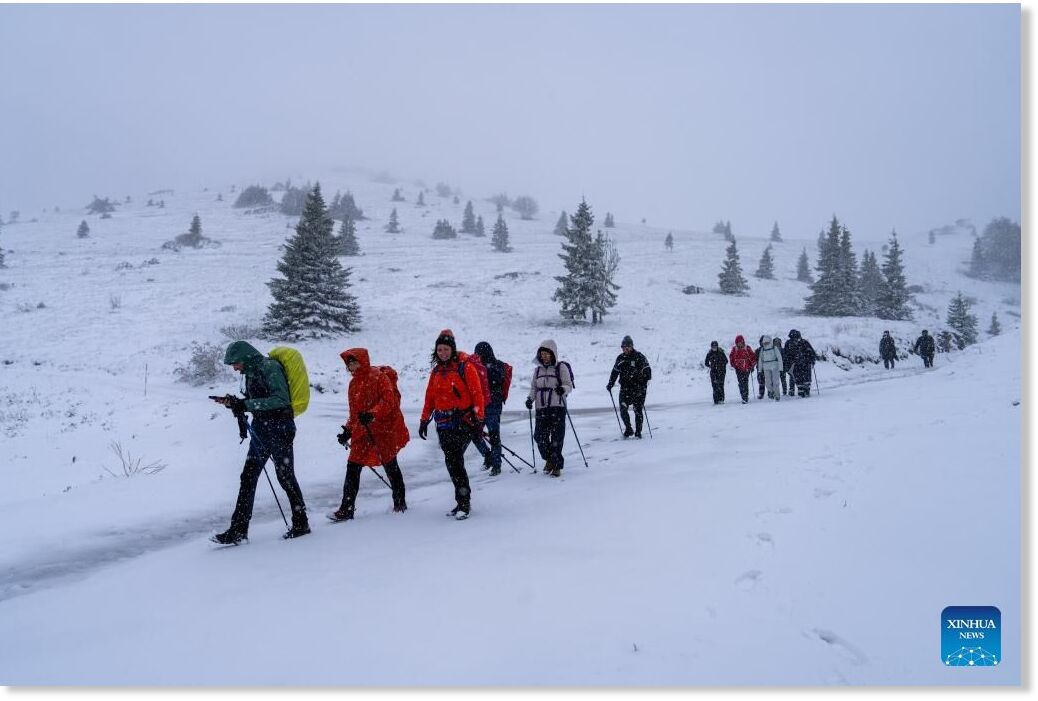
Snow fell in the Carpathians on May 9, and the air temperature dropped to minus 7°C.
Snow has been recorded in the mountains of Chernivtsi and Ivano-Frankivsk regions. On Mount Pip Ivan, the air temperature dropped to -7°C, visibility is limited, and rescuers are urging people to refrain from hiking in the mountains.
Snow was recorded in the mountains of Chernivtsi and Ivano-Frankivsk regions. The atmosphere there is as wintery as possible, the air temperature has dropped below zero, and on Mount Pip Ivan - it has dropped to -7. Ukrainians have begun to actively share photos and videos of snowy places. This is reported by UNN with reference to the State Emergency Service and social networks.
Comment: Related: June begins with wintry weather in Iceland