High StrangenessS


Cow

Cow's death remains a South Whidbey, Washington state mystery this weekend

Dead Cow
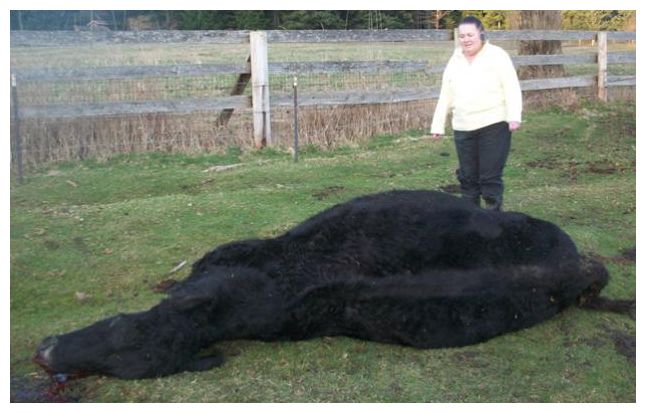
© Jim Larsen/The RecordDiane Schneider stands over her dead cow, a healthy animal with a calf that died suddenly Friday, intact except for a large patch of skin removed from one side of its face.
There's a whodunit on South Whidbey and it has nothing to do with Langley's Mystery Weekend.

This mystery involves a healthy black Angus cow found dead by its owner, Diane Schneider, on her farm near Midvale off Maxwelton Road.

"I've got 11," she said when asked how many cows she has. "I had 12 until just a few hours ago."

She was standing over the body of what was a healthy 6-year-old cow. She discovered its carcass lying in the corner of a muddy, grassy pasture. The other 11 cows, including the dead cow's 6-month-old calf, huddled next to a fence near the house.

Schneider fed the cows that morning and found the dead one at 1 p.m. The cow's calf was still at its side.

"The calf was suckling even though she was dead," Schneider said, estimating the value of the cow at $1,500.

"It can eat by itself," she added, referring to the calf.

There were no footprints from other animals near the dead cow, which looked like it could have been peacefully lying down to catch the last rays of the fading sun. There was nothing abnormal about it except for one side of its face. Something or someone had stripped away the hide on the left side of the face, from below the eye to the jawline.

Question

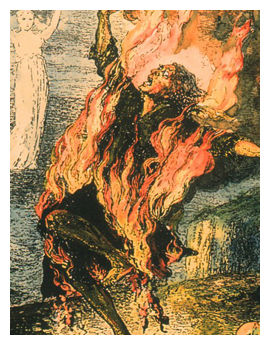
Spontaneous human combustion: A fire in the belly

Spontaneous Combustion
© Laphams Quarterly
In 1725, a tavern owner in Rheims, France named Jean Millet was accused of the murder of his wife. Millet's wife was overweight, past her prime, and Millet, an otherwise upstanding member of the community, was reputed to be interested in a young servant girl from Lorraine. When Mme Millet's remains were found smoldering in the kitchen one night - with only her legs, part of her head, a few large bones and some vertebrae identifiable - suspicion quickly fell to her husband, who was quickly tried, convicted, and sentenced to death.

Luckily for the tavern owner, he was saved at the last minute by one of his lodgers, a young and promising surgeon named Nicholas Le Cat, who argued that because Mme Millet was a known alcoholic, the likely cause of her death was not murder, but spontaneous human combustion. Millet was ultimately acquitted, though the ordeal left him destroyed, and he lived out the remainder of his life in a mental institution - haunted, perhaps, either by the fact that he had gotten away with murder, or that his wife really had, suddenly and without warning, burst into flames from too much drinking.

The evils of alcohol abuse have long been known and preached against by the more sober-minded, but for a period of about two hundred years imbibers had a particularly dire consequence to fear: that too much drinking would cause them to catch fire and be reduced to a small pile of greasy ash. A few decades after the Millet trial, on the evening of June 20, 1745, Countess Cornelia Zangari de Bandi of Cesena, of Verona, also burned to death. She was sixty-two years old; she went to bed at a normal hour, but when the maid came in the following morning, she found the Countess's "corpse on the floor in the most dreadful condition.

At the distance of four feet from the bed there was a heap of ashes. Her legs with the stockings on remained untouched and the head half-burned lay between them. Nearly all the rest of the body was reduced to ashes." The scene was noteworthy in that it many details defied conventional understandings of pyrotechnics: "A small oil lamp on the floor was covered with ashes, but had no oil in it, and, in two candlesticks which stood upright upon a table, the cotton wick of both the candles was left, and the tallow of both had disappeared." The bed was disturbed as if she had just risen from bed, but neither it, nor any other item in the room, showed any trace of fire. As with Millet's wife, the Countess was a known drinker.

Question

Van Lear's coal mining ghosts


Throughout the years, stories have filled the small communities of coal mining towns in Eastern Kentucky, whose lifeblood has always been the coal industry.

But a different story fills the air in Van Lear, a small community tucked away in Johnson County.

In Van Lear along the stretch of the road sits a museum. A place that houses a part of this community's history. But between the walls, you'll find something else... a ghost story.

"We hear walking all the time, we hear talking all the time. I've seen full-body apparitions," said Tina Webb, a museum volunteer.

The people who work at the coal miner's museum say they have no doubt spooks and specters are permanent visitors.

Question

Wales: Can you solve the mystery of the Beast from the East?

Mystery Beast
© Western Telegraph, UK
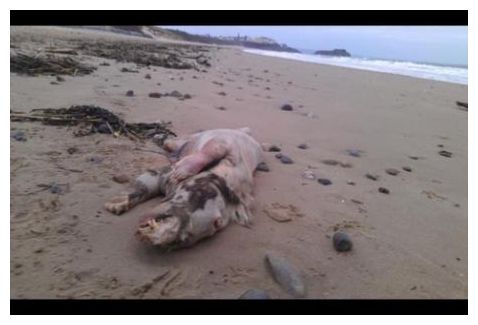
This mysterious creature was washed up on Tenby's South Beach over the weekend.

The photographs were taken by 27 year-old Peter Bailey from Tenby who was walking his dog along the beach on Friday evening.

He told the Western Telegraph: "I was taking my dog for her evening walk across the south beach when she started acting out of character by howling and running round in circles.

"I ran up to her to see if she was ok and then I came across this hideous looking carcass. I could see it had little hair left on it's decomposing body.

"Immediately I thought it was a horse but it had claws like a bear and a body of a pig. Surprisingly it didn't smell."

Do you know what this strange Beast from the East could be? Leave your comments below.

Question

Writings shed new light on 'Nessie's cousin' Morag

Nessie
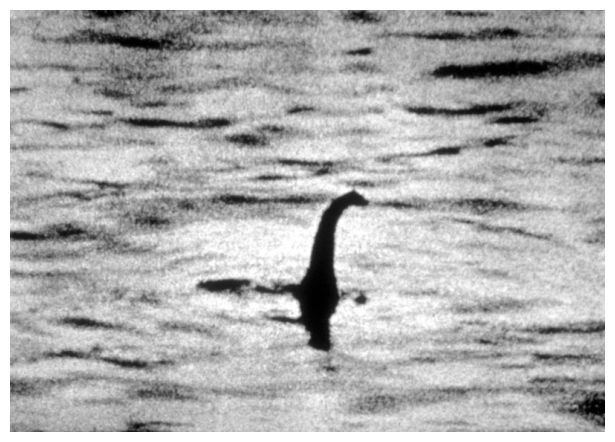
© Scotsman.comWhile many have heard of Nessie, few have heard of his 'cousin' Morag, of Loch Morar.
Some of the earliest-known writings on Nessie's less well-known cousin shed new light on the community which lived in its shadow more than 100 years ago, according to the researcher who uncovered them.

Morag, a mysterious creature supposed to inhabit the depths of Loch Morar, in the Highlands, is the subject of three separate writings from Alexander Carmichael, a prolific gatherer of folklore in his day.

The scripts, believed to date from 1902, have been uncovered by the Carmichael Watson project at the University of Edinburgh library.

Dr Donald Stewart, a senior researcher on the project, discovered the texts while leafing through a "mad mixture" of folklore collected by Carmichael over 50 years.

"We were so pleased when we found them, it was just totally unexpected," he said.

The writings paint a conflicting view of Morag. On the one hand she is presented as a mermaid-like character with flowing hair, while another description paints her as a grim reaper whose sighting was viewed as a death omen.

In the first text, Carmichael states: "Morag is always seen before a death and before a drowning."

Question

'Ghost' caught on CCTV video at 'haunted' community centre in South Ruislip, England


Spooky CCTV footage showing a ghostly figure leaving a community centre in north-west London is creating a stir online.

The video shows a slim man suddenly appear outside the entrance of South Ruislip Community Association and Community Centre on February 1.

It captures the transparent figure walking calmly towards a metal railing before seemingly disappearing into thin air.

Question

Vittorio Missoni's disappearance gives rise to new fears of Bermuda Triangles worldwide

USS Cyclops
© Apic/Getty Images
When ships and planes mysteriously vanish -- sometimes without a trace -- speculation runs wild.

Many worry about the conventional -- pilot error, kidnapping and terrorism come to mind. And there are those who worry about the supernatural.

Acclaimed fashion designer Vittorio Missoni and five others boarded a twin-engine BN-2 Islander aircraft in the Los Roques island chain -- pictured below -- near Venezuela on Jan. 4. They were headed for Caracas and had only flown about 11 miles when they vanished into thin air.

Extinguisher

Oklahoma man dies in fire, spontaneous combustion not ruled out as cause

Oklahoma human combustion
© NewsOn6.comPhoto of the deceased's home, from CBS-affiliate in Fort Smith, KFSM.
The Sheriff in an eastern Oklahoma county said his office is investigating what could be a case of spontaneous combustion.

Sequoyah County Sheriff Ron Lockhart told News On 6 that deputies were called to a house on Bawcom Road, between Sallisaw and Muldrow, around 10:50 a.m. Monday. A neighbor had reported seeing smoke coming out of a home.

Lockhart said they found the nearly completely charred remains of a man in the kitchen, but that there was no other damage done to the home.

The man has been identified as 65-year-old Danny Vanzandt, according to CBS affiliate in Fort Smith, KFSM.

Sheriff Lockhart spent about 20 years as an arson investigator for the Fort Smith, Arkansas Police Department, before retiring to run for Sheriff in Sequoyah County. Lockhart said he'd never seen anything like it. He said it didn't seem that any accelerant was used and only the floor below Vanzandt's body was damaged.

Question

Mysterious stars talk of the town in Arnhem Land

Mystery Stars
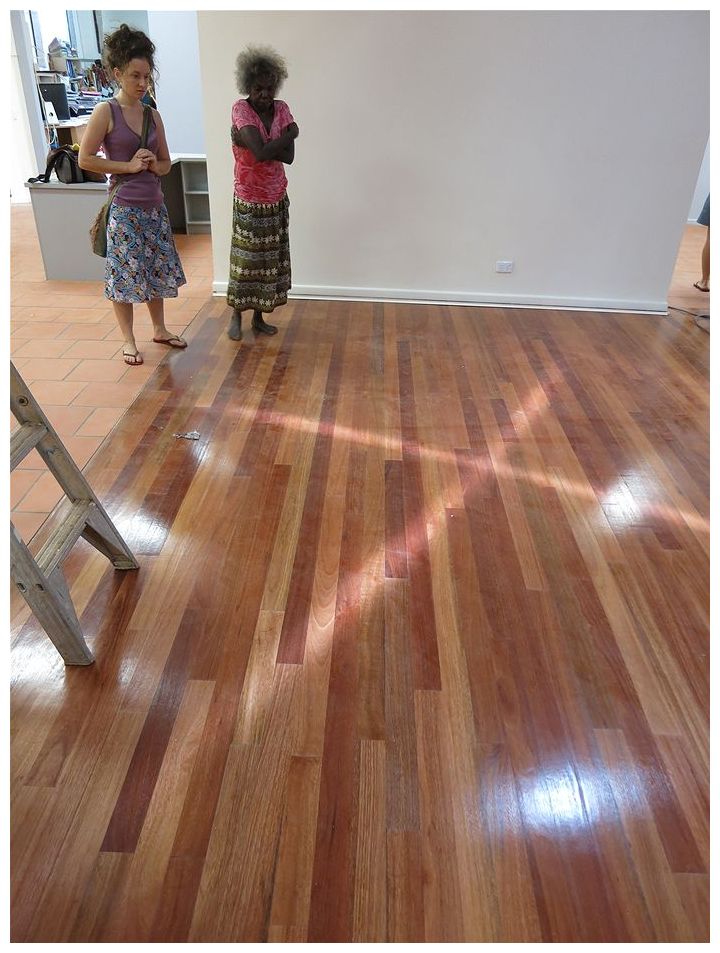
© Miranda TetlowMulthara Mununggurr and Angela Madden inspect the stars.
An Aboriginal arts centre in the Northern Territory is at the centre of a cosmic mystery.

Every morning at 11:30 a series of stars lights up the floor at the arts centre at Yirrkala in north east Arnhem Land.

No one has been able to explain why the stars appear and the locals believe they may be a message or a blessing from an Aboriginal artist who passed away last year.

Will Stubbs is manager at Buku-Larrngay Mulka and says it's hard to explain.

"We've only just noticed it in the last few weeks," he says. "The floor gets illuminated with star shapes that are very, very similar to the star shapes painted by a very important artist who passed away last year.

Question

Russia's Dyatlov Pass incident, the strangest unsolved mystery of the last century

Dyatlov Pass_1
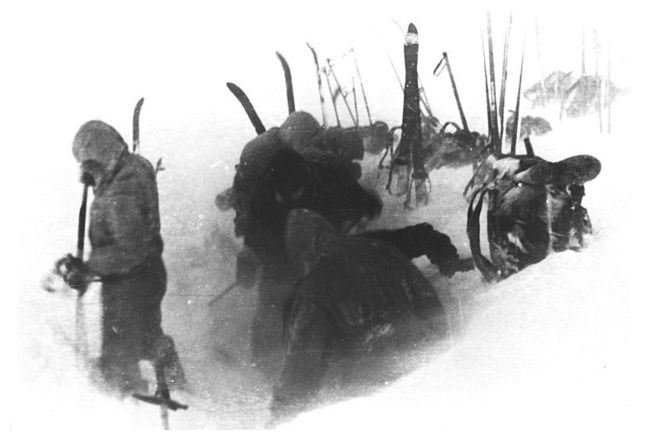
© Motherboard Vice.comThis photo developed from a found roll of film shows the group setting up their final camp on February 2, 1959.
Nearly 1,000 people were injured in Russia today when a meteor exploded somewhere over the Ural Mountains. But crazy cosmic phenomena are nothing new in the Ural range: 54 years ago this month, the northern part of the Urals played host to one of the most fascinating unsolved mysteries in the modern age.

On the surface, what's become known as the Dyatlov Pass incident seems fairly explicable: Of a party of ten skiiers, nine perished in the middle of a high-difficulty trek in conditions that reached -30 degrees Celsius. But the details, which are mostly based on diaries of those involved as well as records from Soviet investigators, are chilling: On the night of February 2, 1959, members of the party apparently ripped their tent open from the inside, and wandered into the tundra wearing nothing but what they wore to bed.

Three weeks later, five bodies were found, some hundreds of meters down a slope from the original camp. It took two more months for investigators to find the other four bodies, which, curiously, were partially clothed in articles belonging to the earlier-discovered dead. Tests of those clothes found high levels of radiation. Despite that, and heavy internal trauma, including fractured skulls and broken ribs, suffered by some members of the party, Russian investigators reported they could not find evidence of foul play, and quickly shut the case.