
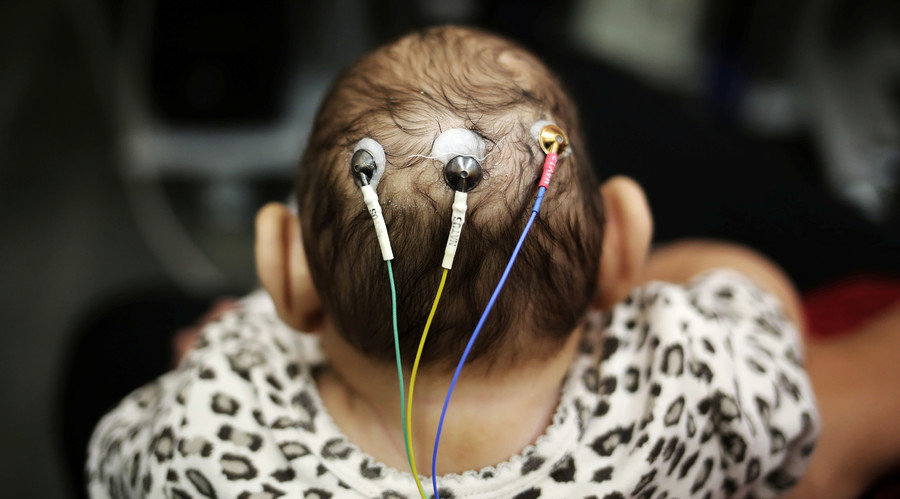
© Nacho Doce / ReutersFive-month-old Laura born with microcephaly undergoes a medical test.
Suspicions have been held for a while, especially after a rise in cases in Brazil and elsewhere, in which the mother of a newborn infected with microcephaly was often found to have been bitten by a Zika mosquito. Now scientists with the Institute of Genetics and Development Biology of the Chinese Academy of Sciences and the Institute of Microbiology and Epidemiology under the Academy of Military Medical Sciences say they have found a direct connection, CCTV reports.
They did this by studying the effect of the virus on fetal mouse brains, after pulling a sample from a Chinese patient. Xu Zhizheng of the Academy of Sciences says the virus felt right at home, quickly spreading and infecting neural stem cells. This led to an abnormal proliferation and differentiation of the cells, leading to neural death. As soon as the mouse embryos were carried to term, all of the symptoms associated with microcephaly manifested themselves as suspected, along with genetic abnormalities.
"We hope the model can be used in drug and vaccine tests, helping with the prevention and treatment of Zika infection," said Qin of the Institute of Microbiology and Epidemiology.
The findings were published in the Cell Stem Cell journal.

















Comment: The Health & Wellness Show: The Zika Virus: Hype vs. Reality