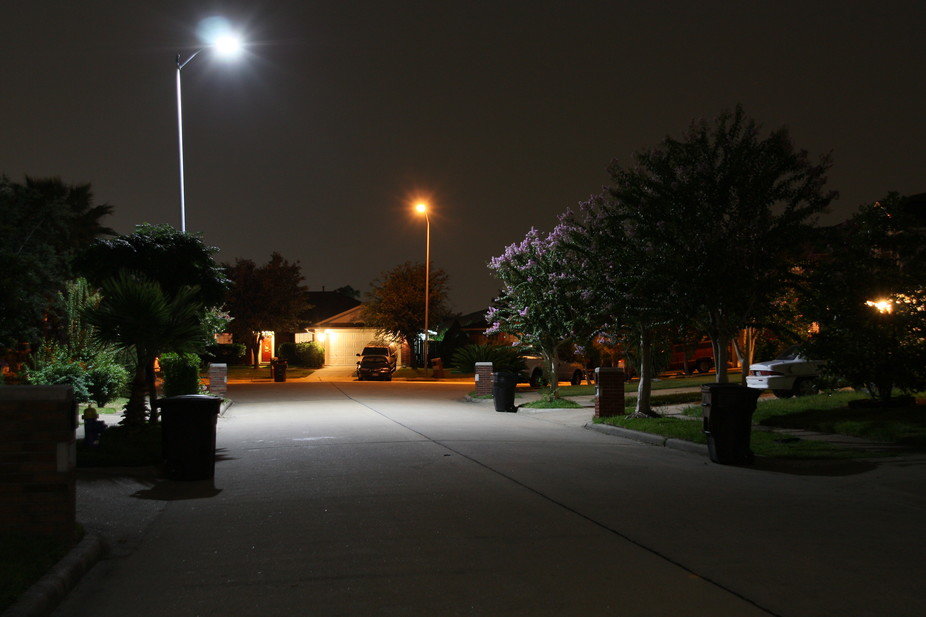
© meltedplastic/flickr, CC BY-NC-NDNew LED-based streetlights are whiter than traditional ones and contain more blue light, which can disrupt people’s circadian rhythms.
The American Medical Association (AMA) has just adopted an
official policy statement about street lighting: cool it and dim it.
The statement, adopted unanimously at the AMA's
annual meeting in Chicago on June 14, comes in response to the rise of new LED street lighting sweeping the country. An AMA committee issued guidelines on how communities can choose LED streetlights to "minimize potential harmful human health and environmental effects."
Municipalities are replacing existing streetlights with efficient and long-lasting LEDs to save money on energy and maintenance. Although the streetlights are delivering these benefits, the AMA's stance reflects how important proper design of new technologies is and the close connection between light and human health.
The AMA's statement recommends that outdoor lighting at night, particularly street lighting, should have a color temperature of no greater than 3000 Kelvin (K).
Color temperature (CT) is a measure of the spectral content of light from a source; how much blue, green, yellow and red there is in it. A higher CT rating generally means greater blue content, and the whiter the light appears.
A white LED at CT 4000K or 5000K contains a high level of short-wavelength blue light; this has been the choice for a number of cities that have recently retrofitted their street lighting such as
Seattle and
New York.
But in the wake of these installations have been complaints about the harshness of these lights. An extreme example is the city of Davis, California, where the residents demanded a
complete replacement of these high color temperature LED street lights.
Can communities have more efficient lighting without causing health and safety problems?

















Comment: Additional articles that clearly show There is no 'safe' exposure to radiation: