Health & WellnessS


Info

Dr. Gary Kohls: Big Pharma and the causes of Parkinson's Disease

big pharma drugs
An open letter to a son whose father has Parkinson's Disease

Recently I read an online essay that was written by a person whose father has had progressive Parkinson's disease for several decades. The tone of the essay was one of despair, confusion and frustration from a son who truly loved his father and would do anything to help him.

Given the fact that a lot of the medical information that is on the internet comes from Big Pharma websites, the author understandably repeated many of the myths about Parkinson's disease, such as the "no known cause" myth or the "it might be genetic" myth.

However, in the middle of the essay, the author did reveal that his dad had been a farmer in his younger years and had been exposed to some of the common agribusiness-promoted neurotoxins (such as insecticides and herbicides) that seem to have been accepted by the industry as normal parts of farming. Of course, physicians have known for a long time that neurodegenerative disorders like Parkinson's disease are one of the occupational hazards of farmers who are exposed to neurotoxins like farm chemicals, solvents and heavy metals.

So, wanting to encourage the author to keep on with his research, I wrote a note to him. As is my wont, the note turned into a 2500 word essay. I submit it below, keeping in mind Dr Marcia Angell's wisdom:
"It is simply no longer possible to believe much of the clinical research that is published, or to rely on the judgment of trusted physicians or authoritative medical guidelines."


Dollars

Big Pharma's latest marketing scam - leading lobby group will spend hundreds of millions to keep drug prices high

pill box
© Dvortygirl/flickr/ccA recent poll found that more than three in four Americans believe that prescription drug prices are "unreasonable."
"PhRMA's decision to hike membership dues 50 percent will increase the trade group's considerable coffers to more than $300 million per year," Politico reports

Facing an increasingly outraged public, the leading Big Pharma lobby group is hiking its annual dues by more than 50 percent as it prepares to defend its pharmaceutical company members against lawmakers and voters who want to rein in out-of-control drug prices.

Politico reported Tuesday that "PhRMA hopes to improve its public image next year and stave off any legislative action" in the wake of recent public scandals like those over EpiPen and Valeant. "It plans to run TV ads emphasizing how new drugs could add years to patients' lives, as well as the years of complex research needed to develop a drug—in other words, a lot of money that must be recouped through high prices."

To do so, it needs some extra cash.

Comment: Courtesy of Big Pharma: The most expensive medicines in the world:
So why is drug price gouging such a serious problem across the US pharmaceutical industry? US laws, the current state of medical insurance, Medicare, and drug research are all parts of the problem, leaving the little to no oversight in how much drug makers can charge for their drugs.
"As opposed to other countries, American laws actually prevent the government from restraining drug prices. Federal law even prevents the single largest drug buyer - Medicare - from negotiating drug prices. This is a perfect example of how Big Pharma has successfully manipulated laws in such a way that they can operate completely unrestrained in the US, under the flimsy argument that high prices and profits are required in order to fund costly research to develop potentially groundbreaking drugs to treat our ever-proliferating ills." Source
Because the FDA has become little more than a revolving door for the pharmaceutical industry to continually grant itself special privilege, the natural checks and balances of the market do not apply and we see seemingly insane price differences when compared to other markets.
According to New York Times columnist Nicholas Kristof, the drug industry spent $272,000 in campaign donations per member of Congress last year. He reports that there are more drug company lobbyists than members of Congress. Even before Gilead's $1000-a-pill hepatitis drug, the result of this unsavory lobbying is a $50 billion annual taxpayer gift to the drug industry - a fact that should outrage every taxpayer.


Microscope 1

The science of psychobiotics

psychobiotics
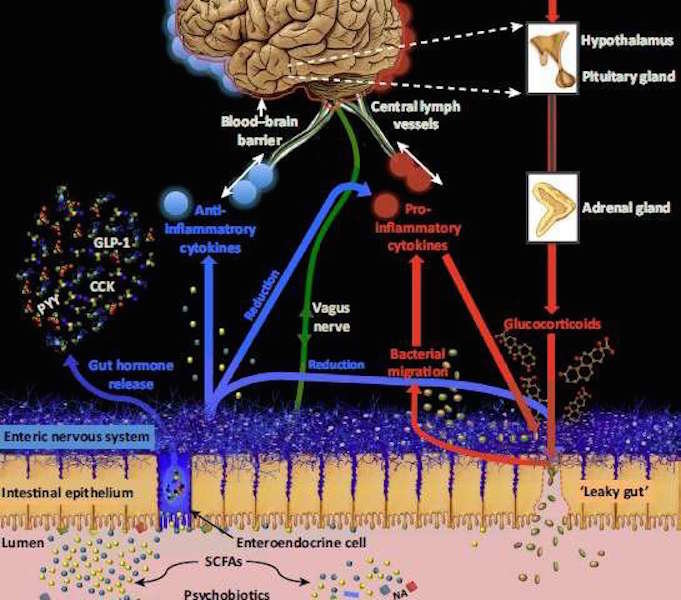
Now that we know that gut bacteria can speak to the brain—in ways that affect our mood, our appetite, and even our circadian rhythms—the next challenge for scientists is to control this communication. The science of psychobiotics, reviewed October 25 in Trends in Neurosciences, explores emerging strategies for planting brain-altering bacteria in the gut to provide mental benefits and the challenges ahead in understanding how such products could work for humans.

Psychobiotics is a recent term. While it's been known for over a century that bacteria can have positive effects on physical health, only studies in the last 10-15 years have shown that there is a gut-brain connection. In mice, enhanced immune function, better reactions to stress, and even learning and memory advantages have been attributed to adding the right strain of bacteria. Human studies are more difficult to interpret because mood changes in response to probiotics are self-reported, but physiological changes, such as reduced cortical levels and inflammation, have been observed.

Comment: More information on how gut bacteria can speak to the brain:


Bacon n Eggs

Children need fat to absorb vital vitamins

tim noakes
Tim Noakes
Children should not be on low-fat diets as their bodies need vital vitamins which can only be absorbed by fat, the hearing into Professor Tim Noakes's conduct was told 
yesterday.

Nina Teicholz, investigative journalist and author of The Big Fat Surprise, was on the stand in Noakes's hearing, where he is accused of unprofessional conduct by the Health Professionals Council of SA.

Teicholz said the only way she could see the world overcoming the obesity and diabetes epidemic was if people went back to eating like they did in 1965, before carbohydrate-based dietary guidelines came into play.

Noakes is facing a charge of unprofessional conduct after he responded to Pippa Leenstra's tweet that babies should be weaned on to a low-carbohydrate, high-fat (LCHF) diet.

Leenstra had tweeted him and nutritional therapist Sally-Ann Creed asking if it was safe for breast-feeding mothers to be on the Banting diet.

Comment: The hearing continued and in fact, The Health Professions Council of South Africa incorrectly announced on Friday that Professor Tim Noakes had been found guilty of unprofessional conduct. Shortly afterwards, they retracted their statement and apologized:
The HPCSA sent out its initial press release that caused mass confusion just before 13:00, and only retracted it at 16:20.

"We apologise for incorrectly stating that Prof Tim Noakes was found guilty by the Professional Conduct Committee," the second press release said.
Spoke too soon? Maybe someone actually cares about the facts? In any case, judgment on the matter would be issued on April 21, 2017.


Arrow Down

Study: US life expectancy trending downward

life expentacy
© Shannon Stapleton / Reuters
Life expectancy for Americans aged 25 to 85 is getting shorter, according to a new study. For 65-year-old males and females, expected lifespan has fallen by six months compared to projections in 2015, the study found.

The Society of Actuaries (SOA) released its latest annual mortality improvement scale for pension plans earlier this month. The scale is crafted using Social Security Administration data from 2012 to 2014 on mortality of Americans of all ages, and is used by pension plans to "help accurately measure pension obligations," said Dale Hall, SOA's managing director of research.

"The updated improvement scale suggests US mortality continues to improve, but at a slower average rate of improvement than previous years, which may decrease pension plan obligations slightly," SOA said, adding that the "updated improvement scale indicates a slight decline in life expectancy as a result of the slower average rate of mortality improvement."

Comment: Mortality rate of middle-aged white Americans increasing rapidly
Princeton economists, Anne Case and Angus Deaton who won the 2015 Nobel Memorial Prize in Economic Science, made an incredible discovery after a careful analysis of health and mortality data from the United States Centers for Disease Control and Prevention (CDC) and other sources between 1999 and 2013. They found that a group of middle-aged white Americans (ages 45 to 54) have an increased mortality rate that continues to increase. This trend is especially alarming as the death rate of other advanced countries, like the United Kingdom, have been declining by about 33 percent.

In the findings of the economists, education seemed to be a factor for the middle-aged white Americans. For those who had a high school diploma or below, the death rate increased by more than 20 percent. Compared with the mortality rate of this group prior to its previous rate from 1979 to 1998, about a half million lives have been lost between the 1999 to 2013 period to something other than chronic disease or aging - something that could have been avoided.

According to the study by Case and Deaton in the Proceedings of the National Academy of Sciences of the United States of America, the mortality rates of middle-aged white Americans has rapidly increased due to things that could have been avoided. After analyzing health and mortality statistics, they reported that the epidemic of alcohol/drug abuse, diseases formed from those abuses (such as liver disease), and suicide are to blame.


Heart

The miracle molecule nitric oxide and it's protective role

 Heart &  Stethoscope
© Chatham Daily News
My initial reaction to this news was "It's too good to be true". But three researchers received the prestigious Nobel Prize for its discovery. Louise J. Ignarro, one of the prize winners, says, "There may be no disease process where this miracle molecule does not have a protective role."

So what is this miracle molecule? And how does it protect us from so many diseases? To find out, I interviewed Dr. Nathan S. Bryan at The University of Texas, a world authority on this minute particle.

Bryan says that for 100 years researchers have known that nitroglycerine eased coronary pain by increasing blood supply to the heart's muscle. But it was a mystery why arteries expanded to allow this flow. Now we know it is due to a molecule, nitric oxide (NO), which when produced, sends messages to coronary arteries and to every cell in the body in nanoseconds.

Early in life we produce large amounts of NO in the endothelial lining (the innermost lining) of blood vessels. This keeps arteries expanded to permit a good supply of oxygenated blood to organs.

But after age 40, nitric oxide decreases, arteries constrict, causing hypertension and increased pressure injures the inner wall of coronary arteries. This damage results in a chemical and inflammatory reaction that kills one North American every 37 seconds, making heart attack the nation's number one killer.

Bryan adds this interesting fact. "Nitric oxide first attained star status when treating erectile dysfunction. ED is cured by drugs that produce NO, sending increased amounts of blood to the male organ."

But bringing more oxygenated blood to cells fights other common problems as well. Bryan claims decreased amounts of NO may play a major role in the development of Type 2 diabetes. Low levels of NO result in insulin resistance, making it difficult for insulin to enter cells to maintain normal blood sugar level. High blood sugar triggers heart attack, stroke, kidney failure, blindness, amputation of legs. Italian researchers discovered that diabetes patients with kidney disease had nitric oxide levels 37 percent lower than healthy people.

Comment: According to a study, cigarette smoke contains high concentrations of Nitric Oxide (NO):
NO from smoke may dilate the constricted airways, allowing the smoke an easier passage into the lungs

NO can endogenously be released by nicotine from nervous tissue, and may decrease the sympathetic output of the brain, which is associated with stress reduction.

(1) inhaled NO from smoke may be able to increase nicotine absorption, (2) NO released through nicotine reduces symptoms of stress, (3) NO endogenously released by nicotine increases post-synaptic dopamine levels


Syringe

Research finds male contraceptive jab almost 100% effective and could increase libido

sperm and egg
© THINKSTOCK
A contraceptive injection for men has been shown to be almost 100 per cent effective, and may also increase libido. The hormone-based jab is designed to lower sperm counts by acting on the brain's pituitary gland.


Comment: One has to wonder just what exactly is the active ingredient(s) which "act" on the brain's pituitary gland and what, if any, effects that action can have aside from lowering sperm counts. The pituitary gland plays a very crucial role in the body, and altering its hormone-producing job could be dangerous.


Over a year-long trial, nearly 96 per cent of couples relying on the injection to prevent unplanned pregnancies found it to be effective. During this time, only four pregnancies occurred among the men's partners.

However, researchers said more work was needed to address the treatment's reported side effects, which included depression and other mood disorders, muscle pain and acne. However it did also increase libido.

Dr Mario Festin, from the World Health Organisation in Geneva, Switzerland, said: "The study found it is possible to have a hormonal contraceptive for men that reduces the risk of unplanned pregnancies in the partners of men who use it.

"Our findings confirmed the efficacy of this contraceptive method previously seen in small studies."

Comment: Female contraceptives, such as birth control pills and intrauterine devices, are well-known to cause negative side effects in women. While it's important to find healthy forms of contraceptives, especially for men, researchers should be wary of doing more damage than it's worth.


SOTT Logo Radio

SOTT Focus: The Health & Wellness Show: What have we done? Antibiotic resistance in the age of superbugs

antibiotics
Alexander Fleming discovered penicillin 1928 and it became available for widespread use in 1945. Since then people have benefited from the use of antibiotics in curing infections that would have previously sent them to their graves. Now, however, this golden age is coming to an end. Top researchers state that we are entering into the post-antibiotic era. Superbugs such as MSRA and CRE are on the rise and becoming increasingly difficult -- if not downright impossible -- to treat with our current stock of antibiotics and new pharmaceutical options are few and far between.

Join us on this episode of the Health and Wellness Show where we'll discuss how is it that what was once a boon for humanity has become a scourge. Does the responsibility lie with Big Pharma, Big Ag, family doctors or ourselves? Has the medical industry painted us into a corner or is the answer to antibiotic resistance to be found elsewhere?

Stay tuned for Zoya's Pet Health Segment where the topic is raisin toxicity in dogs.

Running Time: 01:27:58

Download: MP3


Syringe

Male contraceptive pill works - but side effects halt trial

injection
© WestEnd61/REX/ShutterstockThe male contraceptive is administered as a jab.
An injected male contraceptive has been shown to be almost 100 per cent effective in a trial involving 320 men.

The hormone-based jab is designed to lower sperm counts by acting on the brain's pituitary gland.

Over a year-long trial, the injection was effective in nearly 96 per cent of couples. However, researchers said more work was needed to address the treatment's reported side effects, which included depression and other mood disorders, muscle pain, acne and increased libido.

2 + 2 = 4

Hospitals struggle to address terrifying and long-lasting 'ICU delirium'

hospital icu
© STAT, APStockAlex Hogan
When his fever spiked, he thought someone was setting him on fire. When orderlies slid him into an MRI, he thought he was being fed into an oven. Frequent catheter changes seemed like sexual abuse. Dialysis? He thought someone was taking blood out of a dead woman's body and injecting it into his veins.

The horrifying, violent hallucinations plagued David Jones, now 39, during a six-week stay in the intensive care unit at Chicago's Northwestern Memorial Hospital — and for months after he was discharged. He thought he was going crazy and felt very alone.

He wasn't.

Comment: