
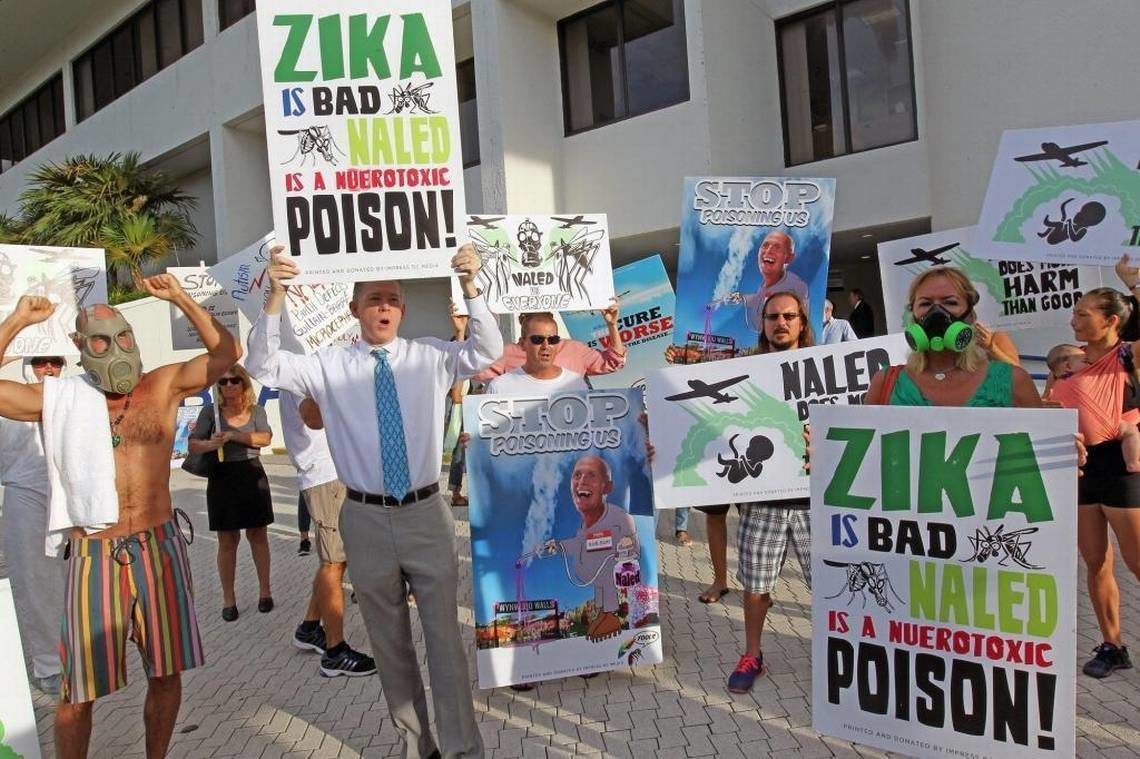
© C.M. GuerreroLast September, over 100 protesters demonstrated on the steps of Miami Beach City Hall against the use of the pesticide Naled being sprayed in Miami Beach to combat Zika. A new study has linked the pesticide to deficits in motor functions in Chinese babies.
The study, whose authors say it is the first to examine real-world exposure to naled outside workplace accidents or lab experiments, used cord blood from 237 mothers who gave birth to healthy babies at a hospital in southeast China between 2008 and 2011. At six weeks, the babies displayed no problems. But at nine months, the babies suffered from slight problems with coordination, movement and other motor functions.
The University of Michigan study was published in the peer-reviewed journal Environment International on Thursday.
While the study provided only a close snapshot of a particular group of mothers, the authors say it suggests the need to take a closer look at using naled to fight mosquitoes, particularly since problems surfaced at lower exposure levels than previous studies.
"Just because changes are small, that doesn't mean they should be discounted," said lead author Monica Silver. "We really need to know more about it."
















Comment: Pain is a sign or signal that something is not right within the body. To focus on getting rid of the pain without addressing the root cause of it hasn't been a very good approach, but to ignore it and tell people to learn to live with pain, while possibly better in certain respects, is not the best approach either. Until doctors can move beyond the pharmaceutical paradigm currently strangling Western medicine, it's likely that chronic pain sufferers will never find long lasting relief. Here are some non-pharmaceutical approaches to dealing with or healing the causes of chronic pain: