
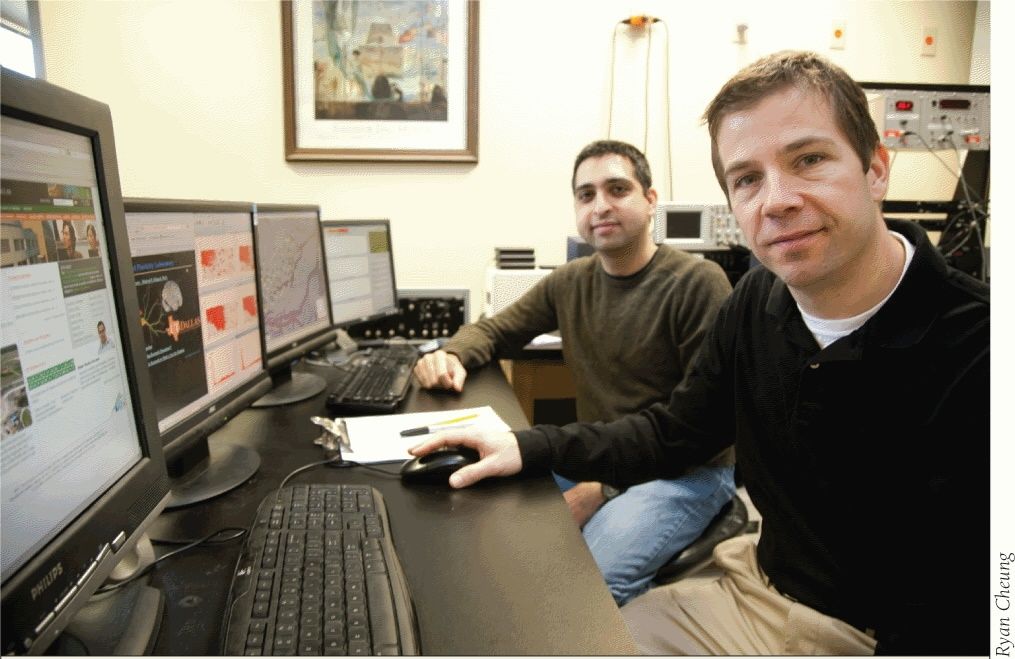
Study authors Dr. Navzer engineer (left) and DR. MICHAEL KILGARD in the Cortical Plasticity Lab at the University of Texas at Dallas.
Investigators were able to use vagus nerve stimulation (VNS) to restore neural activity to normal and reverse the pathology of tinnitus in a rat model, according to a paper published online Jan. 12 before the print edition of Nature.
Based on the findings, the investigators - scientists at the University of Texas and MicroTransponder, a medical device company - are working to design a clinical trial for treating tinnitus.
"Brain changes in response to nerve damage or cochlear trauma cause irregular neural activity believed to be responsible for many types of chronic pain and tinnitus," said the senior investigator Michael Kilgard, PhD, associate professor of neuroscience at the University of Texas at Dallas.
The brain maps in the somatosensory and auditory cortex are changed in response to the noise trauma and this generates pathological neural activity thought to be responsible for the tinnitus, the study author explained, adding that the severity of the tinnitus is correlated with the degree of map reorganization.
"When we paired tones with brief pulses of VNS we eliminated the physiological and behavioral symptoms of tinnitus in noise-exposed rats," said the lead author Navzer D. Engineer, PhD, vice president of preclinical affairs at MicroTransponder and a former post-doctoral fellow in the Dr. Kilgard's laboratory. The animals were monitored for three weeks after the therapy and the changes remained constant. "Pairing sounds with VNS provides that precision by rewiring damaged circuits and reverses the abnormal activity that generates the phantom sound."













Comment: It is possible to safely and easily stimulate the vagus nerve through gentle breathing exercises. To learn more about Vagus Nerve Stimulation, through breathing exercises, and naturally producing the stress reducing hormone Oxytocin in the brain, visit the Éiriú Eolas Stress Control, Healing and Rejuvenation Program here.