Health & WellnessS


Health

Do Cortisone Shots Make Things Worse?

Cortisone
© GreenMedInfo

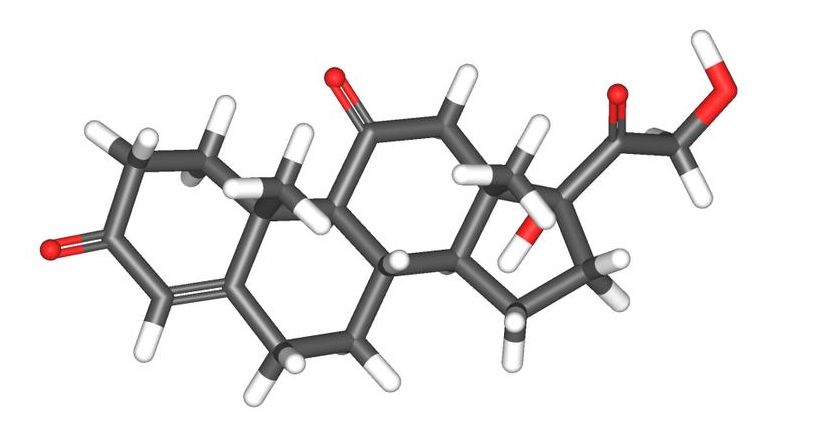
A major article review published in The Lancet in 2010 revealed what many in the natural health profession have suspected for a long time. The review examined the results of over 41 randomized trials and over 2500 patients with tendon injuries. The reviewers found that cortisone injections did in fact provide fast and significant pain relief compared with doing nothing or partaking in physical therapy. However, cortisone shots did not heal the structural damage underlying the pain. Instead, they actually hindered the structural healing, and in 1 case caused tendon rupture.

When patients who received cortisone injections were re-examined at 6 and 12 months, the results were alarming. Overall, people who received cortisone shots had a much lower rate of full recovery than those who did nothing or who underwent physical therapy. They also had a 63 percent higher risk of relapse than people who adopted the time-honored wait-and-see approach. The evidence for cortisone as a treatment for other aching tendons, like sore shoulders and Achilles-tendon pain, was slight and conflicting, the review found.

But in terms of tennis elbow, the shots seemed to actually be counterproductive. In other words, in some way, the cortisone shots impede full recovery, and compared with those who do nothing but rest, those getting the shots are worse off. Those people receiving multiple injections may be at particularly high risk for continuing damage. In one study that the researchers reviewed, an average of four injections resulted in a 57 percent worse outcome when compared to one injection.


Fish

Iconic marine mammals are 'swimming in sick seas' of terrestrial pathogens: researchers

Image
© A W TritesNorthern fur seal pup
Parasites and pathogens infecting humans, pets and farm animals are increasingly being detected in marine mammals such as sea otters, porpoises, harbour seals and killer whales along the Pacific coast of the U.S. and Canada, and better surveillance is required to monitor public health implications, according to a panel of scientific experts from Canada and the United States.

UBC scientists Stephen Raverty, Michael Grigg and Andrew Trites and Melissa Miller from the California Department of Fish and Game, presented their research today at the Annual Meeting of the American Association for the Advancement of Science (AAAS) in Vancouver, Canada.

They called for stronger collaboration among public health, coastal water policy and marine mammal health research sectors to reduce land-sea transfer of pathogens and toxins. These terrestrial sourced pollutants are killing coastal marine mammals and likely pose risks to human health.

Between 1998 and 2010, nearly 5,000 marine mammal carcasses were recovered and necropsied along the British Columbia and Pacific Northwest region of the U.S., including whales, dolphins and porpoises, sea lions and otters.

Comment: The article fails to mention the hidden costs brought about by the environmental consequences of fossil fuel use and exploration


Health

Milk Thistle: Boosting Your Liver Function The Natural Way

"Is life worth living? It all depends on the liver" - William James

Image
The liver is thought of as the 'seat of anger', housing our darkest emotions, which is why liver problems are associated with resistance to change, fear, anger, and hatred. But regardless of its symbolical meaning, one thing is certain: if you have a sluggish liver, you are feeling miserable.

You can think of a sluggish liver as a subclinical liver dysfunction brought on by a lifetime of eating the Standard American Diet (SAD!) and/or too much toxicity. Even though genetics play a role and anyone with a liver disease can have a sluggish liver, for the first time in our evolutionary history we are being exposed to unprecedented levels of toxicity and we are consuming the highest intake ever of carbohydrates (sugar), both of which strain our livers to the max.

The body eliminates hazardous toxins - heavy metals, pesticides, solvents, and microbes - by neutralizing them or by excreting them through the urine, feces, lungs (breathing), and skin (sweat). Toxins that the body is unable to eliminate accumulate in the tissues, typically in our fat cells.

The liver is the detoxification organ par excellence and the body's ability to eliminate toxins largely determines its health. Many diseases, including cancer, rheumatoid arthritis, Lupus, Alzheimer's, Parkinson's, and other chronic age-related conditions, are linked to a sluggish detoxifcation system.

The liver detoxifies toxins through two main phases.

Health

SOTT Focus: The Obesity Epidemic, Courtesy of the Agricultural Industry

Image
The size 12 hour-glass figure, an endangered body shape.
If you love old movies, you've noticed that women back in the old days tended to have beautiful hour glass body shapes, a la Marilyn Monroe. Nowadays, such figures have become a rarity because women have become "boxy" in shape. Research suggests there are now five times as many "rectangular-shaped" women than those with the classic Marilyn Monroe hourglass shape. Almost one in two British women fall into the rectangle category, a boy-ish body shape where there is little difference between the bust, waist and hip measurements.

According to the CDC, about one-third of U.S. adults (33.8%) are obese and approximately 17% (or 12.5 million) of children and adolescents aged 2 - 19 years are obese. In 2010, no state had less than 20% obesity prevalence. Another statistic tells us that over two-thirds of adults in the United States are overweight or obese.

Two thirds! In the country where the USDA food pyramid and low fat eating has guided food choices for at least two generations!

Worldwide, with the spread of Western lifestyle (including diet), obesity has more than doubled since 1980. In 2008, 1.5 billion adults, 20 and older, were overweight and nearly 43 million children under the age of five were overweight in 2010.

According to MyPyramid.gov, you should be consuming at least 3 oz. of whole grain cereals, breads, crackers, rice, cereal or pasta; ideally 6 oz. A lot of people consuming exactly the recommended amounts see no weight loss at all and might actually see their weight go up.
Image
Click on this abomination in order to enlarge it.
Could there be a relationship between this dietary advice and the obesity epidemic? Could it be that the root of the obesity problem is due to our health advisers who believe that animal fat causes heart disease and high cholesterol, and that carbohydrates in grains and vegetables are The Healthy Solution? Based on this, it follows that a diet restricted in carbohydrates and rich in fat is going to be discouraged by them. We are supposed to be consuming at least 45% of our calories as carbohydrates where most of it should come from vegetables, fruits, and whole grains. This diet philosophy is dominant in our world today despite the facts cited above, despite the fact that the obesity epidemic has come upon us in lock-step with this dietary philosophy.

Attention

New Research: GMO Food Far Worse Than We Think

GMO
© GreenMedInfo

Disturbing new research published in the Journal of Applied Toxicology indicates that genetically modified (GM) crops with "stacked traits," that is, with multiple traits such as glyphosate-herbicide resistance and Bacillus thuringiensis (Bt) insecticidal toxins engineered together into the same plant, are likely far more dangerous to human health than previously believed, due to their synergistic toxicity.

Resistance to glyphosate, the active ingredient in the herbicide Roundup, has been engineered into many GM plants, so that fields can be sprayed indiscriminately with herbicide without destroying the crops. While the GM glyphosate-resistant plants survive, they subsequently contain residues of glyphosate and its various metabolites (e.g. aminomethylphosphonic acid) that present a significant health threat to the public.

In this latest study the glyphosate-containing herbicide Roundup was tested on human embryonic kidney cells at concentrations between 1 to 20,000 parts per million (ppm). It was found that concentrations as low as 50 ppm per million, which the authors noted were "far below agricultural dilutions," induced cell death, with the 50% of the cells dying at 57.5 ppm.

Comment: Not to worry, with the coming Ice Age, there won't be any crops anyway.


Attention

US: FDA Ignores Scientists, Dentists Warning of Amalgam Mercury Pandemic

Mercury Filings
© UnHealthy Earth
Mercury found in dental amalgam fillings has been an issue within the dental community and beyond for many years. These fillings, used since the American Civil War, contain an estimated 50 percent mercury. Whenever friction meets these fillings, toxic mercury gases are emitted. This means that with each chew and dental drill comes an emission of mercury gases, leading to numerous health problems. While nearly half of dentists have stopped using amalgam fillings due to health dangers, the Food and Drug Administration has yet to act on these issues.

In December 2010, the Food and Drug Administration convened its second scientific advisory panel on dental amalgams. Scientists yet again told the FDA that amalgam use in children, pregnant women, and hypersensitive adults must come to a halt. The toxic vapors emitted are harmful to everyone, but these groups of individuals especially suffer.

According to Campaign for Mercury Free Dentistry:

Dr. Kotagal said there is "no place for mercury in children," Dr. Ismail said "children less than 6 years of age, I would restrict it significantly," Dr. Thompson said "definitely not in pregnant women and definitely not in those below 6 years of age,"

Dr. Fleming said we need contraindications for pregnant women, and Dr. Burbacher said, "why put amalgams in children if we know they're going to live with that for the rest of their lives? And we don't know what that's going to do."

Health

Heart Disease and Gluten Sensitivity

Image
© Glutenfreesociety.org
A number of research studies have linked gluten sensitivity to different forms of heart disease. The first study below discusses gluten induced autoimmune disease of the heart. The second study discusses how malabsorption of nutrients (in this case carnitine deficiency) induces cardiomyopathy (disease of the heart muscle)...

Autoimmune Heart Disease

Acute pericarditis (inflammation of the sack surrounding the heart) can be caused by virus or bacterial infection, but 85% of the cases have an unknown etiology (cause). The common presence of pro-inflammatory cytokines in the fluid around the heart and antinuclear antibodies (ANA - a blood marker commonly used to help diagnose lupus) in the serum as well as new autoimmune disease diagnosis lead the authors of this paper to suspect that peridarditis itself is caused by an autoimmune process.

Attention

Canada: Beef Products Recalled Over E. coli Fears

Image
© unknown
The Canadian Food Inspection Agency is warning people not to consume food from certain packages of Country Morning Beef Burgers and No Name Club Pack Beef Steakettes because of fears they may be contaminated with E. coli.

The manufacturer New Food Classics of Ontario is conducting a voluntary recall of the products from stores across Western Canada, Manitoba, Ontario and the Northwest Territories.

So far there is one reported case of illness associated with the beef burgers and steakettes.

The Canadian Food Inspection Agency website has detailed information on where the products may have been sold.

Attention

By 2606, The US Diet Will Be 100 Percent Sugar

The US diet has changed dramatically in the last 200 years. Many of these changes stem from a single factor: the industrialization and commercialization of the American food system. We've outsourced most of our food preparation, placing it into the hands of professionals whose interests aren't always well aligned with ours.

It's hard to appreciate just how much things have changed, because none of us were alive 200 years ago. To help illustrate some of these changes, I've been collecting statistics on US diet trends. Since sugar is the most refined food we eat in quantity, and it's a good marker of processed food consumption, naturally I wanted to get my hands on sugar intake statistics-- but solid numbers going back to the early 19th century are hard to come by! Of all the diet-related books I've read, I've never seen a graph of year-by-year sugar intake going back more than 100 years.

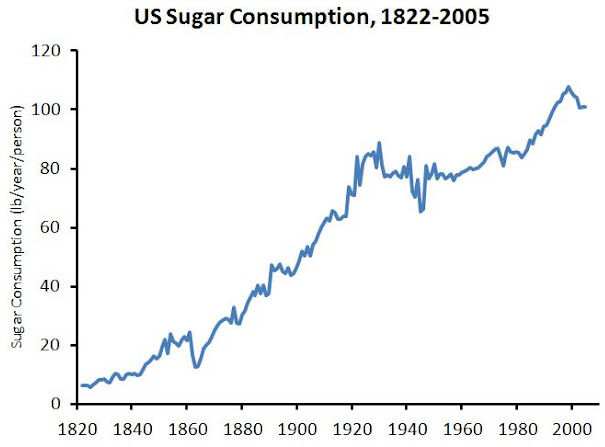
A gentleman by the name of Jeremy Landen and I eventually tracked down some outstanding statistics from old US Department of Commerce reports and the USDA: continuous yearly sweetener sales from 1822 to 2005, which have appeared in two of my talks but I have never seen graphed anywhere else*. These numbers represent added sweeteners such as cane sugar, high-fructose corn syrup and maple syrup, but not naturally occurring sugars in fruit and vegetables. Behold:

Image
© US Department of Commerce
It's a remarkably straight line, increasing steadily from 6.3 pounds per person per year in 1822 to a maximum of 107.7 lb/person/year in 1999. Wrap your brain around this: in 1822, we ate the amount of added sugar in one 12 ounce can of soda every five days, while today we eat that much sugar every seven hours. The increase is so steady I was able to fit a line to it rather well (R2 = 0.95):

Family

Nasty 'Superbug' Emerging? Strikes Otherwise Healthy, Young Patients

Image
© WikimediaIllustration of a bacterium with plasmid enclosed showing genomic DNA and plasmids.
University at Buffalo researchers are expressing concern about a new, under-recognized, much more potent variant of a common bacterium that has surfaced in the U.S.

"Historically, in Western countries, classical strains of Klebsiella pneumoniae have caused infections mostly in sick, hospitalized patients whose host defense systems are compromised," says Thomas Russo, MD, professor in the Department of Medicine at the UB School of Medicine and Biomedical Sciences and head of its Infectious Disease Division.

"But in the last 10 to 15 years, a new variant of it has begun causing community-acquired infection in young, healthy individuals," he says. "This variant causes serious, life-threatening, invasive infections and is able to spread to other organs from the initial site of infection."

Perhaps most important, says Russo, these hypervirulent strains of Klebsiella pneumoniae have the potential to become highly resistant to antibiotics, similar to Escherichia coli and classical Klebsiella pneumoniae.

"These hypervirulent strains are the next 'superbugs' -in-waiting," he says. "If they become resistant to antibiotics, they will become difficult, if not impossible to treat."