
Health & WellnessS


Health

Record 2,118 cases of West Nile virus reported in US

Image
© CDC
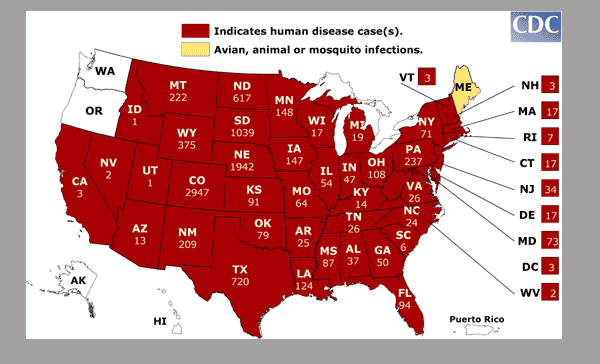
Health officials report record numbers of West Nile virus this year, 2,118 cases and 92 deaths as of Wednesday, a jump of 25% from last week.

Cases will continue "probably into October," said Lyle Petersen, director of the division of vector-borne infectious diseases at the Centers for Disease Control and Prevention. "This is the highest number of cases reported to CDC through the first week in September since West Nile virus was first detected in the United States."

There have been human cases in 44 states. The mosquito-borne disease is hitting Texas hardest, with 1,013 cases and 40 deaths - nine more than last week.

"2012 is now officially our worst year ever for West Nile disease," said David Lakey, commissioner of the Texas Department of State Health Services. The worst year before this was 2003, when Texas had 439 cases and 40 deaths, he said.

Magic Wand

Targeting inflammation to treat depression

Researchers at Emory University have found that a medication that inhibits inflammation may offer new hope for people with difficult-to-treat depression. The study was published Sept. 3 in the online version of Archives of General Psychiatry.

"Inflammation is the body's natural response to infection or wounding, says Andrew H. Miller, MD, senior author for the study and professor of Psychiatry and Behavioral Sciences at Emory University School of Medicine. "However when prolonged or excessive, inflammation can damage many parts of the body, including the brain."

Prior studies have suggested that depressed people with evidence of high inflammation are less likely to respond to traditional treatments for the disorder, including anti-depressant medications and psychotherapy. This study was designed to see whether blocking inflammation would be a useful treatment for either a wide range of people with difficult-to-treat depression or only those with high levels of inflammation.

Comment: The article fails to mention the obvious connection between inflammation and diet. Instead of inventing new biologic drugs to treat depression, it is better to work on fixing the core problem - a diet high in carbohydrates, gluten, casein, and vegetables.

Depression - Caused by Inflammation, Thus Like Other Diseases of Civilization


Health

How LOW Cholesterol Can Harm Your Health

Egg
© GreenMedInfo
You've heard for decades about the dangers of high cholesterol, but did you know that LOW cholesterol can lead to violence towards self and other, and has been linked to premature aging, death and other adverse health effects?

In a world gone mad with anti-cholesterol anxiety, and where gobbling down pharmaceuticals designed to poison the body into no longer synthesizing it is somehow considered sane behavior, it is refreshing to look at some of the research on the health benefits of cholesterol, or conversely, the dangers of low cholesterol.

Benefits of Cholesterol
  • Cholesterol Is Needed To Prevent Aggression: It has been known for almost 30 years that low serum cholesterol levels are associated with habitually violent tendencies of homicidal offenders under the influence of alcohol.[i] Since then, there are at least 8 other studies that have either confirmed or explored the cholesterol-violence link, including both violence towards self and other. One of the possible explanations for this association was discussed in an article published in the British Journal of Psychiatry in 1993: "One of the functions of serotonin in the central nervous system is the suppression of harmful behaviour impulses...Low membrane cholesterol decreases the number of serotonin receptors. Since membrane cholesterol exchanges freely with cholesterol in the surrounding medium, a lowered serum cholesterol concentration may contribute to a decrease in brain serotonin, with poorer suppression of aggressive behaviour".[ii] Not surprisingly, several reports have now surfaced on cholesterol-lowering statin drugs contributing to irritability and/or aggression.
  • Cholesterol Is Needed To Fight Cancer: The inverse relationship between cholesterol levels and the risk for a variety of cancers, and mortality associated with cancer, has been known about since the late 80's.[iii] Since then, the cholesterol-cancer connection has been confirmed over and over again. It is to be expected, therefore, that statin drug use would be linked with increased cancer incidence, which indeed it is.[iv] Even when you take so-called "bad" LDL-cholesterol and administer it to a culture of highly malignant, multi-drug resistant leukemia cells, the cells lose their resistance to chemotherapy. Not exactly what can be characterized as a "bad" substance, now is it? [v]

Arrow Up

Jeremy Hunt Under Fire for Stance on Homeopathy

Jeremy Hunt
© Richard Gardner/Rex FeaturesCould homeopathy eat further into the NHS budget?
The fortunes of the UK's National Health Service (NHS) are about to be transformed with the help of the magical waters of homeopathic medicine. Top marks to The Telegraph's science writer Tom Chivers for quickly picking up on talk that the UK's new health minister, Jeremy Hunt - who replaced Andrew Lansley yesterday in a government reshuffle - thinks that homeopathy works, and should be provided at public expense by the NHS.

Since news of his appointment emerged, senior scientists have spoken up. John Krebs, professor of zoology at the University of Oxford, said: "There is overwhelming evidence that homeopathic medicine is not effective. It would be a real blow for those who want medicine to be science-based if the secretary of state were to promote homeopathy because of his personal beliefs."

Edzard Ernst, former director of complementary medicine at the University of Exeter, UK, added: "To praise the positive contribution of homeopathy to the NHS does not bode well for the new person in charge of UK healthcare. One can only hope that with the reality of the new job, there will be a more rational insight in the actual evidence on this topic."

How did Hunt's views on homeopathy emerge? Firstly, he signed a parliamentary document called an Early Day Motion back in 2007, supporting the provision of homeopathic medicine by the NHS. Such motions are used routinely as barometers of parliamentary interest in issues - in this case, spending public money on treating people with aqueous solutions so diluted that they no longer contain a trace of the supposedly active ingredients they began with.

By signing the motion, along with 205 other MPs, Hunt agreed that parliament "welcomes the positive contribution made to the health of the nation by the NHS homeopathic hospitals", and "calls on the government [then Labour] to support these valuable national assets".

Health

Reduced Brain Connections Seen in People With Generalized Anxiety Disorder

A new University of Wisconsin-Madison imaging study shows the brains of people with generalized anxiety disorder (GAD) have weaker connections between a brain structure that controls emotional response and the amygdala, which suggests the brain's "panic button" may stay on due to lack of regulation.

Anxiety disorders are the most common class of mental disorders and GAD, which is characterized by excessive, uncontrollable worry, affects nearly 6 percent of the population.

Lead author Dr. Jack Nitschke, associate professor of psychiatry in the UW School of Medicine and Public Health, says the findings support the theory that reduced communications between parts of the brain explains the intense anxiety felt by people with GAD.

In this case, two types of scans showed the amygdala, which alerts us to threat in our surroundings and initiates the "fight-or-flight" response, seems to have weaker "white matter" connections to the prefrontal and anterior cingulate cortex (ACC), the center of emotional regulation.

The researchers did two types of imaging -- diffusion tensor imaging (DTI) and functional magnetic resonance (fMRI) -- on the brains of 49 GAD patients and 39 healthy volunteers. Compared with the healthy volunteers, the imaging showed the brains of people with GAD had reduced connections between the prefrontal and anterior cingulate cortex and the amygdala via the uncinate fasciculus, a primary "white matter" tract that connects these brain regions. This reduced connectivity was not found in other white matter tracts elsewhere in their brains.

Health

Rare Genetic Disease Offers Insight Into Common Cancers

Fanconi anemia is a recessive genetic disorder affecting 1 in 350,000 babies, which leaves cells unable to repair damaged DNA. This lack of repair puts Fanconi anemia patients at high risk for developing a variety of cancers, especially leukemias and head and neck cancer.

Cruelly, the condition also nixes the use of an entire class of cancer drugs, namely drugs like mitomycin C, by encouraging DNA to crosslink together like sticky strands of bread dough -- generally, healthy cells can repair a few crosslinks whereas cancer cells cannot and so are killed. However, Fanconi anemia patients are unable to repair the damage done to healthy or cancerous cells done by these drugs and so treatment with mitomycin C is frequently fatal.

A University of Colorado Cancer Center study funded by the Fanconi Anemia Research Fund explored the effectiveness of a novel agent in preventing cancer in this population -- namely, resveratrol as found in red wine. The results of this study will be presented at the 24th annual Fanconi Anemia Research Fund Scientific Symposium, September 27-30 at the Grand Hyatt Hotel in Denver, Colo.

In fact, the findings may go far past Fanconi anemia.

Health

Rate of Women With Pregnancy-Associated Cancer On the Rise, Study Suggests

The rate of pregnancy-associated cancer is increasing and is only partially explained by the rise in older mothers suggests new research published in BJOG: An International Journal of Obstetrics and Gynaecology.

A large Australian study looked at 781,907 women who gave birth in New South Wales (NSW) between 1994 and 2008 which corresponds to 1,309,501 maternities. Women with pregnancy-associated cancer, where the initial diagnosis of cancer is made during pregnancy or within 12 months of delivery, are compared to women without cancer.

A total of 1,798 pregnancy-associated cancers were identified from the total number of maternities corresponding to an overall incidence rate of 137.3 per 100,000 maternities. The research found that between 1994 and 2008 the incidence rate of pregnancy-associated cancer increased from 112.3 to 191.5 per 100,000 maternities.

During this period maternal age also increased. The percentage of women aged 35 years and over increased from 13.2% to 23.6% in New South Wales.

Despite this the research found that only 14% of the increase was explained by increasing maternal age. The research looked at independent risk factors for pregnancy-associated cancer including older maternal age, Australian-born, socio-economic status, multiparity, multiple pregnancy and prior diagnosis of cancer.

Health

Epigenetic Causes of Prostate Cancer: Researchers Observe Modified Methylation Patterns in a Group of Prostate Cancers

In about half of all prostate tumours, there are two genetic areas that are fused with one another. When this is not the case, the exact way cancer cells originate in prostate tumours was not clear until now.

Scientists at the Max Planck Institute for Molecular Genetics in Berlin, in cooperation with a team of international researchers, were able to show that the genesis of this fusion-negative prostate cancer has epigenetic causes: methyl groups are distributed differently over the DNA in the cancer cells than in healthy cells. Thanks to this knowledge, physicians may be able to achieve greater specificity in treating prostate tumours in future. In addition, the aberrant DNA methylations can be used as a potential biomarker for identifying prostate cancer.

About half of all cases of prostate cancer originate through fusion of two genetic areas. As a result, the ERG gene is activated in these fusion-positive cells and prostate cells propagate, leading to tumourigenesis. Fusion-positive prostate cancer can be treated with PARP1 inhibitors that turn off the repair system of the tumour cells.

However, it has not been clear how prostate tumours without a fused ERG gene acquire their tumourigenic potential. Now, a team of Max Planck scientists headed by Michal-Ruth Schweiger from the Department of Vertebrate Genomics have investigated the global DNA methylation pattern -- i.e. at which locations the DNA possesses methyl groups -- in fusion-negative tumours. They have discovered that, compared to fusion-positive tumours, the fusion-negative tumours display more aberrant DNA methylations, which are most likely causative for the malignant transformation of prostate cells.

Health

Prenatal Exposure to Pesticide Additive Linked With Childhood Cough

Children exposed in the womb to the widely used pesticide additive piperonyl butoxide (PBO) have heightened risk of noninfectious cough at ages 5 and 6, according to researchers at the Columbia Center for Children's Environmental Health (CCCEH) at the Mailman School of Public Health and of Columbia University Medical Center.

The findings, which appear in the August 31 online edition of the journal Environment International, support the premise that the children's respiratory system is susceptible to damage from toxic exposures during the prenatal period. A common symptom, childhood cough can disrupt normal daytime activities and interrupt sleep for both child and parent.

Piperonyl butoxide (PBO) is an organic compound used to bolster the effects of pyrethroid pesticides. Pyrethroids are the most commonly used pesticides for both professional pest control and non-professional residential use, according to a 2011 study by Mailman School researchers. Exposure to one pyrethroid, a variation of permethrin, was linked with increased risk for cough by age 5 in a 2009 study by Rachel Miller, MD. In the current study, Dr. Miller and colleagues sought to build on these findings by exploring the effects of subsequent exposure during childhood, looking specifically at the effects of PBO exposure.

Researchers looked at 224 mother-child pairs enrolled in the CCCEH birth cohort study of environmental exposures, examining measures of PBO and pyrethroid in personal air monitors worn by the mothers during pregnancy. Air samples also were collected from the home over the course of two weeks when children were between 5 and 6 years old. Questionnaires were used to evaluate respiratory outcomes.

Health

Infections in Rheumatoid Arthritis Patients: Study Finds Way to Pinpoint Risk

Rheumatoid arthritis alone is painful and disabling, but it also puts patients at higher risk of death. The greater susceptibility to infections that accompanies the autoimmune disorder is one reason. Assessing the danger of infection a particular patient faces so it can be addressed can prove challenging for physicians. A Mayo Clinic study finds that a risk score can be developed to predict a patient's chances of having serious infections. The score uses information about how rheumatoid arthritis is affecting a patient, plus factors including age, corticosteroid use and the presence of other illnesses.

The findings are published online in the American College of Rheumatology journal Arthritis & Rheumatism.

Using the National Institutes of Health-funded Rochester Epidemiology Project, researchers studied medical records of 584 rheumatoid arthritis patients diagnosed between 1955 and 1994 and followed up on until January 2000. Of those, 252, or nearly half, had more than one serious infection requiring hospitalization and/or intravenous antibiotic; those 252 collectively racked up 646 infections.

The Mayo team developed an infection risk score based on those and other rheumatoid arthritis patients they studied. Factors in the calculation include age; previous serious infections; corticosteroid use; a low white blood cell count; elevated results in a blood test used to detect signs of inflammation, called an erythrocyte sedimentation rate; signs of rheumatoid arthritis outside joints; and the presence of other serious conditions such as heart disease, heart failure, diabetes, lung disease, vascular disease and alcoholism. They confirmed the usefulness of the risk score in a second group of patients with rheumatoid arthritis from the same population.