Health & WellnessS


Health

Storm of 'Awakened' Transposons May Cause Brain-Cell Pathologies in ALS, Other Illnesses

A team of neuroscientists and informatics experts at Cold Spring Harbor Laboratory (CSHL) reports important progress in an effort to understand the relationship between transposons -- sequences of DNA that can jump around within the genome, potentially causing great damage -- and mechanisms involved in serious neurodegenerative disorders including ALS (amyotrophic lateral sclerosis, also known as Lou Gehrig's disease), FTLD (frontotemporal lobar degeneration) and Alzheimer's disease.

A close analysis of previously unanalyzed genome data has led CSHL Associate Professor Joshua Dubnau, Ph.D., and colleagues to discover a signature of disease that may help explain these and other neural pathologies. As reported by the team September 6 in the journal PLoS ONE, this signature leads them to hypothesize that dormant transposons awaken in the genome, setting off the equivalent of a transposon storm in some brain cells, capable of causing cell death.

Transposons -- often called transposable elements, or TEs, by scientists -- are understood collectively to occupy a large fraction (~40%) of the genetic material of multicellular organisms, including humans. Most TEs are genomic fossils, effectively inactive. A minority of TEs capable of activation are ordinarily suppressed by a variety of cellular defense mechanisms that have evolved along with life over eons of time to prevent sudden rearrangements (i.e., mutations) of the genetic material.

Health

Childhood Sexual Abuse Linked to Later Heart Attacks in Men

Men who experienced childhood sexual abuse are three times more likely to have a heart attack than men who were not sexually abused as children, according to a new study from researchers at the University of Toronto. The researchers found no association between childhood sexual abuse and heart attacks among women.

In a paper published online this week in the journal Child Abuse & Neglect, investigators examined gender-specific differences in a representative sample of 5095 men and 7768 women aged 18 and over, drawn from the Center for Disease Control's 2010 Behavioral Risk Factor Surveillance Survey. A total of 57 men and 154 women reported being sexually abused by someone close to them before they turned 18 and 377 men and 285 women said that a doctor, nurse or other health professional had diagnosed them with a heart attack or myocardial infarction. The study was co-authored by four graduate students at the University of Toronto, Raluca Bejan, John Hunter, Tamara Grundland and Sarah Brennenstuhl.

"Men who reported they were sexually abused during childhood were particularly vulnerable to having a heart attack later in life," says lead author Esme Fuller-Thomson, Professor and Sandra Rotman Chair at University of Toronto's Factor-Inwentash Faculty of Social Work. "We had expected that the abuse-heart attack link would be due to unhealthy behaviors in sexual abuse survivors, such as higher rates of alcohol use or smoking, or increased levels of general stress and poverty in adulthood when compared to non-abused males. However, we adjusted statistically for 15 potential risk factors for heart attack, including age, race, obesity, smoking, physical inactivity, diabetes mellitus, education level and household income, and still found a three-fold risk of heart attack."

Health

Protein Critical to Gut Lining Repair Identified

Image
© Hiroyuki MiyoshiScientists have identified a protein that is critical to repairing glands in the intestine’s inner lining. The glands appear as dark green spots above and are rebuilt every two to four weeks as the inner lining of the gut is continually renewed.
Scientists at Washington University School of Medicine in St. Louis have identified a protein essential to repairing the intestine's inner lining.

That lining is among the body's busiest highways, trod not only by the food we ingest but also by trillions of microorganisms that aid digestion. Because the intestine plays key roles in absorbing nutrients and containing the microbes, any damage must be fixed promptly.

The researchers report Sept. 6 in Science Express that a protein called Wnt5a is essential for reconstructing glands in the intestinal lining. The glands, called crypts of Lieberkühn, contain stem cells that continually pump out other cells that renew the gut lining, which is replaced every two to four weeks. The crypts look like dimples in the gut lining and are vulnerable to damage and loss from infection and inflammation.

"For example, inflammatory bowel disease can destroy huge stretches of the lining, including the crypts," says senior author Thaddeus Stappenbeck, MD, PhD, associate professor of pathology and immunology. "If crypts can't be repaired as the lining is rebuilt, their absence would place substantial stresses on crypts in healthy portions of the gut. So it's important to better understand how the crypts are replaced."

Health

Obstructive Sleep Apnea (OSA) Increases Cardiovascular Mortality in the Elderly

Untreated severe obstructive sleep apnea (OSA) is associated with an increased risk of cardiovascular mortality in the elderly, and adequate treatment with continuous positive airway pressure (CPAP) may significantly reduce this risk, according to a new study from researchers in Spain.

"Although the link between OSA and cardiovascular mortality is well established in younger patients, evidence on this relationship in the elderly has been conflicting," said lead author Miguel Ángel Martínez-García, MD, of La Fe University and Polytechnic Hospital in Valencia, Spain. "In our study of 939 elderly patients, severe OSA not treated with CPAP was associated with an increased risk of cardiovascular mortality especially from stroke and heart failure, and CPAP treatment reduced this excess of cardiovascular mortality to levels similar to those seen in patients without OSA."

The findings were published online ahead of print publication in the American Thoracic Society's American Journal of Respiratory and Critical Care Medicine.

All subjects in this prospective, observational study were 65 years of age or older. Median follow-up was 69 months. Sleep studies were conducted with either full standard polysomnography or respiratory polygraphy following Spanish guidelines. OSA was defined as mild-to-moderate (apnea-hypopnea index [AHI] 15-29) or severe (AHI ≥30). Patients with AHI (less than) 15 acted as controls. CPAP use ≥4 hours daily was considered as good adherence to treatment.

Health

Melanoma Manifests Differently in Children Than in Adults, Study Finds

Melanoma, newly diagnosed in more than 76,000 Americans in 2011, is the most common and dangerous form of skin cancer. Melanoma is rare in children, accounting for 1 to 4 percent of all melanoma cases and just 3 percent of pediatric cancers. Just as adult cases of melanoma are increasing, pediatric melanoma is rising at the rate of 1 to 4 percent per year.

The physicians and staff at Moffitt Cancer Center have a special interest in melanoma and related conditions occurring in childhood, and recently published results of their experience with cases of pathologically confirmed childhood melanoma. They found evidence that the disease manifests differently in children than in adults, particularly with regard to the likelihood and significance of lymph node metastases. Metastases to the lymph nodes, particularly the sentinel nodes, were found more frequently in children with melanoma than would be expected in adults with the same stage of disease, yet with aggressive surgical and medical treatment, stage-for-stage the survival in children was better than expected for adults.

The study is published in the August issue of the Annals of Surgical Oncology.

Alarm Clock

Farm Use of Antibiotics Defies Scrutiny

Image
© Ellen Weinstein
The numbers released quietly by the federal government this year were alarming. A ferocious germ resistant to many types of antibiotics had increased tenfold on chicken breasts, the most commonly eaten meat on the nation's dinner tables.

But instead of a learning from a broad national inquiry into a troubling trend, scientists said they were stymied by a lack of the most basic element of research: solid data.

Eighty percent of the antibiotics sold in the United States goes to chicken, pigs, cows and other animals that people eat, yet producers of meat and poultry are not required to report how they use the drugs - which ones, on what types of animal, and in what quantities. This dearth of information makes it difficult to document the precise relationship between routine antibiotic use in animals and antibiotic-resistant infections in people, scientists say.

Magnify

Is the 'Natural' Label 100 Percent Misleading?

Image
© grist.com
What do Juicy Juice fruit punch, Tyson chicken, and Nature Valley granola bars have in common? They're all branded with the same mysterious, ubiquitous term: natural.

The natural label's takeover is not just anecdotal. In 2008, Mintel's Global New Products Database found that "all-natural" was the second most used claim on new American food products. And a recent study by the Shelton Group [PDF], an advertising company focusing on sustainability, found that it's also the most popular. When asked, "Which is the best description to read on a food label?" 25 percent of consumers answered, "100 percent natural."

So what does natural mean? Well, that depends on who you're asking. A salesperson in the meat department at Shoprite in Chester, N.Y., told me that Tyson's all natural chicken is "basically the same thing" as organic. At General Mills, 100 percent natural means "that all ingredients used are from a natural source and a natural process," though when I asked for clarification on what counts as a "natural process," the customer service agent was out of answers.

Comment: Read the articles below to learn more about how Many 'All Natural' Foods Are Actually Heavily Processed:

What's Really Behind the Ingredients in 'Natural Flavors?'
Many 'Natural' Foods are Loaded with GMOs
Most "Natural" Cereals Likely to Contain GMOs
The Soy and Other 'Natural' Food Products in Your Cabinet May Contain a Dangerous Neurotoxin


Attention

7 New Toxic Genetically Modified Crops Up For Government Approval

Monsanto Logo
© Prevent Disease.com
A September 11th deadline is around the corner for a new round of herbicide resistant genetically modified (GM) crops that are coincidentally on the table for fast-tracked approval.

Since the introduction of GM crops, the US has seen herbicide use increase by over 300 million pounds. Big Biotech originally claimed that weeds would not develop resistance to glyphosate (RoundUp), but they have and these new "superweeds" have become the driving force behind new crops engineered for stacked, or multiple, herbicide tolerances. Adoption of these new crops will lead to dramatic increases in the use of higher risk herbicides perpetuating the herbicide treadmill that is already in place.

1. Glyphosate (herbicide) Tolerant Soybeans

- Bayer's petition to force its new controversial herbicide (isoxaflutole) tolerant soy on the market conceals crucial information on potential allergenicity and toxicity that came to light when EU experts examined the GMO soybean.

- BASF's petition
- Dow AgroSciences' petition

2. Glyphosate (herbicide) Tolerant Canola

- Monsanto's petition
- Pioneer's petition

3. Glyphosate (herbicide) Tolerant Corn

- Genective's petition

4. Hybrid Corn

- Monsanto's petition

- Four of the nine are genetically engineered with a soil bacteria that keeps them alive even when they're sprayed with massive doses of the herbicide glyphosate (Monsanto's RoundUp). More of these so-called "RoundUp Ready" crops mean more RoundUp sprayed on our food. This is horrible because Monsanto's RoundUp causes birth defects. Instead of "RoundUp Ready" we should call these GMOs "Birth-Defect Ready"!

According to a report published by Earth Open Source, industry's own studies -- including one commissioned by Monsanto -- showed as long ago as the 1980's that RoundUp's active ingredient, glyphosate, causes birth defects in laboratory animals.

Health

Decoding the black death: Anthropologist finds clues in medieval skeletons

Skeletal marker
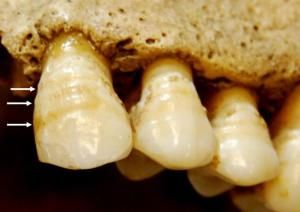
© Sharon DeWitteSkeletal marker: Linear enamel hypoplasia.
Each time Sharon DeWitte takes a 3-foot by 1-foot archival box off the shelf at the Museum of London she hopes it will be heavy.

"Heavy means you know you have a relatively complete skeleton," said DeWitte, an anthropologist at the University of South Carolina who has spent summers examining hundreds of Medieval skeletons, each time shedding new light on the dark subject of the Black Death.

Since 2003, DeWitte has been studying the medieval mass killer that wiped out 30 percent of Europeans and nearly half of Londoners from 1347-1351. She is among a small group of scientists devoted to decoding the ancient plague and the person researchers turn to for providing evidence from skeletal remains.

Her findings may provide clues about the effects of disease on human evolution.

"It can tell us something about the nature of human variation today and whether there is an artifact of diseases we have faced in the past. Knowing how strongly these diseases can actually shape human biology can give us tools to work with in the future to understand disease and how it might affect us," she said.

Having previously analyzed more than 600 skeletons of people who died during and after the Black Death, DeWitte turned her attention this summer to studying the remains of some 300 people who lived in the 11th and 12th centuries before the Black Death. Comparing the life span of people who lived before and after the blight, she expected to see a post-Black Death population that lived longer. The more complete the skeletons she studies, the more information she has about the people and their health at the time they died.

Comment: New Light on the Black Death: The Cosmic Connection


Syringe

Devil's humble servant "Paul Offit" Threatens All Vaccine Exemptions - An MD Responds

open scroll
© Unknown
Millionaire vaccine inventor and mandatory vaccine advocate Paul Offit recently released a short VIDEO for doctors on medscape. Here is a transcript of the speech. This statement that outlines Offit's personal belief system could be a prelude to the legal removal of all philosophical and religious vaccine exemptions in the United States of America. This is something that Offit has been working toward for years, and the likely end-purpose of his series of books.

Paul Offit believes that exempting your child from vaccination is morally reprehensible. He considers himself an authority on autism, all infectious diseases, morality, history, every religious system, and infant immunology. You may also recognize Dr Offit as the one who says that all vaccines are perfectly safe and infants can tolerate theoretically 10,000 of them at once:
"A more practical way to determine the diversity of the immune response would be to estimate the number of vaccines to which a child could respond at one time... each infant would have the theoretical capacity to respond to about 10, 000 vaccines at any one time." [1]
The status accorded to him by the pharmaceutical and medical fields permits him to influence the opinions and practice of lower rung physicians regarding vaccine exemptions. Unfortunately, even doctors will simply believe the "expert"[2] without bothering to go and check their own medical literature, to see if the self-proclaimed expertise has a solid scientific foundation. Research shows that when people listen to the expert, the part of their brains that is capable of independent thought goes to sleep.[3]