Health & WellnessS


Magic Wand

A carefully scheduled high-fat diet resets metabolism and prevents obesity

Image
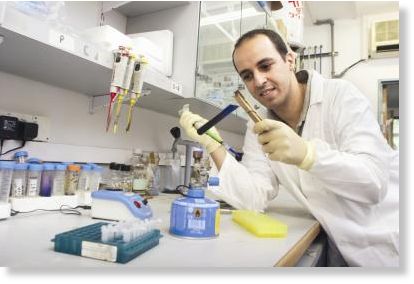
© Sasson TiramThe Hebrew University's Professor Oren Froy conducts research at the Robert H. Smith Faculty of Agriculture, Food and Environment.
New research from the Hebrew University of Jerusalem shows that a carefully scheduled high-fat diet can lead to a reduction in body weight and a unique metabolism in which ingested fats are not stored, but rather used for energy at times when no food is available.

The research was conducted by Prof. Oren Froy along with Prof. Zecharia Madar, research student Yoni Genzer and research fellow Dr. Hadas Sherman at the Institute of Biochemistry, Food Science and Nutrition, at the Hebrew University's Robert H. Smith Faculty of Agriculture, Food and Environment. The results were published in FASEB Journal under the title 'Timed high-fat diet resets circadian metabolism and prevents obesity.'

Previous research has established that disrupting mammals' daily rhythms, or feeding them a high-fat diet, disrupts metabolism and leads to obesity. The researchers wanted to determine the effect of combining a high-fat diet with long-term feeding on a fixed schedule. They hypothesized that careful scheduling of meals would regulate the biological clock and reduce the effects of a high-fat diet that, under normal circumstances, would lead to obesity.


Attention

Dow Brings Back An Agent Orange Ingredient for New GM Plants

Pesticides
© GreenMedInfo
Whether you are aware of it or not, your food, air and water are the battle ground upon which a titanic struggle between the multinational biotech corporations Monsanto and Dow AgroScience is now playing out. As a result, your health and environment (and that of all future generations) are at profound risk of irreparable harm.

Dow AgroSciences (a subsidiary of Dow Chemicals) recently announced their development of genetically-engineered corn, soybean, and cotton plants metabolically resistant to the herbicide 2,4-Dichlorophenoxyacetic acid (2,4-D), a major ingredient in Agent Orange. What this means for our future is that, if approved for use, vast regions of our country will soon be sprayed with a chemical that has been linked to over 400,000 birth defects in Vietnam.

How did we end up here?

History is repeating itself before our eyes. Dow Chemicals and Monsanto, joined at the karmic hip, both manufactured Agent Orange for use in Vietnam, and both are notorious for minimizing the adverse health effects associated with exposure to the agent. Neither corporation learned from its mistakes, largely because the US government underwrote the risk of using the chemical, and therefore shielded them from the bulk of the legal and financial fallout.

But this lack of culpability has now set up the conditions for a reliving of the horrors of systemic herbicide exposure, only this time on American soil, with Monsanto choosing glyphosate (also a birth-defect causing chemical), and Dow Chemical sticking with its old time favorite.

Cell Phone

Singer Sheryl Crow Blames Cell Phone For Brain Tumor

Sheryl Crow
© Christopher Polk/Getty Images for StagecoachSheryl Crow
In June, Sheryl Crow made news when she admitted that she had been diagnosed with a brain tumor. Though, she was quick to let her fans know it was benign and she was doing just fine, she's now talking more candidly about what she thinks was the cause of the tumor.

While speaking with Katie Couric, Sheryl said she thought her tumor was caused by cell phone radiation.

"I do have the theory that it's possible that's it's related to that," she said. "I used to spend hours on the old archaic cell phones."

She also admitted that there were no doctors who would confirm her suspicions even though she felt she had adequate reasons to back up her claims, explaining that her tumor was in the part of her brain where she often held her phone.

But is there any scientific evidence to show that cell phones could cause cancer?

In July 2011, the Journal of National Cancer Institute published the first study on cell phone use and the risk of brain tumors in children and teens. The study concluded that there was no clear link between cell phone usage and cancer.

In April 2012 though, the Environmental Health Trust, a group founded in 2007 that looks to educate individuals about public health concerns, called the study "sloppy." They concluded from the original findings that children who used cell phones had a 115 percent increased risk of brain tumors over those who did not, which means these kids have a doubled risk of brain cancer.

Comment: Is Your Cell Phone Killing You?


Health

Her Vision Is 20/20, but She Can't Make Sense of What She Sees

It was a quiet Thursday afternoon when AS, a 68-year-old woman from a suburb of Chicago, awakened from a nap to the realization that something was terribly wrong.

Thus begins a Loyola University Medical Center paper on a rare and baffling neurological disorder called Balint's syndrome, which badly impairs a patient's ability to make sense of what he or she sees.

The article describes, in novelistic detail, the difficult adjustments two patients have had to make in their lives. The article is published in the Sept. 11, 2012, issue of Neurology®, the medical journal of the American Academy of Neurology. The paper was written by Jose Biller, MD, Murray Flaster, MD, and first author Jason Cuomo. Biller and Flaster are neurologists and Cuomo is a fourth-year medical student at Loyola University Chicago Stritch School of Medicine.

The authors note that amid the rigors of clinical practice, physicians can content themselves with understanding the phenomenon of disease to the exclusion of understanding the patient's experience. Their article "is an attempt to inform both our clinical and subjective understandings of Balint's syndrome through narratives of two patients suffering from this rare and unique neurological disorder."

Health

Hyponatremia Linked to Increased Risk of Death, Complications Following Surgery

An observational study of nearly 1 million patients who underwent surgery suggests that preoperative hyponatremia (an electrolyte disorder in which sodium levels in the blood are low) was associated with an increased risk of complications and death within 30 days of surgery, according to a report published Online First by Archives of Internal Medicine, a JAMA Network publication.

Hyponatremia has been linked to increased morbidity and mortality in a variety of medical conditions but its association with perioperative (around the time of surgery) outcomes is uncertain, according to the study background.

Alexander A. Leung, M.D., of Brigham and Women's Hospital,Boston, and colleagues conducted a study using theAmericanCollegeof Surgeons National Surgical Quality Improvement Program database to identify 964,263 adults who underwent major surgery at more than 200 hospitals from 2005 through 2010. Preoperative hyponatremia (defined as sodium level < 135mEq/L) was present in 75,423 surgical patients (7.8 percent).

"We found that preoperative hyponatremia was present in approximately 1 in 13 patients, and this group had a 44 percent increased risk of 30-day perioperative mortality, even after adjustment for all other potential risk factors," the authors note. "Preoperative hyponatremia was also associated with an increased risk of perioperative major coronary events, surgical site wound infections, pneumonia and prolonged hospital stays."

Health

Risk-Glorifying Video Games May Lead Teens to Drive Recklessly

Teens who play mature-rated, risk-glorifying video games may be more likely than those who don't become reckless drivers who experience increases in automobile accidents, police stops and willingness to drink and drive, according to new research published by the American Psychological Association.

"Most parents would probably be disturbed to learn that we observed that this type of game play was more strongly associated with teen drivers being pulled over by the police than their parenting practices," said study lead author Jay G. Hull, PhD, of Dartmouth College. "With motor vehicle accidents the No. 1 cause of adolescent deaths, popular games that increase reckless driving may constitute even more of a public health issue than the widely touted association of video games and aggression."

Researchers conducted a longitudinal study involving more than 5,000 U.S. teenagers who answered a series of questions over four years in four waves of telephone interviews. The findings were published online in APA's journal Psychology of Popular Media Culture.

Health

Toothpicks and Surgical Swabs Can Wreak Havoc in the Gut When Inadvertently Swallowed or Left Behind After Surgery

Toothpicks and surgical swabs can wreak havoc in the gut when inadvertently swallowed or left behind after surgery.

A woman developed severe blood poisoning (sepsis) and a liver abscess, after inadvertently swallowing a toothpick, which perforated her gullet and lodged in a lobe of her liver, reveals a case published in BMJ Case Reports.

Swallowing "foreign bodies" is relatively common, particularly among children, but the subsequent development of a liver abscess is rare, with the first recorded incident dating back to 1898, the authors point out.

But it has mostly been associated with inadvertently swallowing pins, nails, fish and chicken bones, rather than toothpicks.

Most foreign body mishaps don't do any damage unless they create an obstruction or chemical burn. But they can be difficult to deal with effectively, because they don't show up on conventional x-rays and symptoms are often non-specific and remote.

Health

Puberty Turned On by Brain During Deep Sleep

Slow-wave sleep, or 'deep sleep', is intimately involved in the complex control of the onset of puberty, according to a recent study accepted for publication in The Endocrine Society's Journal of Clinical Endocrinology and Metabolism (JCEM).

The many changes that occur in boys and girls during puberty are triggered by changes in the brain. Previous studies have shown that the parts of the brain that control puberty first become active during sleep, but the present study shows that it is deep sleep, rather than sleep in general, that is associated with this activity.

"If the parts of the brain that activate the reproductive system depend on deep sleep, then we need to be concerned that inadequate or disturbed sleep in children and young adolescents may interfere with normal pubertal maturation," said Harvard researcher, Natalie Shaw, MD, of Massachusetts General Hospital and Boston Children's Hospital who led the study. "This is particularly true for children who have been diagnosed with sleep disorders, but may also have more widespread implications as recent studies have found that most adolescents get less sleep than they require."

Health

Active Follow-Up With Telephone Help Can Reduce Deaths in Chronic Heart Failure Patients

Chronic heart failure (CHF) patients are less likely to have died a year after discharge if they are involved in a programme of active follow-up once they have returned home than patients given standard care, according to a new Cochrane systematic review. These patients were also less likely to need to go back into hospital in the six months that follow discharge.

CHF is a serious condition, mainly affecting elderly people. It is becoming increasingly common as the population ages, and carries high risks of emergency hospitalisation and death. It affects around three to 20 per 1,000 of the general population, with figures rising to 10% of people aged between 80 and 89. In the UK, CHF consumes almost 2% of the National Health Service's budget, most of the cost being linked to hospital admissions.

A team of six researchers based in the UK and Australia examined 25 clinical trials with nearly 6,000 patients. The trials tested different methods of organising the care of CHF patients after they leave hospital. The researchers identified three types of care:

Health

Survey finds potential link between marijuana and testicular cancer

smoker
© Shutterstock
The use of marijuana in young adulthood might increase the risk of testicular cancer, researchers at the University of Southern California said in a study published by the medical journal Cancer on Monday.

No tests were carried out to determine whether marijuana use actually causes cancerous growths, but the study marks the first scientific research to actually spot a correlation between marijuana use and testicular cancer.

Researchers said that after interviewing more than 350 men, including a focus group of 163 who were diagnosed with testicular cancer, they determined that men who smoked marijuana in their adolescence and later quit "had a 2-fold increased risk" for developing dangerous germ cell tumors.

