Health & WellnessS


Beaker

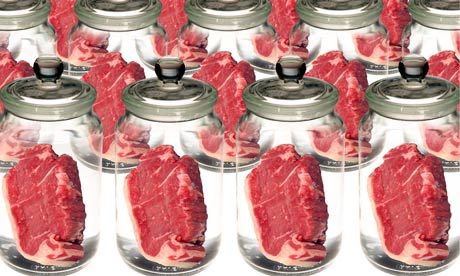
Inside the meat lab: The future of food

Image
© Victor de Schwanberg/Science Photo LibraryDish of the day: breeding and mutating food species may be the only convincing plan anyone has for feeding the world
With billions of mouths to feed, we can't go on producing food in the traditional way. Scientists are coming up with novel ways to cater for future generations. In-vitro burger, anyone?

The future feast is laid out around a cool white room at Eindhoven's University of Technology . There is a steak tartare of in-vitro beef fibre, wittily knitted into the word "meat". There are "fruit-meat" amuse-gueules. The green- and pink-striped sushi comes from a genetically modified vegetarian fish called the biccio that, usefully, has green- and pink-striped flesh. To wash this down, there's a programmable red wine: with a microwave pulse you can turn it into anything from Montepulciano to a Syrah. For the kids, there are sweet fried crickets, programmable colas and "magic meatballs". These are made from animal-friendly artificial meat grown from stem cells: packed with Omega 3 and vitamins, they "crackle in your mouth". Yum.

None of this is quite ready to dish up. The meatballs at the Eindhoven future food show are made from Plasticine; the knitted steak, appropriately, from pinky-red wool. But the ideas aren't fantasy. Koert van Mensvoort, assistant professor at the university, calls them "nearly possible". Van Mensvoort - who is also the brains behind nextnature.net, a must-see website for technological neophiliacs - put his industrial design undergraduates together with bio-tech engineers, marketing specialists and a moral philosopher, tasking them to come up with samples of food that is, technologically, already on our doorstep.


Comment: The tone of the article sounds like Propaganda for Franken Foods. In particular the last sentence; 'When the future food arrives, most of us won't have any choice about what we eat.'

SOTT.net has carried numerous articles on the dangers of Genetically Modified Foods and while the article appears to be doing damage control when it comes to altering the 'negative perception of GM Food', the reality is that there are some serious concerns behind GMO technology. Read the following articles for more information:

How Genetically Modified Foods Could Affect Our Health in Unexpected Ways
GMO Scandal: The Long Term Effects of Genetically Modified Food in Humans
Latest GMO Research: Decreased Fertility, Immunological Alterations and Allergies
How Do Genetically Modified Foods Affect Your Health?
The Very Real Danger of Genetically Modified Foods


Info

Genetically modified food labeling measure to qualify for Washington state ballot

Image
© Getty Images
A measure to require special labeling of genetically modified foods appeared virtually certain to qualify for the ballot in Washington state on Friday, two months after voters in California rejected a similar initiative.

Sponsors of the measure turned in petitions signed by an estimated 350,000 registered voters - at least 100,000 more signatures than required - on Thursday, a day ahead of deadline, said David Ammons, a spokesman for the Washington secretary of state.

The submission all but assures that the GMO-labeling initiative would be certified by the secretary and sent on to the state legislature, which could adopt the measure or leave it to a popular vote on the November 2013 election ballot, Ammons said.

The initiative would make Washington the first U.S. state to require that all genetically modified seeds used by farmers as well as food with genetically altered ingredients be labeled as such.

Evil Rays

'Smart' utility meters causing sleep trouble, headaches, heart problems

Smart Meter
© Natural Society
Smart meters - utility meters that use radio frequencies (RF) to report data to utility offices for billing and other purposes - may be harmful to your health. Just ask Joe Esposito, on whose home the Public Service Company of Oklahoma slapped a smart meter despite his explicit wishes it not be installed.

Shortly after installation, Esposito began to experience tooth aches, constant tingling, and aches in his leg that kept him from sleeping. After watching a video by Dr. Dietrich Klinghardt called "Smart Meters & EMR: The Heath Crisis of Our Time," (watch video below) Esposito put up lead sheeting around the meter.

He began immediately to sleep well, to feel no pain in his leg, and relief from his other symptoms. He even experimented on himself by removing the lead once in a while, noting that the pains and sleeplessness returned upon doing so.

Esposito is not alone in this experience; a survey by Dr. Ed Halteman, PhD, found that the many of the 318 residents of a surveyed area with smart meters installed in their homes experienced:
  • Sleep problems (49 percent surveyed)
  • Stress (43 percent)
  • Headaches (40 percent)
  • Ringing in the ears (38 percent)
  • Heart problems (26 percent)
Admittedly, symptoms like stress and sleep problems come from many factors. Halteman noted, however, that sleep problems doubled after smart meter installation.

Cupcake Pink

Wheat gluten newly confirmed to promote weight gain

Image
New research confirms some of the basic tenets of the Wheat Belly, a book by Dr. William Davis, which argues that wheat avoidance results in healthy weight loss.

Published in Journal of Nutritional Biochemistry this month, and titled "Gluten-free diet reduces adiposity, inflammation and insulin resistance associated with the induction of PPAR-alpha and PPAR-gamma expression," researchers compared the effects of a gluten-based diet to a gluten-free diet in mice.

Researchers noted
Gluten exclusion (protein complex present in many cereals) has been proposed as an option for the prevention of diseases other than coeliac disease. However, the effects of gluten-free diets on obesity and its mechanisms of action have not been studied. Thus, our objective was to assess whether gluten exclusion can prevent adipose tissue expansion and its consequences.
Mice were fed either a high-fat diet containing 4.5% gluten (Control) or no gluten (GF). The researchers then assessed the following 16 parameters in both groups:

Comment: In short, go gluten-free!


Evil Rays

Is your headache caused by electro-smog?

Image
Most of us are too busy to notice. We have texting to do, and constant important information to exchange. But something invisible could be harming us. More people are experiencing headaches, tinnitus, brain fog, ear pressures, sleep disorders, neurological symptoms, cardiac, and cancer risks, plus more. There are even mysterious hums that people hear.

According to accepted scientific principles, our bodies first communicate bio-electrically, and then bio-chemically. Dr. Becker (researcher in electromagnetic emissions) noted that exposure to any abnormal electromagnetic field produces a stress response. These artificially-induced stress responses can be likened to an assault on our immune system, similar to a chemical exposure.

According to Dr. Klinghardt, MD, PhD, electromagnetic radiation (EMR) is 'the health crisis of our time'. He noted that in a research study mothers who gave birth to autistic children slept in a location where microwave radiation was 20.7 times higher than mothers who gave birth to non-autistic children. Coincidence? Certainly there are many contributing factors in the pathogenesis of autism, but manmade electromagnetic emissions must be figured into the equation.

Bug

Nightmare of drug-resistant malaria in Thailand

Image
© Ian Williams / NBC NewsAyemyint Than, 5, is being treated for malaria in northwestern Thailand.
Mae Sot, Thailand -- Clipboard in hand, Dr Francois Nosten worked his way down a ward of malaria patients. He stopped in front of five-year-old Ayemyint Than, who sat to attention and smiled. The smile told Nosten as much as his lines of graphs and figures.

"She's doing well," he said, moving to an older man, whose pale face and dull sunken eyes told a very different story. "Day five, and he's still positive?" he asked another of the doctors. "That's not very good. It means he was very slow to clear the parasite, no?"

To Nosten, it was further evidence of an alarming rise in resistance to artemisinin, currently the front-line drug in the treatment of malaria. He fears it could be the start of a global "nightmare" in which millions of people could lose their lives.

"We have to beat this resistance, win this race and eliminate the parasite before it's too late. That's our challenge now," he said.

He said that artemisinin should take about 24 hours to deal with the parasite, but it was now taking three or four days in some cases. "We are going to see patients that don't respond to the treatment anymore," he warned.

Nosten runs the Shoklo Malaria Research Unit, which is part of the Faculty of Tropical Medicine at Thailand's Mahidol University.

The unit has a string of clinics on both sides of the Moi River, which marks the porous border between Thailand and Myanmar.

Life Preserver

Vitamin C and your immune system

Image
Vitamin C is made naturally in almost all living animals except humans, primates and guinea pigs. Dogs and cats produce their own vitamin C from ingested food that have metabolized into glucose. Humans must consume vitamin C from its food sources or it risks severe health problems. There is an intimate relationship between glucose and vitamin C that has a dramatic impact on immunity and overall cellular health.

Most animals and plants are able to synthesize their own vitamin C. This is done through a biochemical pathway that depends on 4 key enzymes which convert glucose to vitamin C. In mammals, the glucose is extracted from stored sugar (glycogen) and the transformation into vitamin C is produced in the liver.

Vitamin C Metabolism

Humans lack the L-gulonolactone oxidase enzyme that is critical for the last step of vitamin C synthesis. Humans require a good amount of vitamin C in order to build healthy tissue collagen and promote strong immune function. When low levels of vitamin C are present the body makes due by recycling the oxidized version of vitamin C. This redox cycling is performed by the master anti-oxidant glutathione. As long as enough glutathione is present the vitamin C redox cycle can continue.

The Nobel prize winning chemist Linus Pauling discovered that white blood cells need very high doses of vitamin C in order to function effectively. In the late 1960's, he developed the understanding of using high dose vitamin C to combat the common cold. This technique has worked effectively for many individuals; however, there is more to the story when it comes to vitamin C.

The Glucose/Vitamin C Competition

In the 1970's, Dr. John Ely discovered the Glucose-Ascorbate-Antagonism (GAA) theory. Glucose and vitamin C (ascorbate) have a very similar chemical makeup. This theory proposes that elevated glucose levels compete and effectively restrict vitamin C from entering cells. Both glucose and vitamin C depend upon the pancreatic hormone insulin and its signaling effects in order to get into cells.

There is an important receptor called the Glut-1 receptor that activates in response to insulin to allow both glucose and vitamin C to enter the cell. However, glucose has a greater affinity for the insulin receptor. This means that the greater the content of circulating blood sugar the less vitamin C will enter the cell.

Cow

The abuse of antibiotics and the rise of 'super bugs'

Image
The use of antibacterial drugs on healthy livestock is a common practice in the United States. The meat industry's overuse of antibiotics has become so widespread that about 29 million pounds of these drugs (or 80% of all antibiotics sold in the US) are used in industrial feedlots, with only 14% of these drugs being used for therapeutic purposes.

As a result, dangerous germs, dubbed "super bugs", capable of fighting off antibiotics, are spreading throughout our communities, not only jeopardizing our health, but also the future of healthcare.

Antibiotic Use in Industrial Farms

Giving low-level antibiotics to farm animals started in the 1950s, when raising animals in large confined feedlots began to replace small local farms. The conditions in this new type of farming were ripe for the spread of infectious disease amongst livestock, as animals were now being confined to overcrowded spaces and given limited access to fresh air, sunlight and exercise. Antibiotics were thus used as preventative medicine. Over the last 50 years, in an effort to prevent infections large meat producers have been regularly putting antibiotics into the feed and water given to farm animals.

Comment: To learn more about antibiotic resistant 'Superbugs' read the following articles:

Superbugs: Will Millions Die Needlessly Before We Act?
New Superbugs Resist Most Powerful Antibiotics
Antibiotic Resistance Marching Across Europe
Common Infections Will Be 'Untreatable' If Antibiotic Misuse Continues

The articles listed below provide additional data regarding the growing concern of the overuse of antibiotics in factory farmed meat production:

U.S. Consumers Say 'No' to Antibiotics for Meat Production
What the USDA Doesn't Want You to Know About Antibiotics and Factory Farms
The FDA Finally Reveals How Many Antibiotics Factory Farms Use
Drugs, Poisons and Metals in Our Meat - USDA Needs A Major Overhaul


Red Flag

The apocalypse is here: FDA clears way for fast-growing GM monster salmon

Image
© rogergolubRun, little salmon, the monsters are coming!
The Food and Drug Administration has a special present for you this holiday season: genetically modified salmon that have been developed to grow at twice the usual salmon speed. What, you didn't put that on your list? Well, surprise!

USA Today reports:
The Food and Drug Administration on Friday released its environmental assessment of the AquaAdvantage salmon, a faster-growing fish which has been subject to a contentious, yearslong debate at the agency. The document concludes that the fish "will not have any significant impacts on the quality of the human environment of the United States." Regulators also said that the fish is unlikely to harm populations of natural salmon, a key concern for environmental activists.

The FDA will take comments from the public on its report for 60 days before making it final ...

Experts view the release of the environmental report as the final step before approval.

Comment: Read the articles below to learn more about the AquaBounty's Genetically Modified Frankenfish!:

Genetically Engineered Salmon's Fishy Promises
Genetically Engineered Salmon and the Company Pushing It on Consumers
Genetically Altered Salmon? It Doesn't Stop There
Genetically Modified Salmon Present a Number of Risks to Consumer Health and Environment
US: Genetically Modified Salmon Approval Pushed by USDA with Nearly $500,000 Funding
First Study into GM Atlantic Salmon Mating Reveals Danger of Escape to Wild Gene Pool
Newly Disclosed Government Documents Conclude GE Salmon Pose A Critical Threat To Marine Environments
You are what you eat: GM salmon set for supermarket shelves after U.S. watchdog rules 'Frankenfish' is safe for environment


Attention

Why psychiatry and big government are in a pornographic embrace

Patient
© The Sleuth Journal
Modern psychiatry is based on the premise that there is something wrong with almost everybody. But when it comes to dependence, psychiatry takes a distinct back seat to big government.

Psychiatry and big-government actually share a bed. They both need dependents; otherwise, they'd fade away. In this pornographic intimacy, psychiatry functions as a medical and cultural salesman and PR hustler.

It ensures a steady supply of diagnosed and designated victims for government.

Dr. Marcia Angell, for two decades the editor of the most prestigious medical journal in the world, The New England Journal of Medicine, wrote a devastating piece on psychiatry for the The NY Review of Books.

In the "The Epidemic of Mental Illness: Why?", Angell points out that a staggering 10% of Americans at least seven years old take antidepressants.

She also reveals that these drugs, observed to increase levels of a neurotransmitter called serotonin, were the springboard for claiming that depression was caused by a serotonin deficit. In other words, the whole theory of depression was invented backwards, to fit what the drugs were doing.

This would be somewhat like saying the flu is caused by a lack of Tamiflu in the body. That was "the science" behind the whole chemical-imbalance theory of depression.

"We've got this drug (Prozac) that raises serotonin levels, so let's say depression is caused by a deficit of serotonin, and let's sell that idea."