Heavy snow in the Russian capital has paralyzed life, APA's Moscow bureau reports.
The snowy weather brought by the "Francis" cyclone has been prevailing in the Russian capital for several days. As a result, the snow depth in Moscow has exceeded 65 centimeters.
Although central streets have been partially cleared of snow, a tense situation has arisen in the surrounding districts. The Moscow city hall announced that 130,000 workers and 15,000 pieces of equipment have been mobilized to clear the streets of snow. However, continuous snowfall has hindered the clearing of streets and roads.
Numerous videos of people being stuck on streets and roads have circulated on social media.
Traffic on the Moscow Ring Road has been paralyzed.
Due to the heavy snow, entry to Moscow from regional directions has been blocked. The traffic jam on the Yaroslavl Highway has reached 20 km, and people have been stuck in traffic for more than six hours.
Meteorologists reported that the snow will continue until late today. It was noted that more than half of the monthly precipitation norm will fall on January 9. Snow was observed with strong winds. An orange weather warning was issued for Moscow due to the snowstorm.
Comment: The Business Standard reported on January 11
Russia's capital Moscow on Friday experienced the heaviest snowfall in 56 years, with 42 percent of the monthly average precipitation recorded in just 24 hours.
"The snowstorm that hit central Russia on Friday brought record-breaking snowfall, paralyzing ground and air traffic across the region," said Evgeny Tishkovets, a leading specialist at the Phobos Weather Center, a private weather forecasting service.
Mount Semeru, located on the border of Lumajang and Malang Districts, East Java, erupted on Sunday night (Jan 12), sending pyroclastic flows -locally known as hot clouds- as far as five kilometers from the summit.
"Mount Semeru erupted at 10:25 p.m. local time. The eruption consisted of a pyroclastic flow with a distance of approximately 5 km," an officer at the Mount Semeru Observation Post, Sigit Rian Alfian, said in a written report.
The eruption column was observed to be approximately 2,000 meters above the summit, or 5,676 meters above sea level (masl).
This latest activity follows a period of heightened unrest for the volcano, which has remained frequently active for several years.
A Canadian teen is dead after being attacked by three large-breed dogs while riding his bike past the property where they lived.
On Saturday, Jan. 3, Drew Nickerson, a high school student who lived in Welshtown, Nova Scotia, was airlifted to a Halifax hospital having been mauled in the 100 block of Upper Sandy Cove Rd., said Shelburne District RCMP in a news release.
Nickerson, 13, succumbed to his injuries two days after he was viciously attacked by two Cane Corsos and a Rottweiler, according to CBC, Global News and The Globe and Mail.
Staff Sgt. Mark Macpherson, the detachment commander for Shelburne District RCMP, told CBC News that video footage captured from a nearby residence shows the dogs ran out into the road while Nickerson was riding his bike past their owners' property.
"At this point we're collecting the facts and trying to understand the circumstances around this attack and why it happened," Macpherson told the outlet. "Drilling down on exactly how that occurred or what restraint systems were in place, I just can't comment on that as of yet."
Communities in north Queensland are being warned heavy rain and the risk of flash flooding could continue overnight after ex-Tropical Cyclone Koji soaked parts of the region.
The ex-cyclone crossed the north Queensland coast between the towns of Ayr and Bowen on Sunday morning, weakening into a tropical low-pressure system.
However, authorities said significant rainfall remained a concern, with the Bureau of Meteorology (BOM) predicting some areas could see up to 340 millimetres in the next 24 hours.
Coastal areas between Ayr and St Lawrence had been tipped to get the worst of the weather on Sunday, but the danger zone extended south towards Rockhampton from Monday, according to the BOM.
On Sunday, a severe weather warning for heavy rainfall remained in place for an area south of Proserpine to Gladstone.
"The system has the potential to produce locally more intense rainfall, which may produce life-threatening flash flooding," forecaster Sue Oates said.
Several flood warnings also remained in place for areas including Finch Hatton and Eungella to the west of Mackay.
Strong winds and rough ocean conditions have led to several boats breaking free of their anchorages off the coast and being pushed on to shore.
Switzerland's Glacier 3000 was already posting the world's deepest snow at 3.8m (13 feet) before the storm.
After three days of snowfall in the Alps and Pyrenees (with rain, sleet and gales in the mix for many areas), several resorts are claiming totals of more than 1.5 metres (five feet), and many 50-100cm (20-40"). For quite a few areas it was the first significant snowfall since late November or early December last year.
Saint Sorlin d'Arves is the French Alps is posting the most over 72 hours, with 165cm (5.5 feet). Switzerland's Saas-Fee say they've had 1.4m (just under five feet) and a number of resorts including Chamonix, Les 2 Alpes, St Gervais Les Arcs and La Thuile in Italy say they've had 1m or more. Ski areas in the Pyrenees have also reported up to 90cm (3 feet) of snowfall.
As a result of the combination of snow and weather factors the avalanche danger is now very high in many areas of France and Western Italy and Switzerland, among others. An off-piste ski touring avalanche fatality was reported in the Aosta Valley on Saturday.
In Switzerland the Institute for Snow and Avalanche Research (SLF), issued the "high" danger level (level 4 out of 5) saying the highest danger is in Valais, southwestern Switzerland, and in the eastern part of the northern slopes of the Swiss Alps. Skiers are advised to avoid skiing off-piste in these areas.
Six pilot whales have died after a mass stranding on a remote New Zealand beach
Six whales have died on a remote beach in New Zealand's South Island following a mass stranding and volunteers are racing against time to get 15 others that are still alive back to the sea.
Some 55 pilot whales washed up on Farewell Spit on Thursday. While most managed to make their way back out to sea, 15 have restranded and are now spread along about 1km (0.6mi) of the beach.
A video from Project Jonah, a non-profit working with marine mammals, showed volunteers pouring buckets of water on the whales to keep them cool.
"When the tide comes in, we're going to have to move really quickly to bring these whales together, then move them out to deeper waters," said Louisa Hawkes from Project Jonah.
Fifteen pilot whales who were released into deep water after becoming stranded on Farewell Spit in Golden Bay have restranded with two of them dying overnight.
Project Jonah posted on their Facebook page the whales had restranded at two sites - Pūponga and Farewell Spit.
"This is the fourth day these whales have been stranded and welfare assessments are being carried out by Department of Conservation staff, Cetacean Ecology Research Group - CERG and Project Jonah.
2025 was the 43rd consecutive year in which ANIMALS 24-7 logged fatal and disfiguring dog attacks by breed or breed type, beginning in 1982.
All of the fatal dog attacks in the U.S. and Canada during 2025 and known to ANIMALS 24-7 are enumerated below by breed or breed type. There are 87 total enumerations because some fatal dog attacks involving multiple dogs are enumerated under each dog type involved.
Details & differences
The U.S. and Canadian totals are logged together because the U.S. and Canada form an ecological and cultural continuum, but ANIMALS 24-7 also keeps a separate log of Canadian cases, accessible here: Fatal & disfiguring dog attacks in Canada, 2004-present.
The final 2025 total of 84 known fatalities includes two in Canada.
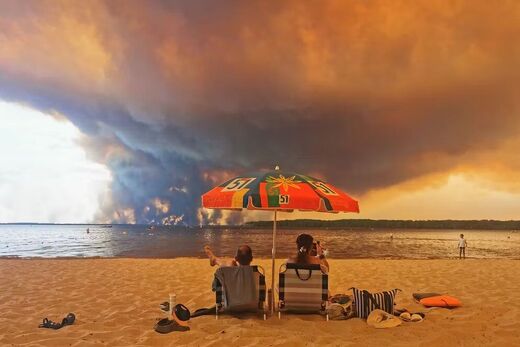
As emergency crews battle blazes across the Cape, residents in Pearly Beach flee their homes. With over 100,000 hectares burnt, the priority remains saving lives.
Several fires are raging across the Western and Eastern Cape provinces, with the Western Cape Premier stating they have 'deployed more helicopters than ever', including a military helicopter sent to assist. However, resources remain stretched, and difficult decisions are being made regarding where to focus much needed aerial efforts to prevent the loss of life at the potential cost of losing infrastructure.
Islamuddin Sajid Anadolu Agency Sat, 10 Jan 2026 18:41 UTC
A 6.4 magnitude earthquake hit eastern Indonesia late Saturday, but with no casualties reported as yet or a tsunami warning issued, according to the US Geological Survey.
The earthquake struck 244 kilometers (151.6 miles) north-northwest of the country's Tobelo area at 1458GMT, the US Geological Survey reported.
The quake was initially measured at magnitude 6.7 before being revised down to 6.5, and then to 6.4 with a depth of 52 km (32.3 mi).
Tobelo is located in the North Maluku province of eastern Indonesia, near the northern tip of Halmahera Island.
There were no immediate reports of casualties or major damage.
Indonesia's Meteorology, Climatology, and Geophysics Agency said the quake posed no tsunami threat but warned residents to stay alert for possible aftershocks, according to state-run news agency Antara.
Comment: The Business Standard reported on January 11