Earth ChangesS


Evil Rays

Mystery Booming Noise Leaves Residents and Houses Reeling in Costa Rica

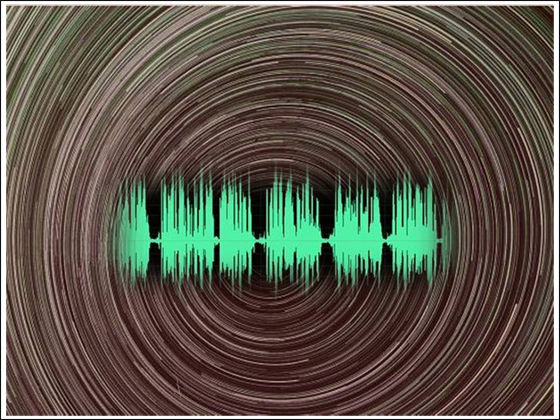
'the hum' soundwave graphic
© n/a
Authorities say the boom was not a volcanic eruption or a supersonic aircraft.

Monday morning started off with a bang for residents of the Central Valley when a loud, as yet unidentified, series of booms rattled windows about 30 minutes after midnight. Many did not hear it, but enough people did to cause a firestorm of comment on social media such as Facebook and Twitter.

The strange sound was prolonged - many described it as lasting for five minutes or so. Perhaps the only one making no comments were scientists and government authorities, who were reticent about commenting or speculating. A few things it wasn't: Volcanologists discounted a volcanic eruption; nor was it a supersonic aircraft, because the powerful radar at Juan Santamaría International Airport outside of San José picked up no planes at the time, not even subsonic ones.

Also, there were no climatological phenomena or strange weather conditions. By nightfall Monday, the speculation was still going along briskly with the major vote going to fireworks at the festival at Zapote, in San José. But many said it sounded like no fireworks they had ever heard. Mario Sánchez, spokesman for the National Meteorological Institute, discounted a storm because the only thing that would sound like the noise described would be a storm accompanied by lightning - and early Monday morning was clear with a full moon.

Snowflake

European ski resorts in 'lockdown' after freak snowfalls cut road, rail and air links

  • 1,000 British skiers trapped in Alps after severe snowfalls
  • Falling trees and rocks blocking many routes
  • Avalanche warning raised to stage three, or 'considerable risk'
  • Holidaymakers advised to stay indoors
British holidaymakers are in a race against time to get out of Austrian ski resorts before more snowfalls arrive at the weekend.

Many have become stranded since the weekend because of the heaviest snowfalls in Alps in the past 30 years.

Some holiday makers are four days overdue to be back home and back at work due to the weather. As much as 18ft has fallen over the past few days.
Image
© Getty ImagesClearing up: A resident in Ischgl, Austria, contemplates the enormous task of clearing the snow from his roof

Igloo

US: First winter blast hits Northeast, Midwest

Cold fronts moving in from the north on Thursday made for the first winter blast across the Midwest and Northeast, with parts of Connecticut seeing their first snow since October and snow-starved Chicago expected to get hit later in the day.

"This is a pretty potent storm and covers a wide area," TODAY's weather and feature anchor Al Roker warned.

Up to 3 inches fell overnight in Connecticut, the first since an early October snowstorm, NBC Connecticut reported.
Image
© Seth Perlman/APSpringfield, Illinois, on Thursday saw its first significant snow in nearly 11 months.
Kansas City, Mo., also saw about an inch of snow overnight as a system moved into the Midwest.

The Weather Channel said winter was making "a roaring comeback" across the country after weeks of mild weather.

Up to 8 inches of snow was forecast for Chicago, and even more for neighboring northwest Indiana, NBC Chicago reported.

New England should see 6-9 inches in many areas, and isolated areas could get a foot, Roker forecast.

Parts of Rhode Island and Massachusetts saw slushy snow early Thursday, making for a messy commute.

Areas as far south as Nashville, Tenn., could also see a bit of snow Thursday.

Igloo

Australia: Cold snap sets new record low temperatures

Summer Snow in Oz
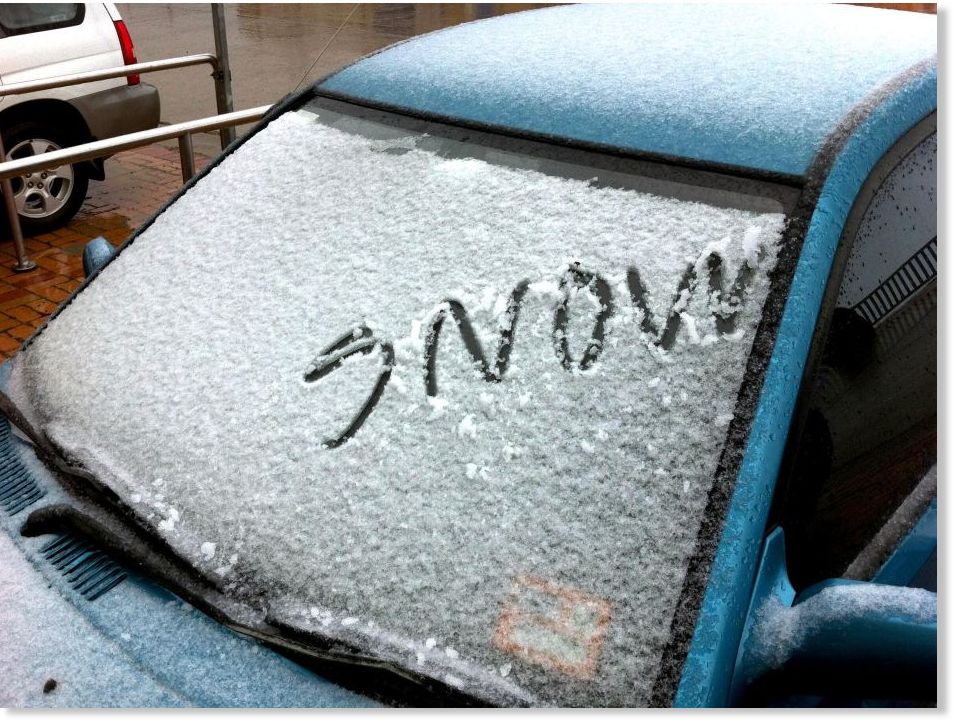
© Gillian DobsonA message is written on a car windscreen after Mt Buller in the Victorian Alps received a sprinkling of snow on January 11
The weather bureau says an extreme cold front has broken a series of low temperature records for Canberra, Goulburn and the Snowy Mountains.

The southern tablelands and Victoria's Alpine region have also been hit by the summer chill.

A rapidly moving cold front from Antarctica moved though Tasmania, Victoria, New South Wales and the ACT yesterday.

The icy and changeable weather delivered a low of -4 degrees Celsius and a dusting of snow to the Snowy Mountains.

Igloo

Best of the Web: Ice Age "News" is Wrong--It's Coming Sooner Than Later

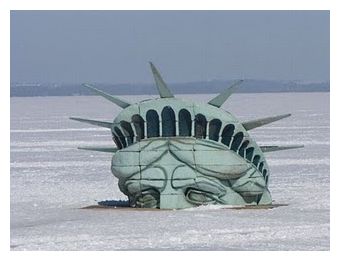
Liberty in Ice
© Warning Signs

When you consider the millions of words published as "news" about global warming, a massive hoax based on the theory that an increase in the Earth's levels of carbon dioxide (CO2), a minor atmospheric gas (0.0380%), it boggles the mind that reporters for a respected newswire, Reuters, would still be writing utter rubbish about it.

Just as the "news" about global warming was demolished in 2009 and again in 2011 with the leaked emails of the conspirators behind the fictions of the United Nations Intergovernmental Panel on Climate Change (IPCC), the main agency behind the hoax, on January 9, Nina Chesney of Reuters London Bureau, reported about a paper in the journal, Nature Geoscience, that the "Next Ice Age not likely before 1,500 years: study."

The paper claimed that "Concentrations of the main gases blamed for global warming reached record levels in 2010 and will linger in the atmosphere for decades even if the world stopped pumping out emissions today, according to the U.N.'s weather agency."

The U.N. does not have a "weather agency." It has a propaganda agency devoted in its own words to "climate." The two are not the same. Weather is what is occurring right now and climate is the measurement of trends over centuries.

Radar

7.3 Magnitude Earthquake Hits off Indonesia; Panic, No Injuries

Image
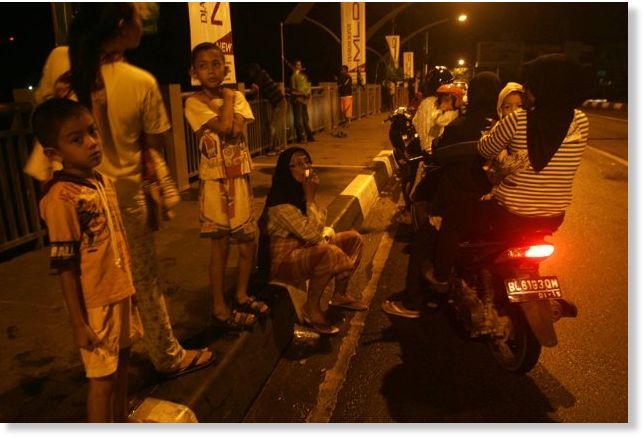
© The Associated Press/Heri Juanda Local residents wait for evacuation on a roadside following an earthquake in Banda Aceh, Aceh province, Indonesia, early Wednesday, Jan. 11, 2012.
A powerful earthquake hit off the coast of western Indonesia early Wednesday, prompting officials to briefly issue a tsunami warning. Panicked residents ran from their homes, some fleeing to high ground by car or motorcycle, but there were no reports of injuries or serious damage.

The U.S. Geological Survey said the magnitude-7.3 quake struck 260 miles (420 kilometers) off the coast of Aceh province just after midnight. It was centered 18 miles (30 kilometers) beneath the ocean floor.

People in the provincial capital, Banda Aceh - still deeply traumatized by the 2004 monster quake and tsunami - poured into the streets as sirens blared from local mosques. Some headed to the hills, choking roads with traffic.

"I'm afraid," said Fera, a resident, who skidded off on her motorbike with her two children and her mother.

Nuke

Fukushima Lays Bare Japanese Media's Ties to Top

Chief Cabinet Secretary Yukio Edano
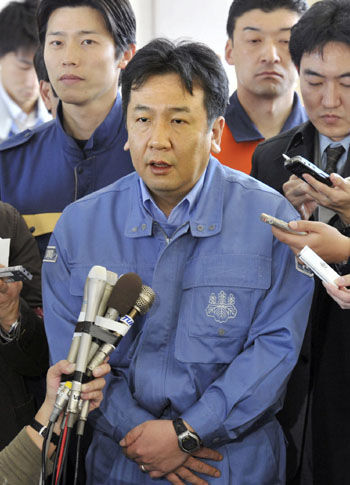
© KyodoOfficial lines: Chief Cabinet Secretary Yukio Edano on April 17, 2011, during his first visit to Fukushima after the disasters triggered by March 11's Great East Japan Earthquake.
Is the ongoing crisis surrounding the Fukushima No. 1 nuclear power plant being accurately reported in the Japanese media?

No, says independent journalist Shigeo Abe, who claims the authorities, and many journalists, have done a poor job of informing people about nuclear power in Japan both before and during the crisis - and that the clean-up costs are now being massively underestimated and under-reported.

"The government says that as long as the radioactive leak can be dammed from the sides it can be stopped, but that's wrong," Abe insists. "They're going to have to build a huge trench underneath the plant to contain the radiation - a giant diaper. That is a huge-scale construction and will cost a fortune. The government knows that but won't reveal it."

The disaster at the Fukushima plant operated by Tokyo Electric Power Co. (Tepco) again revealed one of the major fault lines of Japanese journalism - that between the mainstream media and the mass-selling weeklies and their ranks of freelancers.

The mainstream media has long been part of the press-club system, which funnels information from official Japan to the public. Critics say the system locks the country's most influential journalists into a symbiotic relationship with their sources, and discourages them from investigation or independent lines of analysis.

Bizarro Earth

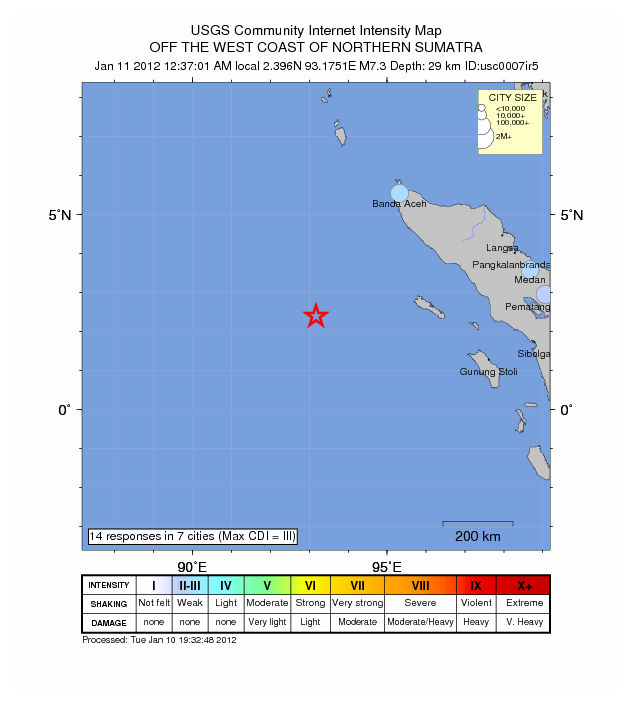
Off The West Coast of Northern Sumatra - Earthquake Magnitude 7.3

Sumatra Quake_100112
© USGS
Date-Time
Tuesday, January 10, 2012 at 18:37:01 UTC

Wednesday, January 11, 2012 at 12:37:01 AM at epicenter

Time of Earthquake in other Time Zones

Location
2.396°N, 93.175°E

Depth
29.1 km (18.1 miles)

Region
OFF THE WEST COAST OF NORTHERN SUMATRA

Distances
423 km (262 miles) SW of Banda Aceh, Sumatra, Indonesia

537 km (333 miles) SW of Lhokseumawe, Sumatra, Indonesia

951 km (590 miles) W of KUALA LUMPUR, Malaysia

1789 km (1111 miles) WNW of JAKARTA, Java, Indonesia

Bizarro Earth

South Pole Hits Record High Temperature on Christmas Day

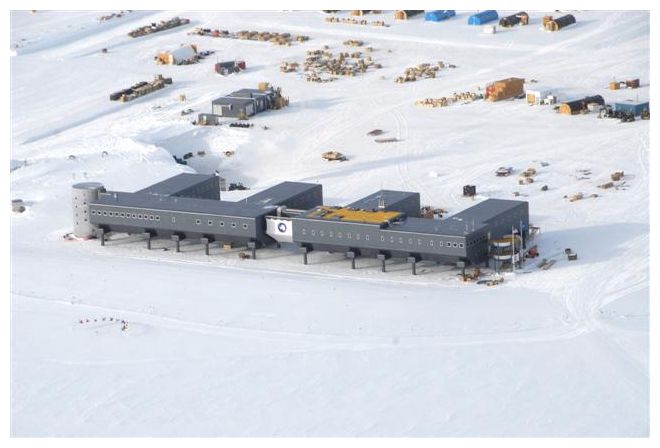
South Pole Station
© Andrew V. Williams/Antarctic Photo LibraryThe South Pole Station, which saw a record high of 9.9 degrees Fahrenheit on Christmas Day, shattering the previous record of 7.5F set 33 years ago. The warm temperatures were accompanied by a rare bit of snow.

A rare white Christmas at the South Pole brought with it a record-breaking heat wave - at least for a day.

The temperature officially hit 9.9 degrees Fahrenheit (minus 12.3 degrees Celsius) about 3:50 p.m. on Dec. 25, according to South Pole Station site senior meteorologist Phillip Marzette. That shattered the old record of 7.5F (minus 13.6C) set on Dec. 27, 1978 - though technically that record had been broken on Christmas Eve, Dec. 24, 2011, when the temperature climbed to 8.1F (minus 13.3C). (All dates and times are local, based on the New Zealand time zone.)

Those sorts of temperatures may not qualify as mild to some people, but consider that the average annual temperature at the South Pole is about minus 56.9F (minus 49.4C). In the summer, from late October to early February, the average is closer to minus 26F (minus 32C), Marzette said.

"We like to call this our little Christmas miracle that we ended up getting snow and getting a record high for the books," Marzette said a few days after the record-breaking day, when temperatures had returned to mid-summer norms, about minus 15F (minus 26C).

The snow was certainly an unexpected bonus. Precipitation in the continental interior is normally very light. Ice crystals are the most common form of precipitation at the South Pole. Ice crystals often fall out of a clear sky, glittering like tiny diamonds in the sunshine, and sometimes creating atmospheric phenomena like sundogs.

Larger snow grains often accompany storms, while actual snowflakes usually only occur at the height of summer, from mid-December to mid-January, when temperatures are at their warmest.

Bomb

"Off The Scale" Smog Grounds China Flights

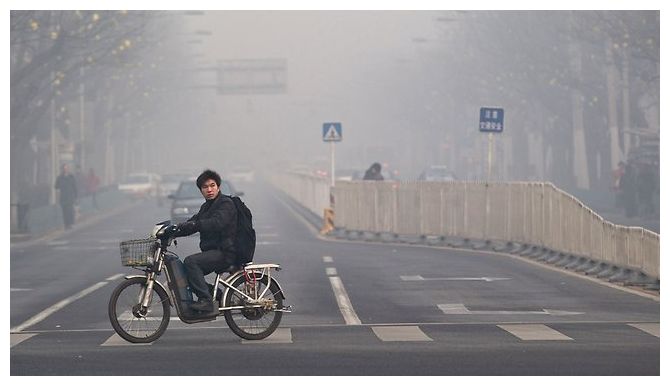
Beijing Smog
© Associated PressRider battles thick smog in Beijing on January 10, 2012.
More than 150 flights to and from Beijing have been cancelled or delayed as a thick cloud of acrid smog shrouded the city, with US figures saying the pollution was so bad it was off the scale.

The national meteorological centre said the Chinese capital had been hit by thick fog that reduced visibility to as little as 200 metres in some parts of the city, while official data judged air quality to be "good".

But the US embassy, which has its own pollution measuring system, said on its Twitter feed that the concentration of the smallest, most dangerous particles in the air was "beyond index" for most of the morning.

The US system measures particles in the air of 2.5 micrometers or less, known as PM2.5, considered the most dangerous for people's health.

Today's reading on its air quality index, which rates anything over 150 as unhealthy, over 200 as very unhealthy and over 300 as hazardous, breached the upper limit of 500, at which it stops giving figures.

Meanwhile, the Beijing Environmental Bureau, which currently bases its air quality information on particles of 10 micrometres or larger, known as PM10, said the air quality in the capital was "good".