
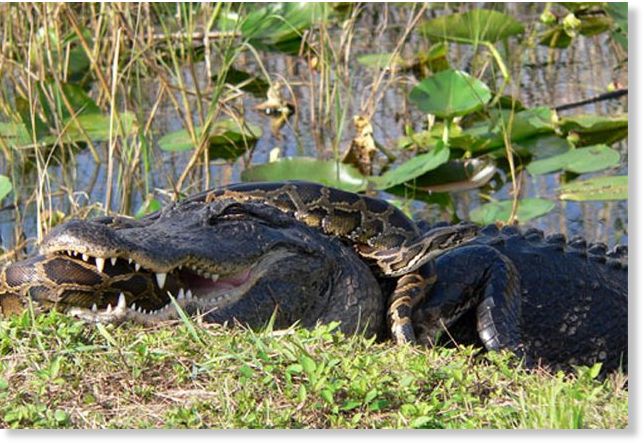
© The Associated Press/National Park Service/Lori OberhoferA Burmese python is wrapped around an American alligator in Everglades National Park, Fla.
The study, published Monday in the Proceedings of the National Academy of Sciences, found that sightings of medium-size mammals are down dramatically - as much as 99 percent, in some cases - in areas where pythons and other large, non-native constrictor snakes are known to be lurking.
Scientists fear the pythons could disrupt the food chain and upset the Everglades' environmental balance in ways difficult to predict.
"The effects of declining mammal populations on the overall Everglades ecosystem, which extends well beyond the national park boundaries, are likely profound," said John Willson, a research scientist at Virginia Tech University and co-author of the study.
Tens of thousands of Burmese pythons, which are native to Southeast Asia, are believed to be living in the Everglades, where they thrive in the warm, humid climate. While many were apparently released by their owners, others may have escaped from pet shops during Hurricane Andrew in 1992 and have been reproducing ever since.
















Comment: For further information on "strange sounds from the sky" watch the latest Sott report: Strange Noises in the Sky: Trumpets of the Apocalypse?