Earth ChangesS


Evil Rays

3.6 earthquake shakes Israel's Tiberias area

A 3.6-magnitude earthquake shook Israel's Tiberias area Sunday morning, officials said. There were no reports of injuries or damage.

The quake's center was about three miles northeast of Ginosar, near Lake Kinnere, Ynetnews.com reported.

Residents of the area wrote Ynetnews.com about how objects shook in their homes.

"I felt like someone was pushing me off the chair," said Noa Boganim from Tiberias.

Michael from Tiberias wrote: "I felt as if I was dizzy, the computer screen fell down."

This was the third quake to strike Israel in four days, The Jerusalem Post reported.

Heart - Black

Poachers kill 300 Zimbabwe elephants with cyanide

Cyanide has been used to kill 300 elephants in Zimbabwe's biggest nature reserve - three times the original estimate - as new photos show the scale of the slaughter

Image
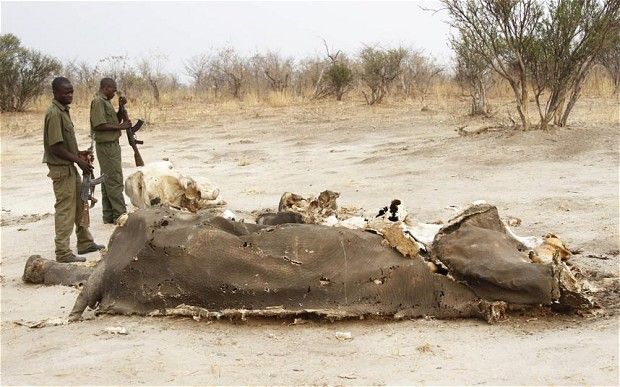
© APWorkers look at a rotting elephant carcass in Hwange National Park, Zimbabwe
Poachers in Zimbabwe have killed more than 300 elephants and countless other safari animals by cyanide poisoning, The Telegraph has learned.

The full extent of the devastation wreaked in Hwange, the country's largest national park, has been revealed by legitimate hunters who discovered what conservationists say is the worst single massacre in southern Africa for 25 years.

Pictures taken by the hunters, which have been obtained exclusively by The Telegraph, reveal horrific scenes. Parts of the national park, whose more accessible areas are visited by thousands of tourists each year, can be seen from the air to be littered with the deflated corpses of elephants, often with their young calves dead beside them, as well as those of other animals.

There is now deep concern that the use of cyanide - first revealed in July, but on a scale that has only now emerged - represents a new and particularly damaging technique in the already soaring poaching trade.

Zimbabwean authorities said that 90 animals were killed this way. But the hunters who captured these photographs say they have conducted a wider aerial survey and counted the corpses of more than 300.

Bizarro Earth

Second rare oarfish washes up in Southern California

Oarfish
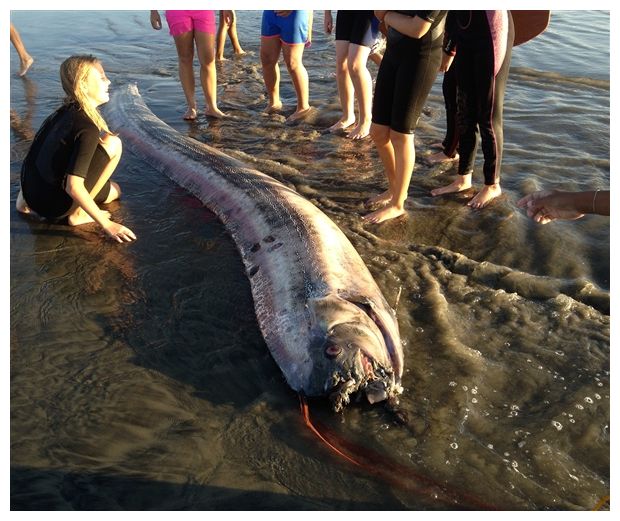
© Mark Bussey/OceansideA 13.5 foot oarfish was found along the coast in Oceanside, Calif. on Friday.
For the second time in a week, the rare, serpentine oarfish has surfaced on a Southern California beach.

Beach goers at Oceanside Harbor crossed paths Friday afternoon with the deep-sea monster when its carcass washed ashore, Oceanside Police Officer Mark Bussey said. The fish measured 13 ½ feet long.

The discovery came just days after an 18-foot dead oarfish was found in the waters off Catalina Island.

"The call came out as a possible dead whale stranded on the beach, so we responded and saw the fish on the sand right as it washed up," Bussey said.

Oceanside police then contacted SeaWorld San Diego, the Scripps Research Institute and the National Oceanic and Atmospheric Administration. Suzanne Kohin of NOAA Fisheries Serivice responded, measured and took possession of the oarfish for research, Bussey said.

Bussey added that people on the beach were "flabbergasted" to see the fish.

Comment: See also.

18-foot oarfish caught by Catalina marine science instructor in California

Something amiss deep down? Bizarre-looking oarfish washes ashore on Cabo San Lucas beach

Appearance of "Earthquake fish" spook Japanese

Rare "King of Herrings" Found off Swedish Coast

England: Monster of deep washes up on beach


Water

Copersucar blaze: Brazil's Santos port fire destroys one of world's biggest sugar terminals

180,000 tonnes of sugar have been destroyed - driving prices up to the highest in a year.
brazil sugar factory blaze
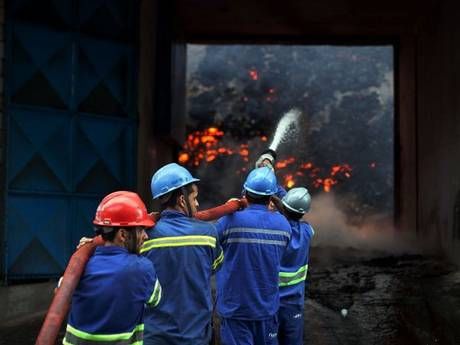
© AFP/Getty ImagesFirefighters attempt to extinguish a fire in a warehouse with sugar at the port of Santos, the biggest of Latin America, some 60 km of Sao Paulo, Brazil on 18 October, 2013.
A fire that blazed through Brazil's Santos port has ravaged six warehouses, destroying 180,000 tonnes of raw sugar in the Copersucar terminal.

The fire hit all of the sugar giant's warehouses at the port, driving prices up to the highest in a year.

Operations at the world's biggest sugar trader, which sees nearly a fifth of world sugar exports pass through its trading desks, have now been paralysed.

Santos port authority Codesp said the fire started in the conveyor system responsible for transporting sugar through Copersucar's warehouses at around 6am (9am GMT).

Fire fighters battled for six hours to extinguish the flames and warn it could keep smoldering for two days.

In a statement, Codesp said: "Facilities involved in the accident are totally destroyed."

Television footage showed a mountain of sugar three stories high engulfed by flames inside a warehouse, surrounded by overhanging conveyor belts and waiting ships that appeared to have been toppled over.

International sugar markets reacted quickly. ICE March raw sugar prices rose more than six per cent to a one-year high on news of the fire before paring gains. The March contract settled up 2.5 per cent at 19.48 cents per lb.

Newspaper

LA Times bans letters from climate skeptics

Image
The Los Angeles Times is giving the cold shoulder to global warming skeptics.

Paul Thornton, editor of the paper's letters section, recently wrote a letter of his own, stating flatly that he won't publish some letters from those skeptical of man's role in our planet's warming climate. In Thornton's eyes, those people are often wrong -- and he doesn't print obviously wrong statements.

"Simply put, I do my best to keep errors of fact off the letters page; when one does run, a correction is published," Thornton wrote. "Saying 'there's no sign humans have caused climate change' is not stating an opinion, it's asserting a factual inaccuracy."

What amounts to a ban on discourse about climate change stirred outrage among scientists who have written exactly that sort of letter.

"In a word, the LA Times should be ashamed of itself," William Happer, a physics professor at Princeton, told FoxNews.com.

"There was an effective embargo on alternative opinions, so making it official really does not change things," said Jan Breslow, head of the Laboratory of Biochemical Genetics and Metabolism at The Rockefeller University in New York.

Nuke

6,500 times spike in radiation at Fukushima water tank; "nobody really knows how to dodge disaster"


Cow

3,060 head of cattle have fallen to foot-and-mouth disease in India

The foot-and-mouth disease appears only to be spreading geographically and in intensity across the State, even as the Animal Husbandry Department reiterates that the cattle disease is "under control".
By Wednesday, the disease had claimed 3,060 head of cattle (since September 1), according to official figures with the department, a significant jump from last week's casualty figure of 2,060. Another 23,500 animals have been infected with the virus, as against 16,573 last week.
Image
The Animal Husbandry Department has reiterated that the cattle disease is 'under control.'

The disease, which so far had South Karnataka under its grip, now appears to have spread to several other districts, including those in the north of the State such as Bidar, Bellary and Belgaum.

Deputy Director of the Animal Husbandry Department Sriram Reddy, however, said the disease was "under control" and that the department was continuing its "ring vaccination" of cattle within a specified radius of affected villages.

Network

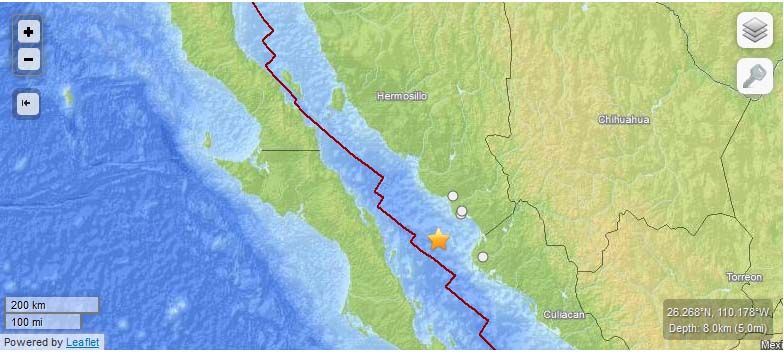
USGS: Earthquake Magnitude 6.5 - 75km SW of Etchoropo, Mexico

Mexico earthquake
© USGS
Event Time
2013-10-19 17:54:56 UTC
2013-10-19 10:54:56 UTC-07:00

Location
26.268°N 110.178°W depth=8.0km (5.0mi)


Nearby Cities

75km (47mi) SW of Etchoropo, Mexico
82km (51mi) SW of Huatabampo, Mexico
100km (62mi) SSW of Villa Juarez, Mexico
106km (66mi) WNW of Ahome, Mexico
816km (507mi) SSE of Phoenix, Arizona

Technical Data

Windsock

Category 4 Tropical Cyclone Phailin makes landfall in India: 500,000 evacuated

Cyclone Phailin
© weather.comCyclone Phailin
From the BBC - "As many as 500,000 people in India have been evacuated as a massive cyclone sweeps through the Bay of Bengal towards the east coast.

Cyclone Phailin, categorized as "very severe" by weather forecasters, is expected to hit Orissa and Andhra Pradesh states on Saturday evening.

The Meteorological Department has predicted the storm will bring winds of up to 220km/h (136mph).

A super-cyclone in 1999 killed more than 10,000 people in Orissa.

But officials say this time they are better prepared, the BBC's Sanjoy Majumder in Orissa reports.


Fish

And then they came for the oceans: Biologists call for part privatisation of oceans

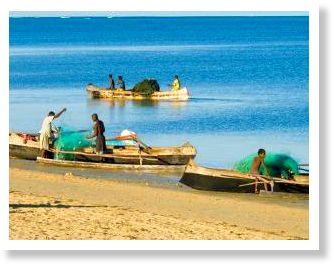
Mozambique Channel
© Danita Delimont/Gallo Images/GettyThe marine life in the Mozambique Channel will suffer unless protection measures are put in place. But is Ocean privatization the solution?
If you can't beat them, join them. Leading marine biologists have joined a call to partly privatise the oceans' beleaguered biology, in the interests of effective conservation. The kill-or-cure message comes from a "blue-ribbon panel" set up by the World Bank's Global Partnership for Oceans, which aims to come up with effective ways of financing ocean protection.

The panel of 21 scientists, conservationists, government representatives and seafood industrialists warns in its new report that the oceans are in crisis as a result of overfishing, pollution, global warming and ocean acidification.

"We've got 10 years to set the oceans on a course that is sustainable, or they will be in a terminal state of decline," says the chair of the panel, Ove Hoegh-Guldberg, a coral reef biologist from the University of Queensland in Brisbane, Australia.

The panel says conservation will only work if it delivers acceptable economic benefits. The solution, it says, lies in public-private partnerships that bring together fishing communities, corporations and governments.

Comment: When did government or corporate involvement bring any benefit to the environment?! Mother nature, if left alone, is perfectly capable of restoring balance. Government and corporate privatization of parts of the oceans means only one thing: exploitation of the natural resources.