Earth ChangesS


Bizarro Earth

'Volcano-like eruption' on Manipur hill, India see locals flee to safety

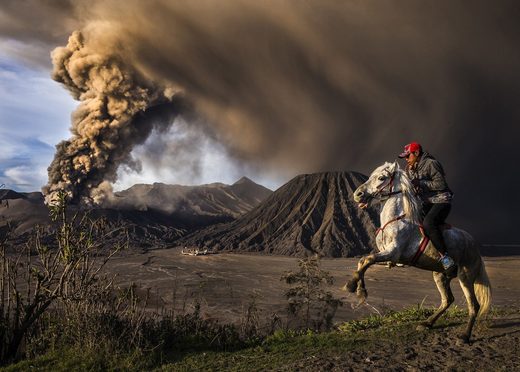
A suspected volcano-like eruption has been reported in a remote village of Manipur near the India-Myanmar border which forced locals to evacuate the area, official sources said on Sunday.

According to locals in Tusom village in Ukhrul district of Manipur, a deafening sound was followed by the rolling down of a huge boulder from a nearby hilltop which then released a lava-like liquid that charred trees and plants on the hill slopes.

Although the incident reportedly occurred on October 13, road link between the district headquarters and Tusom was so bad it took the villagers several days to reach the information about the matter to the officials concerned, sources said.

The district headquarters is 120km away from the village. No casualty was, however, reported in the incident. Official reports from the district said mud, water and other discharges were still flowing from the hilltop. Villagers have moved to safer places in the neighbourhood, they added.

Sources said it would take time to assess whether the event was a volcanic eruption or not.

Bizarro Earth

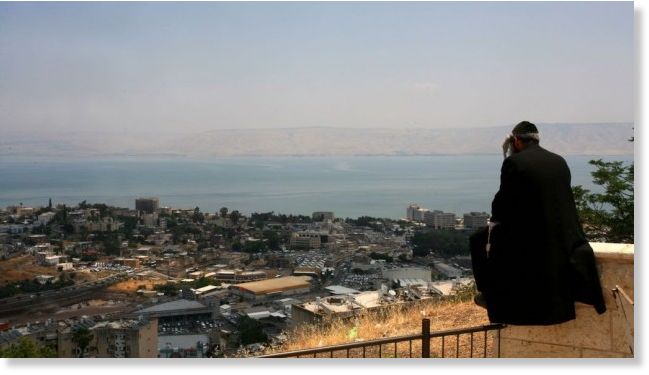
Fifth earthquake in six days rattles northern Israel

Image
A small earthquake shook the Sea of Galilee area on Tuesday morning, the fifth such tremor in less than a week. The quake, measuring 3.3 on the Richter scale, caused no reported damage or injuries. On Sunday, two minor earthquakes, both measuring 3.6 in intensity, were reported in the north, which followed similar quakes on Saturday and Thursday. No injuries have been reported, although some buildings in Tiberias were lightly damaged by the tremors. Last Sunday, a 6.4-magnitude quake, centered in the Mediterranean Sea near Crete, was felt in Athens, Egypt and Israel. And in September, an early-morning 3.5-magnitude quake was felt in the northern Dead Sea area, including in Jerusalem. In response to the string of temblors, Prime Minister Benjamin Netanyahu convened a special cabinet meeting Monday to discuss the state's earthquake preparedness, and, on Sunday, the Home Front Command and emergency services representatives held a meeting to discuss emergency procedures in the case of a more major earthquake.

However, seismologist Dov Lakovsky of the Geophysical Institute of Israel told The Times of Israel Sunday that there was no cause for alarm and that the quakes were just "a bit stronger than usual." Such tremors, he said, "happen all the time." According to the GII's statistics, seven earthquakes strong enough to be felt have rattled Israel in 2013. Israel is situated along the Syrian-African rift, a tear in the earth's crust running the length of the border separating Israel and Jordan, and is part of the Great Rift Valley, which extends from northern Syria to Mozambique. Israel's last major earthquake rattled the region in 1927 - a 6.2-magnitude tremor that killed 500 and injured another 700. An earthquake in 1837 left as many as 5,000 people dead. According to a 2010 Haaretz report, major earthquakes strike Israel once every 80 years or so. The country is currently in the midst of a program to upgrade buildings to withstand earthquakes.

Bizarro Earth

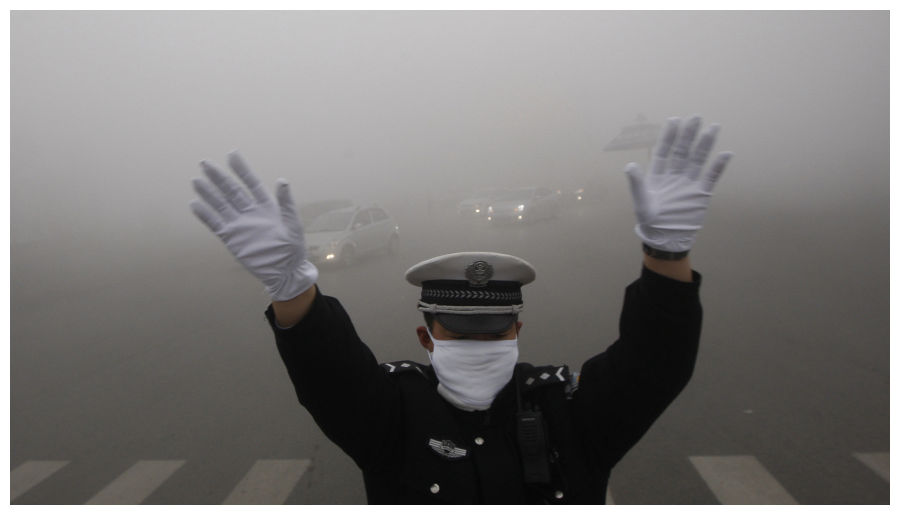
China's northeast hit by air pollution so bad "you can't see your own fingers in front of you"

China Air Pollution_1
© Reuters/China DailyA traffic cop braves Harbin's haze.
It's getting colder in China, which means firing up the coal plants and turning the atmosphere into a toxic sauna.

And it's not surprising that China's first major "airpocalypse" of this winter season was in Harbin, the capital of Heilongjiang province, in China's far northeast. Visibility in Harbin hit 10 meters (33 feet) today, as the city's air quality index (AQI), which measures fine particulate matter (PM2.5) per cubic meter, exceeded 500 - at least 20 times greater than levels the World Health Organization deems safe. And that was just in the "good" neighborhoods. In some areas, PM2.5 soared to 1,000. (For comparison, PM2.5 exceeded 900 during Beijing's notorious airpocalypse last winter.) "You can't see your own fingers in front of you," Harbin's official news site noted, reports Sinosphere, the New York Times' new China blog.

That was severe enough to prompt local officials to close schools and warn Harbin's 11 million residents to stay home. And that wasn't just for their lungs. The noxious fug clouded visibility so much that it caused two pileups before the police closed off highways (link in Chinese), shutting Heilongjiang province airports as well. Meanwhile, patients with breathing problems mobbed Harbin hospitals, driving admissions up 30%, says Sinosphere.

Attention

Yachtsman describes horror at 'dead', rubbish strewn Pacific Ocean

Ivan MacFadyen says he was shocked by absence of sea life during his 37,000km voyage between Australia and Japan

Image
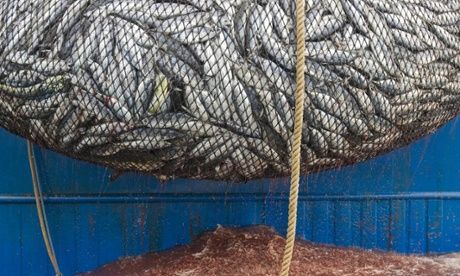
© Greenpeace, Alex Hofford/AAPA fishing net on a boat in the Pacific Ocean loaded with tuna and bycatch.
An Australian sailor has described parts of the Pacific Ocean as "dead" because of severe overfishing, with his vessel having to repeatedly swerve debris for thousands of kilometres on a journey from Australia to Japan.

Ivan MacFadyen told of his horror at the severe lack of marine life and copious amounts of rubbish witnessed on a yacht race between Melbourne and Osaka. He recently returned from the trip, which he previously completed 10 years ago.

"In 2003, I caught a fish every day," he told Guardian Australia. "Ten years later to the day, sailing almost exactly the same course, I caught nothing. It started to strike me the closer we got to Japan that the ocean was dead.

"Normally when you are sailing a yacht, there are one or two pods of dolphins playing by the boat, or sharks, or turtles or whales. There are usually birds feeding by the boat. But there was none of that. I've been sailing for 35 years and it's only when these things aren't there that you notice them.

MacFadyen said that the lack of ocean life started at the edge of the Great Barrier Reef, describing Queensland waters as "barren" and "unquestionably overfished".

Cloud Precipitation

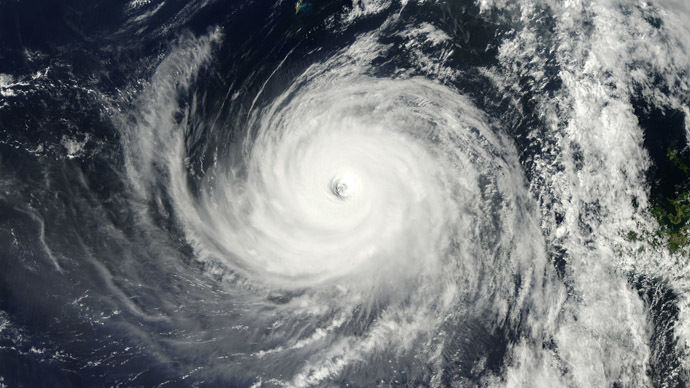
Hurricane Raymond strengthens off Mexico's Pacific coast

Hurricane Raymond picked up strength Monday as it churned off a region of Mexico's Pacific coast still recovering from a devastating storm last month. In just a few hours, Raymond went from a tropical storm to a Category Three hurricane on the five-point Saffir-Simpson scale, the Miami-based National Hurricane Center (NHC), which tracks hurricanes in the hemisphere, reported at 0900 GMT.
Image
© AFPView of a flooded street in Acapulco, Guerrero state, Mexico, Sept 26, 2013
Raymond packed maximum sustained winds of 195 kph, with higher gusts. Hurricane force winds extend up to 30 kilometers out from the storm's center, while tropical force winds extend up to 110 kilometers. "Some additional strengthening is possible during the next day or so," the NHC warned.

Raymond however stalled some 265 kilometers west-southwest of the resort town of Acapulco after steadily moving for hours towards the mainland, the NHC said.

Windsock

Flashback 'Hay tornado' whips through Hampshire farm

Amateur footage shows the moment a dust devil sucked up straw on farmland near the Hampshire village of Dummer, sending it flying hundreds of feet into the air.

A Hampshire man had the rare privilege in the UK of witnessing a dust devil touch down in farmland near his home.

Kevin Farndell, 63, filmed the phenomenon on his mobile phone and uploaded it to his YouTube page.


The dust devil sucked up loose straw waiting to be bailed after a recent harvest sending it swirling over the field for around 45 seconds.

Mr Farndell said it was "quite a sight."

Dust devils form when warm air close the surface of the land rises rapidly through an area of cooler air above. They rarely cause injuries, but have been witnessed reaching heights up to 1,100 yards (1,000m).

Windsock

Tornado comes ashore in Hampshire, UK - 100 homes damaged

Image
© Ian Hoult
About 100 homes have been damaged by a "tornado" on Hayling Island in Hampshire, police have said.

Havant Council said properties in Blackthorn Road and Ilex Walk were damaged by high winds at about 08:00 BST.

The council said there were no reported injuries and its officers were assessing the damage to properties.

Kayla Killshaw-Laing, who was staying on the island overnight, described the experience as "horrendous".

Hampshire Constabulary has received calls regarding damaged vehicles, power lines, and beach huts.

Highway teams are currently clearing up debris around the area.

He said: "We drove down to survey the damage and were quite shocked by what we saw... the neighbouring hut was lifted too."

Umbrella

Japan's shocking, deadly deluge from Typhoon Wipha: 33 inches of rain in 24 hours

Image
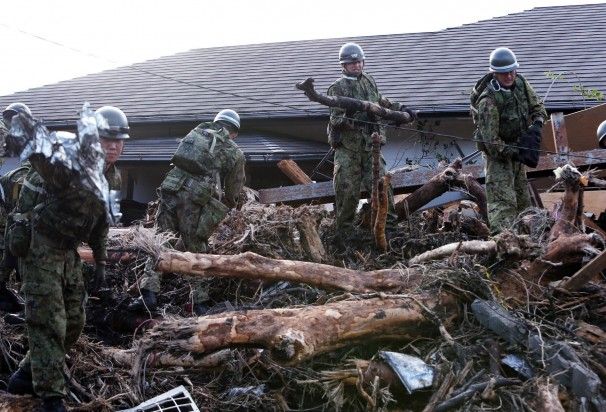
© AFP PHOTO / JIJI PRESS JAPAN OUTJIJI PRESS/AFP/Getty ImagesJapan’s Ground Self Defense Force soldiers remove debris to search for survivors after a landslide buried houses caused by heavy rain of typhoon Wipha at Oshima island, 120km south of Tokyo on October 16, 2013.
Here's an astonishing statistic: Typhoon Wipha dumped 33 inches (850 mm) of rain in 24 hours on Oshima Island, 75 miles south of Tokyo.

It is the greatest rainstorm to occur on Oshima, populated by 8,200 people, since records began in 1991 reports the AP. It also twice the entire average rainfall for the month of October, notes the Wall Street Journal.

"People on this island are somewhat used to heavy rainstorms, but this typhoon was beyond our imagination," Yutaka Sagara, an island resident, told the AP.

Incredibly, 17 inches (426 mm) fell in 4 hours and nearly 5 inches in one hour.

Those are unfathomable rainfall rates and, thus, it is no surprise they led to destructive mudslides and fatalities.

At least 17 people are dead from the typhoon and 45 to 50 missing according to wire reports. 16 of the 17 casualties occurred on Oshima.

Nuke

Unprecedented deluge leaks radioactive water from Fukushima nuclear plant into Pacific Ocean

Image
The operator of the Fukushima Daiichi nuclear power plant says water has overflowed 12 barriers around tanks holding radioactive water. Tokyo Electric Power Company says some of the water may have reached the ocean.

The utility says workers found water overflowing from five barriers Sunday afternoon. They found additional overflows in seven barriers Sunday evening.

TEPCO says the barriers are 30-centimeter-high. Some of them have already contained at least 20-centimeters of rain water. But workers can pump out only a couple of centimeters a day.

More than 100 millimeters of rain was recorded at the Fukushima Daiichi nuclear power plant over four hours on Sunday afternoon.

The operator of the crippled plant also says workers released some of the water accumulated inside barriers into the ground. The utility says the water met safety standards for radioactivity approved by the Nuclear Regulation Authority.

Bizarro Earth

The ocean is broken

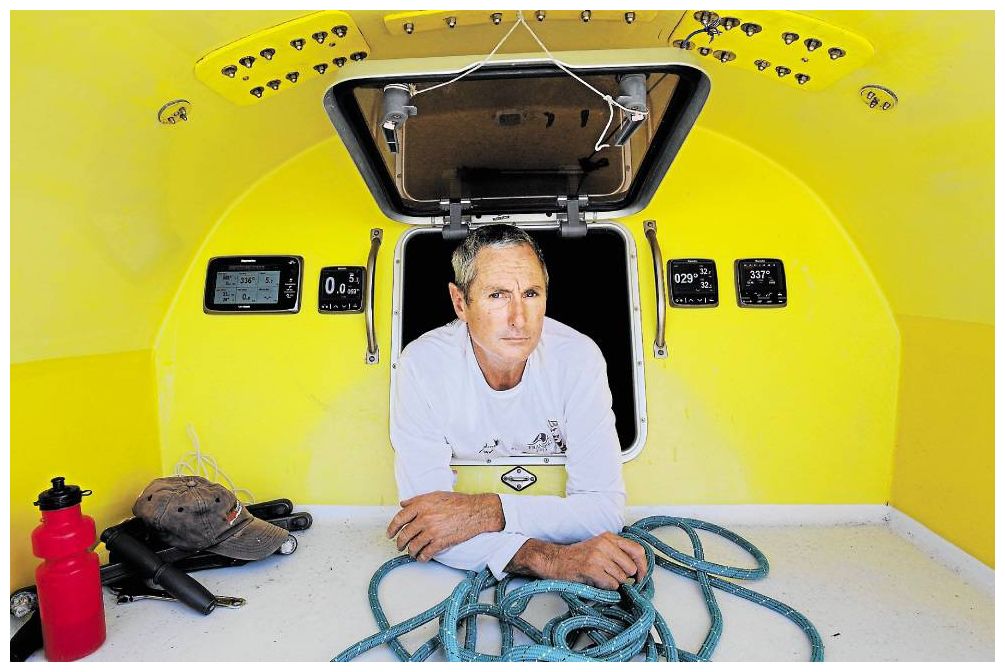
Ivan
© The Herald, AustraliaIvan Macfadyen aboard the Funnel Web.
It was the silence that made this voyage different from all of those before it.

Not the absence of sound, exactly.

The wind still whipped the sails and whistled in the rigging. The waves still sloshed against the fibreglass hull.

And there were plenty of other noises: muffled thuds and bumps and scrapes as the boat knocked against pieces of debris.

What was missing was the cries of the seabirds which, on all previous similar voyages, had surrounded the boat.

The birds were missing because the fish were missing.

Exactly 10 years before, when Newcastle yachtsman Ivan Macfadyen had sailed exactly the same course from Melbourne to Osaka, all he'd had to do to catch a fish from the ocean between Brisbane and Japan was throw out a baited line.

"There was not one of the 28 days on that portion of the trip when we didn't catch a good-sized fish to cook up and eat with some rice," Macfadyen recalled.

But this time, on that whole long leg of sea journey, the total catch was two.

No fish. No birds. Hardly a sign of life at all.