Earth ChangesS


Magnify

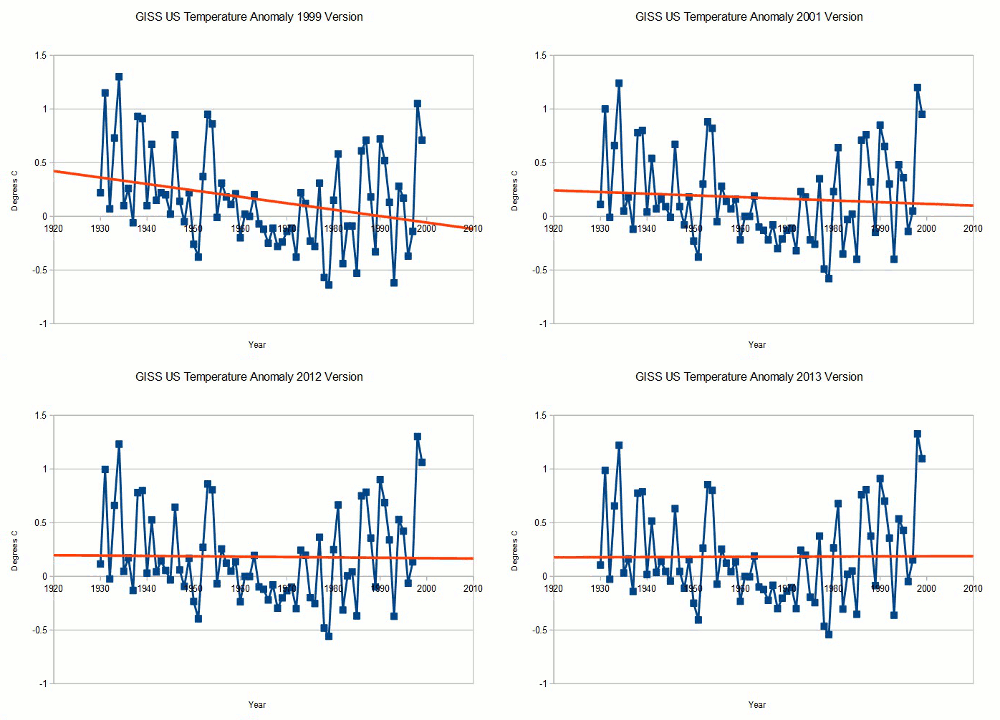
Thirteen years of NASA data tampering - in six seconds


1999 version : www.giss.nasa.gov/data/update/gistemp/graphs/FigD.txt
2001 version : www.giss.nasa.gov/data/update/gistemp/graphs/FigD.txt
2012 version : data.giss.nasa.gov/gistemp/graphs_v3/Fig.D.txt
2013 version : data.giss.nasa.gov/gistemp/graphs_v3/Fig.D.txt

The animation above shows four versions of GISS 1930-1999 US temperatures - from 1999, 2001, 2012, and 2013. NASA has repeatedly tampered* with the data to hide the decline in US temperatures since the 1930′s. Each successive alteration makes the past cooler and the present warmer.

Earlier versions showed even more of a decline, but I can't locate digital data for them.

*Mosher says these adjustments are all first rate science.


Comment: All kinds of scientific frauds are being committed in order to convince a shivering population that the globe is warming, when all the data says otherwise.


Snowflake Cold

Video: Snow in the Middle East, floods and fireballs in the first half of December 2013


Question

Unexplained mass animal deaths - documentary


Unexplained mass animal deaths from across the globe over the last two years. Featuring dead fish, birds, bees, bats, crabs, dolphins, whales and other species.

Eagle

Dead bald eagle total increases to 13 in Utah

Image
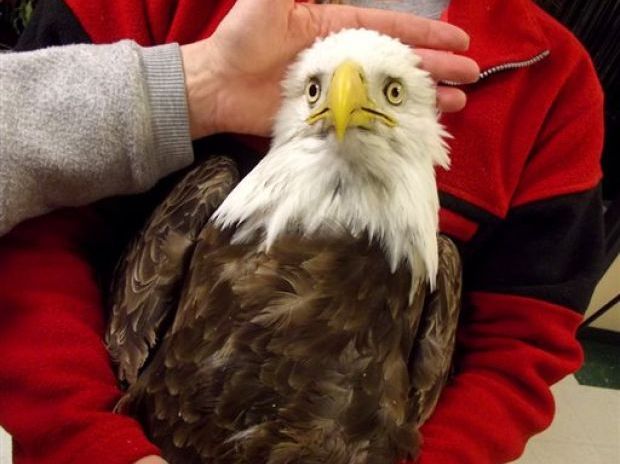
© AP Photo/Wildlife Rehabilitation Center of Northern Utah)This undated image provided by the Wildlife Rehabilitation Center of Northern Utah shows one of four bald eagle that was brought into the center, but eventually died. They each had symptoms: body tremors and paralysis. Four bald eagles have died in northern Utah in the past two weeks, raising alarms among state wildlife officials.
The recent deaths of as many as 13 bald eagles found in Northern Utah is alarming.

As predators, the poor health of bald eagles can be an indicator of bigger problems. Like a canary in a coal mine -- which was a warning for miners that their oxygen was being depleted -- the rash of deaths could be a sign of some environmental imbalance in the region.

Thousands of bald eagles migrate to Utah each winter, with many gathering at the Great Salt Lake where they feast on carp in diked freshwater reservoirs, such as Farmington Bay.

Bald eagles almost went extinct in the lower 48 states because of their susceptibility to pesticides they may have breathed in or ingested through fish. It wasn't until 1972 when DDT was banned in the United States that eagles began to rebound. In this case, the pesticide didn't kill adult eagles, but made males sterile and caused females to lay eggs that were too thin.

Question

Namibia: Dead Cape seals litter coast

The Ministry of Fisheries and Marine Resources received numerous reports from the public regarding dead Cape seals washed ashore as well as living seals that appear to be lost or hungry along the coast.

The Ministry of Fisheries and Marine Resources therefore wishes to inform the public that these scenarios are natural and occur more frequent during the August to February period.

The Cape fur seal (Arctocephalus pusillus pusillus) is endemic to the Southern African region (southern Angola to the west coast of South Africa). About 60 percent of the Southern African population occurs in Namibia along the coastline on twenty-six colonies, some of which are situated on islands and others on land. To date, Namibia has about 1.2 million Cape fur seals, which is the highest recorded population estimate.

The period between November and December is a breeding season for seals and during this period many pups from the previous breeding season are weaned and expected to fend for themselves. Some pups find it difficult to survive on their own in the new environment, hence they starve and die, while others get lost and end up in strange places, such as towns, instead of going back to their colonies, stated the Ministry of Fisheries and Marine Resources.

"At the breeding colonies, new-born pups usually die from being abandoned by their mothers or from injuries incurred during bull fights. Furthermore, pups that are born on islands are at a high risk of drowning during high tides. Mortalities may also result from viral or bacterial infections," the ministry said.

"Thus, it is normal to encounter dead and lost seal pups along the coastline during this time of the year. Besides natural causes of death, anthropogenic induced mortality, especially littering from fishing gear, especially nylon material, results in snares that entangle body parts (e.g. neck). As the entangled animal grows, the snare cuts through the flesh suffocating the animal leading to death (when neck entangled). Flipper entanglement disables the seal causing it to drown," Charlie Matengu the spokesman at the Ministry of Fisheries and Marine Resources stated on Wednesday.

The ministry acknowledges and shares the concerns of the public. However, this is a natural phenomenon and very little can be done as it is extremely difficult to rear seal pups outside of their natural environment. Therefore, the ministry advises the public (as per the Marine Resources Act of 2000, section 32 (1)) not to touch or remove seals from their natural habitat.

"The ministry's officials will continue to closely monitor the population and any abnormal mortalities observed shall be communicated to the public," Matengu assured in the statement.

Info

South Africa: 300 dead seals wash ashore in Cape Town

Image
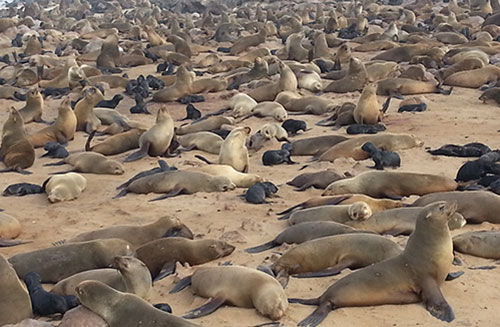
Disaster management officials say they have removed about 300 dead seals from Kommetjie Beach in Cape Town.

A high tide or extreme wind conditions probably caused the animals to be washed off Seal Island on Thursday night and officials say it is not a particularly unusual phenomenon.

Hundreds of dead seals are scattered around the peninsula from Strandfontein as far as Kommetjie.

Those passing by say the mammals have been laying there for hours.

An onlooker who drives past Muizenberg Beach everyday says he spotted the seals on the shore at 7am.

According to disaster management's Johannes Solomons-Johannes, there are more 100 dead seals which must still be removed between Strandfontein and Monwabisi Beach.

Meanwhile, the Society for the Prevention of Cruelty to Animals (SPCA) says it is not that unusual for dead seals to wash ashore in Cape Town at this time of year.

However, it is surprised by the sheer number of carcasses which washed up on the False Bay coastline.

SPCA spokesperson Brett Glasby says the City of Cape Town is conducting a clean-up.

"These high winds and high seas washed over the Seal Island and seem to wash off any of the young seals that can't swim and any seals that have died on the island," he says.

Info

Florida: Number of annual manatee deaths top 800 for first time on record

Image
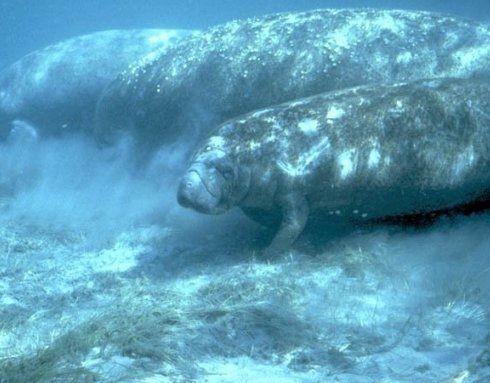
© Wikimedia Commons. A group of three manatees
For the first time since records began being kept in Florida in the 1970s, the number of manatee deaths in a single year has topped 800, with two weeks remaining to the end of 2013.

Numbers released by the Florida Fish and Wildlife Research Institute in St. Petersburg this week showed the number of dead manatees at 803 as of Dec. 13. That's about 16 percent of the state's estimated population of 5,000 manatees.

And 173 of the dead were breeding-age female manatees, Martine DeWit of the institute's Marine Mammal Pathology Laboratory said Thursday.

Although it's too soon to say how this will affect the future of the species, she said, "It must have an impact to lose these important breeding females."

For comparison, last year's total number of manatee deaths was 392, which is more in line with what's normal.

The old record for manatee deaths, set in 2010, resulted from a lengthy cold snap that killed hundreds of manatees, pushing that year's number of deaths to 766. That cold snap mostly affected younger manatees that had not yet attained breeding age, DeWit said.

This year's record die-off was driven by two causes - one of which remains a mystery.

Cloud Precipitation

U.S. bracing for tornadoes, freezing rain as storm moves across country

East is next in the storm front's crosshairs creating pre-Christmas travel worries from Chicago and Detroit to Boston and New York
stormy weather
© Scott Olson /Getty ImagesAAA projected that nearly 95 million Americans would travel 50 miles or more during the holiday period, which runs from Saturday through January 1.
A stew of foul weather, ranging from freezing rain and snow in the Midwest to thunderstorms and possible tornadoes in the South, is arriving just in time for one of the busiest travel weekends of the year.

Much of the nation was bracing for something, with freezing rain then snow likely in the northern Plains, downpours expected from St Louis through Appalachia, and even weekend tornadoes a possibility in Arkansas, Louisiana and Mississippi.

While much of the East awoke Friday to unusually warm weather for this time of year, the region was next in the storm front's crosshairs, creating pre-Christmas travel worries from Chicago and Detroit to Boston and New York.

AAA projected that nearly 95 million Americans would travel 50 miles or more during the holiday period, which runs from Saturday through January 1.

Cloud Lightning

Storms expected to lash France over Christmas

Image
© LaChaineMeteo.com
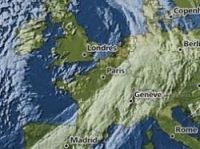
VIOLENT storms with winds of more than 100kph are expected to lash the west of France and the length of the Channel coast at the start of next week, washing out any hope of a white Christmas.

Forecasters at Météo France say Monday and the next few days could see rainstorms gusting up to 120kph over an area from the Vendée to south Brittany and the Channel.

They do not exclude gusts of up to 150kph on Christmas Day, echoing the violent storm that lashed France in 1999 when winds of more than 170kph struck.

Last night winds that had battered Scotland with gusts of up to 176kph were also touching Brittany where winds of 97kph hit Brest and gusts reaching 122kph were recorded at Pointe du Raz.

Snowflake Cold

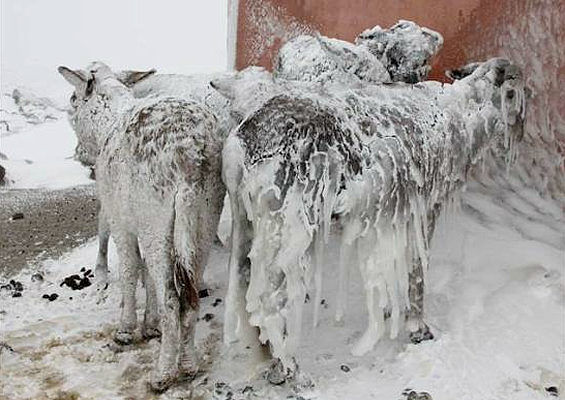
Ice Age cometh: Northern Thailand declared cold disaster zone - Snow in Vietnam - In Turkey, animals literally freeze where they stand

Donkeys freeze in Turkey
© UnknownDonkeys freeze where they stand during a cold snap in Turkey
A flurry of Middle Eastern and Asian news websites are reporting on "unusual" cold sweeping across vast areas of Asia and the Middle East.

The online Thailand pattayamail.com reports "Hundreds of thousands of residents of northern and northeastern Thailand are suffering from the current cold snap, with many areas having been declared disaster zones. [...] Some 100,000 people are suffering from the cold and in need of winter clothing. "

The German language thailand-tip.com reports that the "Meteorological Institute forecasts temperatures in the north to fall another 4 - 7°C by Thursday."