
© LaChaineMeteo.com
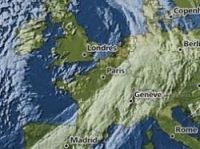
Forecasters at Météo France say Monday and the next few days could see rainstorms gusting up to 120kph over an area from the Vendée to south Brittany and the Channel.
They do not exclude gusts of up to 150kph on Christmas Day, echoing the violent storm that lashed France in 1999 when winds of more than 170kph struck.
Last night winds that had battered Scotland with gusts of up to 176kph were also touching Brittany where winds of 97kph hit Brest and gusts reaching 122kph were recorded at Pointe du Raz.
The storm front is on a line from the Pays-Basque up to Lorraine and is moving south-east and will hit the Côte d'Azur this afternoon with heavy rains of up to 50mm this weekend.
Early this morning La Chaine Météo noted rainfall of between 5 and 155mm in the north, with 8mm at Beauvais, 10mm at Nantes and 11mm at Charleville-Mézières in Ardennes - with milder, less stormy weather arriving.
After the unusually mild first half of December temperatures are set to plummet from around December 27 or 28 across the whole of France. However, there is not likely to be any snow on low-lying areas and the heavy rains will only turn to heavy snow in the mountains.
Météo France said that strong high-pressure anticyclonic conditions meant a cold and sunny start to December across much of the country, but this was now changing to more stormy conditions with a depression centred on Scotland and Ireland.
After Christmas the high-altitude jetstream will move south over the Atlantic and cross England along the length of the Channel coast bringing storms across France.



Israel opened the gates to two dams. Now Gaza is sinking
EDITOR
Richard Forer writes:
In November 2012, I was a member of an InterFaith Peace Builders delegation to the Gaza Strip, where I witnessed the hardships, including food deprivation, Gazans live with. Most are a direct consequence of Israel’s long-term blockade that limits supplies of building material, fuel and food and enervates agricultural and fishing yields.
In 2006, Dov Weisglas, the chief adviser to Israeli Prime Minister Ariel Sharon, said “The idea is to put the Palestinians on a diet, but not to make them die of hunger.” At the time, many thought Weisglas was speaking in hyperbole. In 2012, however, as a result of a successful legal challenge by the Israeli human rights group Gisha, Weisglas’s comment was revealed to be not hyperbole but policy. Cold-bloodedly, Israeli health officials had calculated the per capita number of calories required for a subsistence diet and then interpolated that figure into truckloads of food. The final figure did not even attempt to take into account food spoilage due to long delays at border crossings.
The inhumanity of this policy is magnified by the fact that more than half of Gaza’s population is children, under age 16. Malnutrition, anaemia and stunted growth are common. Of the Gazans I met during my visit, Rana stands out. She and I had been in communication for a couple of years and finally met in person when she spent a day with our delegation. Because the blockade of Gaza would not be possible without the billions of dollars provided Israel by the US, Rana wants Americans to discover a greater awareness of what life is like for her and her people. Here is her message.
My name is Rana. I have lived in the city of Khan Yunis in the Gaza Strip all 21 years of my life. What is happening in Gaza is not fiction but a bitter reality, which we lack the means to defend ourselves against. In the last few days, an unusually powerful storm has flooded many areas, displacing hundreds of residents from their homes. Children are without shelter from the cold and rain. Entire neighbourhoods are sinking.
My family and I spent four days in darkness in below freezing weather: no electricity, no water and no heat. I was so cold, I couldn‘t leave my bed and the small comfort it and my blankets provided. The cold felt like it penetrated my bones. Yet, I am lucky. I witnessed many people as they became homeless, their children desperate for food and warmth.
Friends called to tell me about the flooding and freezing in their areas. I felt bad, unable to help.
Power lines are down and our streets are filled with raw sewage. Greenhouses have been destroyed, affecting farmers and reducing the already minimal food supply we Gazans are forced to survive on.
Making conditions worse, Israel opened two dams, releasing a torrent of water that inundated many homes. As their houses sank, some of my neighbours nearly drowned. Fortunately, rescue workers came to their aid.
All of this was not enough for Israel. Its soldiers have been shooting at civilians in the village of Khuza’a, to the east of my city. Unarmed residents, women and children, attempting to flee the flooded town, were driven back for fear of being shot.
Israel’s action, assisted by the world’s silence, increases our suffering. Where is the international law we hear so many people talk about but never implement? Where is the community that talks about justice and humanitarian support? If my people are prevented from obtaining the basic requirements of life at least we should speak up and raise our voices.
Another storm is expected to hit my vulnerable homeland next week, bringing with it more suffering and more homelessness. When will the world wake up and treat us like human beings?
Rana Alshami, Khan Yunis, Gaza Strip