Earth ChangesS


Question

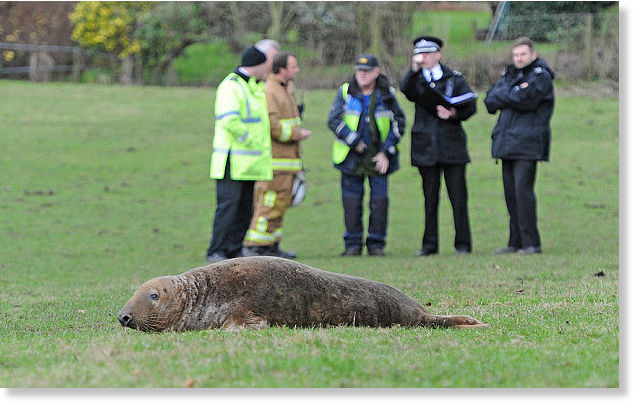
Seal found 20 miles inland near St Helens, UK

Image
© Liverpool Echo
Seal washed up in a field in Newton-le-Willows near Warrington, Cheshire
A seal had to be rescued from a field more than 20 miles inland - after apparently getting "very, very lost".

The seal, which was discovered in Newton-le-Willows, near St Helens in Merseyside on Monday morning, was likely to have swum up to 50 miles away from its home before clambering into the fenced-off field from a nearby brook, experts said.

It was found in a "distressed" state by a dog-walker at about 9.45am, sparking a rescue operation involving the emergency services and the RSPCA as police warned locals to stay away from the "potentially dangerous" animal.

The creature, believed to be a juvenile male grey seal, was eventually coaxed into a trailer using mackerel as bait and taken to a wildlife centre for checks.

Farm owner Gary Watkinson, who owns the field where the seal was found, said: "We woke up this morning and found a seal in our field, which is quite unusual to say the least.


Eye 2

Over 100 live snakes released on Vietnam highway

Image
Over 100 snakes of different kinds crawled along a national highway in southern Dong Nai Province, throwing locals into panic on Saturday afternoon.

Around 4.40pm, locals who travelled and live in a neighborhood in the province's Thong Nhat District along the National Highway No. 1 were petrified at the ghastly sight of over 100 snakes crawling across the highway.

Witnesses said they earlier saw three men, who resembled Buddhist monks with shaved heads in yellow outfits, getting down from a seven-seat car with three green sacks.

The men unpacked the sacks as if they were pouring out the contents.

Info

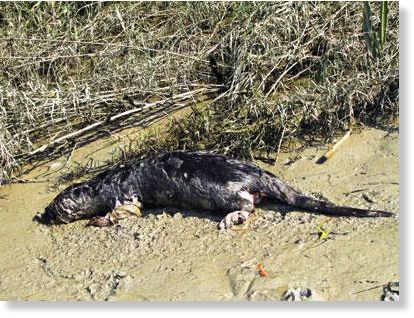
Two otters found dead in Sundarbans oil spill, Bangladesh

Image
Autopsy on the two otters, recovered by forests department workers from the river Shela in the Sundarbans on Thursday, have confirmed that they had died from ingestion of oil.

The veterinarians of the forests department on Saturday found furnace oil in the mouths and lungs of the two animals. Previously innumerable otters could be seen in the rivers of the southwest regions, but now they are only found in the Sundarbans. These are enlisted as endangered species by the International Union for Conservation of Nature (IUCN). Fishermen of Narail and the Sundarbans use otters to catch fish, and National Geographic as well as other wildlife agencies have done researches on this.

After 350 thousand litres of oil was spilled in the river Shela of the Sundarbans in the 9 December tanker capsize, the shipping ministry has stated that this will cause no harm to the forest. The ministry for environment and forest took samples of water from the rivers Shela and Pashur and observed that the water has an adequate level of dissolved oxygen for plants and animals to survive. In other words, the animals and plant life was free of risk.

Cloud Precipitation

Flash floods in Sri Lanka displace 46,000

Image
Three days of heavy rainfall have caused flash floods in northern and central areas of Sri Lanka. Eastern, North-Central, Northern and North-Western provinces have all seen heavy rain since Saturday 20 December 2014. Sri Lanka's Disaster management Centre (DMC) say that as many as 452,960 people have been affected by floods or landslides in the past 3 days.

Evacuations

DMC say that around 46,000 people have evacuated their homes and are currently staying in temporary accommodation, including local schools and community centres. Some of the latest TV news reports in Sri Lanka have the total number displaced as being much higher at over 200,000. This as yet has been unconfirmed by Sri Lanka authorities.

Eastern province is thought to be the worst affected. According to the latest situation report from Sri Lanka's Disaster management Centre (DMC), over 30,000 people from the districts of Batticaloa, Trincomalee and Ampara. DMC also say that 3 deaths have occurred in the province as a result of the recent floods. One person was reported as injured in the floods in Anuradhapura, North Central Province.

The huge amounts of rain have increased river and reservoir levels across the provinces, forcing the authorities to open flood gates. Xinhua report that 29 of the big dams and 83 of the medium ones have reached spill level, forcing sluice gates to be opened, threatening people living downriver.


Wolf

Animals and insects can predict natural disasters and diseases

golden wing warbler predict disaster
Anecdotal evidence has long suggested that certain animals can predict natural disasters, detect disease and more, and now science is proving many of these stories to be correct.

Close observation of such animals could even help people to plan well in advance of coming problems, suggests a new paper in the latest issue of the journal Current Biology.

Henry Streby of the University of California, Berkeley, and his colleagues discovered that golden-winged warblers take off from their expected locations more than 24 hours before storms hit. In this case, the storm in question produced tornadoes that killed at least 35 people.

"The most curious finding is that the birds left long before the storm arrived," said Streby. "At the same time that meteorologists on The Weather Channel were telling us this storm was headed in our direction, the birds were apparently already packing their bags and evacuating the area."

Comment: The idea that animals can predict earthquakes has ancient origins. In 373BC, the Greek historian Thucydides recorded that rats, dogs, snakes and weasels deserted the city of Helice in droves a few days before a catastrophic earthquake.

On the morning of December 26, 2004, Thai villagers noticed that buffalo grazing on the beach lifted their heads, pricked their ears and looked out to sea, then stampeded to the top of a nearby hill. For the villagers who chose to follow them, it was a live-saving move as the tsunami struck only minutes later. There have been hundreds of reports of animals seemingly foretelling catastrophe, sometimes hours and even days before it occurred. These include tales of bizarre behavior by wild beasts including elephants, antelopes, bats, rats and flamingos, plus stories of dogs refusing to go for their usual morning walk.


Bizarro Earth

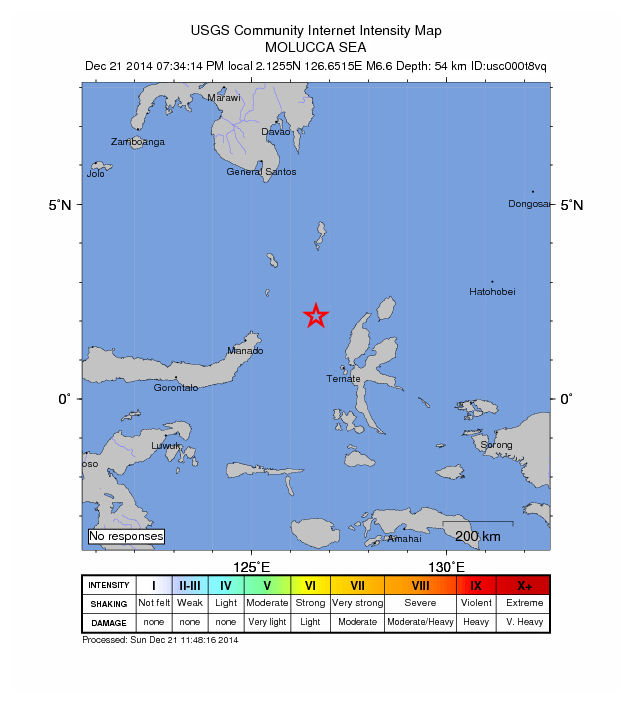
USGS: Earthquake Magnitude 6.6 - 157km WNW of Tobelo, Indonesia

Tobelo Quake_211214
© USGS
Event Time
2014-12-21 11:34:14 UTC
2014-12-21 19:34:14 UTC+08:00 at epicenter

Location
2.126°N 126.651°E depth=54.6km (34.0mi)

Nearby Cities
157km (98mi) WNW of Tobelo, Indonesia
168km (104mi) NNW of Kota Ternate, Indonesia
168km (104mi) NNW of Ternate, Indonesia
179km (111mi) ENE of Bitung, Indonesia
1042km (647mi) WSW of Koror Town, Palau

Scientific Data

Eye 2

Local people terrorized by unusual explosion of venomous snakes in central Vietnam

Image
© Tuoi TreA Quang Ngai resident is shown holding a green snake he has killed.
The green pit viper, a species of venomous snake, has appeared in urban residential areas in Vietnam's central region at an alarming rate, slithering into kitchens, bedrooms, gardens, and schools.

Dozens of people in Da Nang City, as well as Quang Nam and Quang Ngai Provinces, have been hospitalized recently after being bitten by the poisonous reptile 'rắn lục' (green snake), with the scientific name of Trimeresurus albolabris.

The snake perfectly disguises itself around trees thanks to its green body. It is yellow or pale green below the eyes, while its belly is green, yellowish or white, and the end of the tail is brown or red.

The situation has reached such a dangerous level that the Department of Forest Management of Quang Ngai has asked local authorities to urgently begin a campaign to drive the animals out of local neighborhoods.

Question

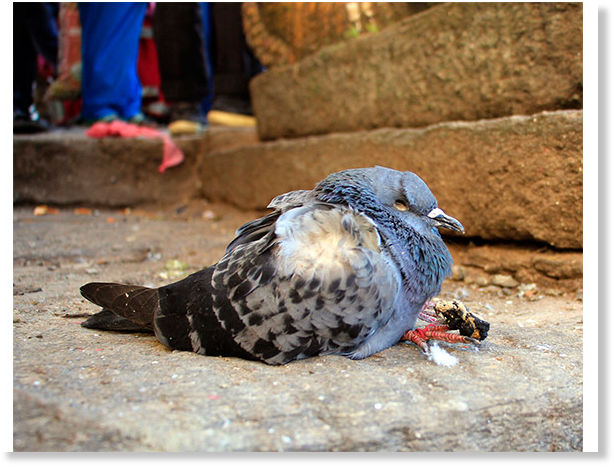
Mystery as 5,000 pigeons die in Nepal

Image
Mystery surrounds the death of thousands of pigeons on the Bhimeshwor temple premises in the past week.

According to the people in Dolakha Bazaar, dead pigeons are lying on the streets, rooftops, gardens and paddy fields. The stench from dead birds pollutes the atmosphere.

"Approximately 5,000 pigeons have died in a week," said Bharat Shrestha, treasurer of the Bhimeshwor temple prayer and trust management committee.

Authorities are yet to respond to the situation. Vets said an unidentified virus may be responsible for the menace while the locals have got into a panic fearing a disease outbreak in humans.

"Such cases happened in the past but the damage this time is terrible," said temple caretaker Kashi Narayan Shrestha. He added that rooftops and areas surrounding the temple had yet to be cleared of dead pigeons.

Comment: Similar reports: Bird deaths in Moscow spark 'zombie pigeon' scare

Over 500 pigeons drop dead in Bihar village, India


Attention

More than 30 earthquake tremors hit Italy's Chianti region

Image
© Konrad LawsonThe epicentre of the strongest quake was nine kilometres below ground close to Greve in Chianti.
Several mini-earthquakes with a maximum magnitude of 4.1 shook Italy's famous Chianti wine region on Friday.

The tremors were sufficiently powerful to result in homes, schools and offices being evacuated but no serious damage or injuries were reported.

The National Institute for Geophysics and Vulcanology (INGV) said there had been more than 30 tremors over 24 hours with the strongest, measuring 3.8 and 4.1, registered mid-morning on Friday.

The epicentre of the strongest quake was nine kilometres (six miles) below ground close to Greve in Chianti, one of the best known wine villages in an area of rolling hills around and between the historic cities of Florence and Siena.

The area lies in the foothills of the central section of the Apennine mountains, which run like a spine down the centre of Italy and are subject to significant seismic activity.

Source: AFP

Heart - Black

Wind company PacifiCorp Energy convicted in the deaths of eagles and other birds

Image
© Wyoming Jackrabbit/Flickr/Creative Commons LicenseWind turbines near Medicine Bow, Wyoming
A Portland-based wind energy company that recently sued the federal government to keep its bird death data secret has been convicted in federal court over deaths of protected birds at two of its wind facilities in Wyoming.

The carcasses of 38 golden eagles were found at PacifiCorp Energy's "Seven Mile Hill" and "Glenrock/Rolling Hills" installations in Carbon and Converse counties between 2009 and this year, along with 336 other birds protected under the Migratory Bird Treaty Act. According to the U.S. Fish and Wildlife Service, PacificCorp disregarded risk to eagles and other birds when it built its turbines at the two facilities.

"PacifiCorp Energy built two of its Wyoming wind projects in a manner it knew would likely result in the deaths of eagles and other protected birds," said Sam Hirsch, the U.S Department of Justice's Acting Assistant Attorney General for Environment and Natural Resources.