Science of the SpiritS


People 2

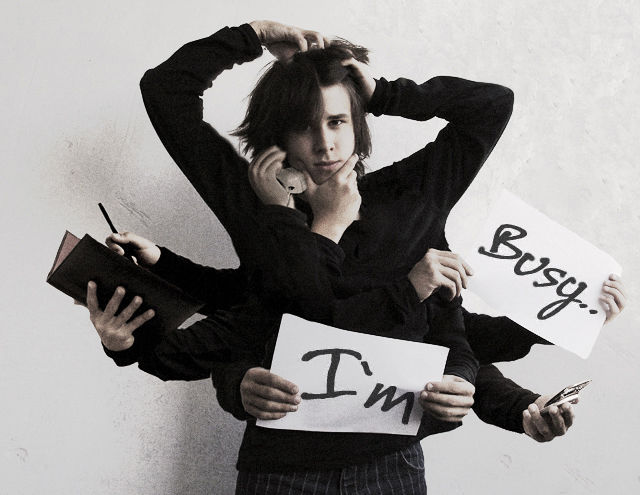
The dis-ease of being busy

Image
I saw a dear friend a few days ago. I stopped by to ask her how she was doing, how her family was. She looked up, voice lowered, and just whimpered: "I'm so busy... I am so busy... have so much going on."

Almost immediately after, I ran into another friend and asked him how he was. Again, same tone, same response: "I'm just so busy... got so much to do."

The tone was exacerbated, tired, even overwhelmed.

And it's not just adults. When we moved to North Carolina about ten years ago, we were thrilled to be moving to a city with a great school system. We found a diverse neighborhood, filled with families. Everything felt good, felt right.

After we settled in, we went to one of the friendly neighbors, asking if their daughter and our daughter could get together and play. The mother, a really lovely person, reached for her phone and pulled out the calendar function. She scrolled... and scrolled... and scrolled. She finally said: "She has a 45-minute opening two and half weeks from now. The rest of the time it's gymnastics, piano, and voice lessons. She's just.... so busy."

Horribly destructive habits start early, really early.

Heart

Brain's response to threat silenced when we are reminded of being loved and cared for

Image
Being shown pictures of others being loved and cared for reduces the brain's response to threat, new research from the University of Exeter has found.

The study discovered that when individuals are briefly presented pictures of others receiving emotional support and affection, the brain's threat monitor, the amygdala, subsequently does not respond to images showing threatening facial expressions or words. This occurred even if the person was not paying attention to the content of the first pictures.

Forty-two healthy individuals participated in the study, in which researchers used functional magnetic resonance imaging (fMRI) to study the brain response.

The study, published this week in the journal Social, Cognitive and Affective Neuroscience, suggests that being reminded of being loved and cared for dampens the threat response and may allow more effective functioning during, and activation of soothing resources after, stressful situations. This was particularly true for more anxious individuals.

Palette

Crafting offers meditation-like benefits

Image
© culturbia.net
More than half of US households craft at least once a year,1 but for some it becomes a daily pastime. If you're an avid crafter - knitting, quilting, scrapbooking, etc. - you've probably lost yourself in a project on more than one occasion.

This tendency to become so absorbed in your craft that you're able to forget about your worries, obligations, and even physical pains is called "flow" - and it's a key reason why crafting may be phenomenal for your mental and emotional health.

Comment: Creativity Explained
Creativity is not magic, and there's no such thing as a creative type. Creativity is not a trait that we inherit in our genes or a blessing bestowed by the angels. It's a skill. Anyone can learn to be creative and to get better at it. New research is shedding light on what allows people to develop world-changing products and to solve the toughest problems. A surprisingly concrete set of lessons has emerged about what creativity is and how to spark it in ourselves and our work.

The science of creativity is relatively new. Until the Enlightenment, acts of imagination were always equated with higher powers. Being creative meant channeling the muses, giving voice to the gods. ("Inspiration" literally means "breathed upon.") Even in modern times, scientists have paid little attention to the sources of creativity.

But over the past decade, that has begun to change. Imagination was once thought to be a single thing, separate from other kinds of cognition. The latest research suggests that this assumption is false. It turns out that we use "creativity" as a catchall term for a variety of cognitive tools, each of which applies to particular sorts of problems and is coaxed to action in a particular way.


Bullseye

Modern life is making us addicted & insane

Image
© parentingoc.com
Constant distraction creates an insecure attachment with kids, which can lead to addiction and mental health issues.

Over the past decade or two, seasoned therapists who treat young people have been seeing some increasingly worrisome trends. Although solid statistics are hard to come by, one indication of a surge in troubled young adults comes from the reports of college mental health services. A 2010 survey by the Higher Education Research Institute (HERI) at the University of California, Los Angeles of almost 202,000 incoming college freshmen at 279 colleges and universities showed a shocking decline in self-reported mental and emotional well-being - at its lowest level since 1985, when HERI began conducting the surveys. In this recent survey, the percentage of students who rated their emotional health "above average" fell from 64 percent in 1985 to 52 percent.

According to the June 2013 APA Monitor, 95 percent of surveyed college counseling-center directors said that the number of students with "significant psychological problems is a growing concern," citing anxiety, depression, and relationship issues as the main problems. Another 2013 survey, the American College Health Association - National College Health Assessment, reported that 51 percent of 123,078 responders in 153 US colleges had experienced "overwhelming anxiety" during the previous year, 31.3 percent had experienced depression so severe it was difficult to function, and 7.4 percent had seriously considered suicide.

Heart

Putin: 'Love is the meaning of life'

Image
© RIA Novosti/Michael KlimentyevRussian President Vladimir Putin.
Vladimir Putin is known for his sharp wit, but musings on love are a relative novelty. In an unexpected remark Friday, the Russian president spoke of the "meaning of life," saying that for him "in general" it is love that matters.

Briefly digressing from politics, Putin ventured a philiosophical observation that "multifaceted" love is the basis of all actions and the essence of being.

"The meaning of our whole life and existence is love," Putin told his audience at the 15th Congress of the Russian Geographical Society. "It is love for the family, for the children, for the motherland. This is a multifaceted phenomenon; it lies at heart of any of our behaviors."

Comment: Love is light is knowledge. To love you must know.
 And to know is to have light.
 And to have light is to love. 
And to have knowledge is to love.

Despite extreme defamation and lies Putin makes sure for others to have the chance to know and to love.


Family

Are we only as old as we think we are?

senior citizen gymnast
© UnknownOctogenarian Johanna Quaas showed off her skills at the 2012 Cottbus World Cup in Germany
Are we as old as our age, or only what age we think we are?

That's something that Harvard University psychologist Ellen Langer has been examining for over three decades.

Through different experiments with senior citizens, she tries to show the deep connection between body and mind.

She believes it's possible for a person's mind to help remedy a physical ailment. To examine this, she's conducted numerous studies that focus on an individual's expectation of aging versus the real symptoms of aging.

Family

Showing people pictures of others receiving emotional support reduces brain response to threat

emotional support
Being shown pictures of others being loved and cared for reduces the brain's response to threat, new research from the University of Exeter has found.

The study discovered that when individuals are briefly presented pictures of others receiving emotional support and affection, the brain's threat monitor, the amygdala, subsequently does not respond to images showing threatening facial expressions or words. This occurred even if the person was not paying attention to the content of the first pictures.

Forty-two healthy individuals participated in the study, in which researchers used functional magnetic resonance imaging (fMRI) to study the brain response.

The study, published this week in the journal Social, Cognitive and Affective Neuroscience, suggests that being reminded of being loved and cared for dampens the threat response and may allow more effective functioning during, and activation of soothing resources after, stressful situations. This was particularly true for more anxious individuals.

2 + 2 = 4

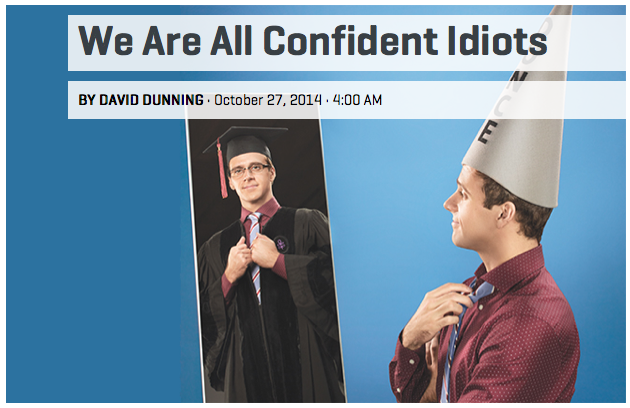
We are all confident idiots: 'The doorstep to the temple of wisdom is a knowledge of our own ignorance'

Image
© Gregg Segal
Last March, during the enormous South by Southwest music festival in Austin, Texas, the late-night talk show Jimmy Kimmel Live! sent a camera crew out into the streets to catch hipsters bluffing. "People who go to music festivals pride themselves on knowing who the next acts are," Kimmel said to his studio audience, "even if they don't actually know who the new acts are." So the host had his crew ask festival-goers for their thoughts about bands that don't exist.

"The big buzz on the street," said one of Kimmel's interviewers to a man wearing thick-framed glasses and a whimsical T-shirt, "is Contact Dermatitis. Do you think he has what it takes to really make it to the big time?"

"Absolutely," came the dazed fan's reply.

Comment: For more information on the Dunning-Kruger Effect, see these Sott links:


Network

Magic mushrooms create a hyperconnected brain and might offer a new treatment for depression

Magic Mushrooms
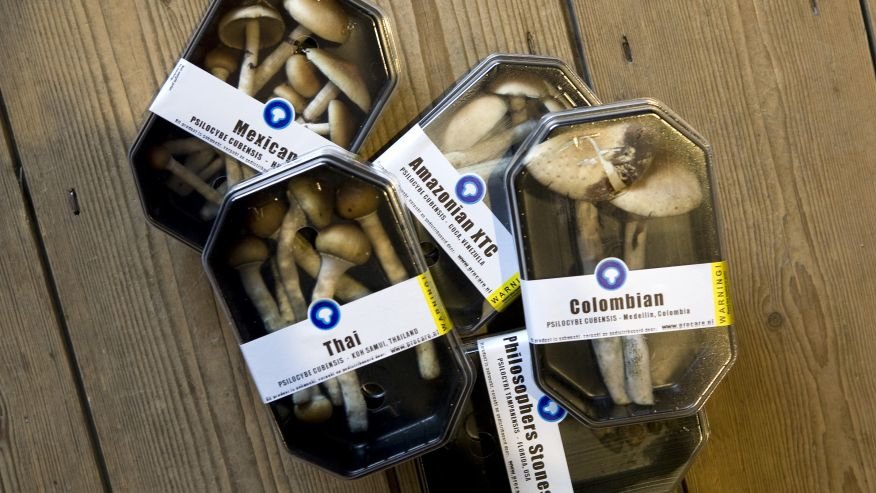
© Reuters/Jerry LampenBoxes containing magic mushrooms are displayed at a coffee and smart shop in Rotterdam November 28, 2008.
Magic mushrooms may give users trippy experiences by creating a hyperconnected brain.

The active ingredient in the psychedelic drug, psilocybin, seems to completely disrupt the normal communication networks in the brain, by connecting "brain regions that don't normally talk together," said study co-author Paul Expert, a physicist at King's College London.

The research, which was published Oct. 28 in the Journal of the Royal Society Interface, is part of a larger effort to understand how psychedelic drugs work, in the hopes that they could one day be used by psychiatrists in carefully controlled settings to treat conditions such as depression, Expert said.

Magic mushrooms

Psilocybin, the active ingredient in magic mushrooms, is best known for triggering vivid hallucinations. It can make colors seem oversaturated and dissolve the boundaries between objects.

But the drug also seems to have more long-lasting effects. Many people report intensely spiritual experiences while taking the drug, and some studies even suggest that one transcendent trip can alter people's personalities on a long-term basis, making those individuals more open to new experiences and more appreciative of art, curiosity and emotion.

People who experiment with psilocybin "report it as one of the most profound experiences they've had in their lives, even comparing it to the birth of their children," Expert told Live Science.

Comment:

How Psychedelics Saved My Life

Magic mushrooms: How they affect the brain's emotion centers


Info

Robot makes people feel like a ghost is nearby

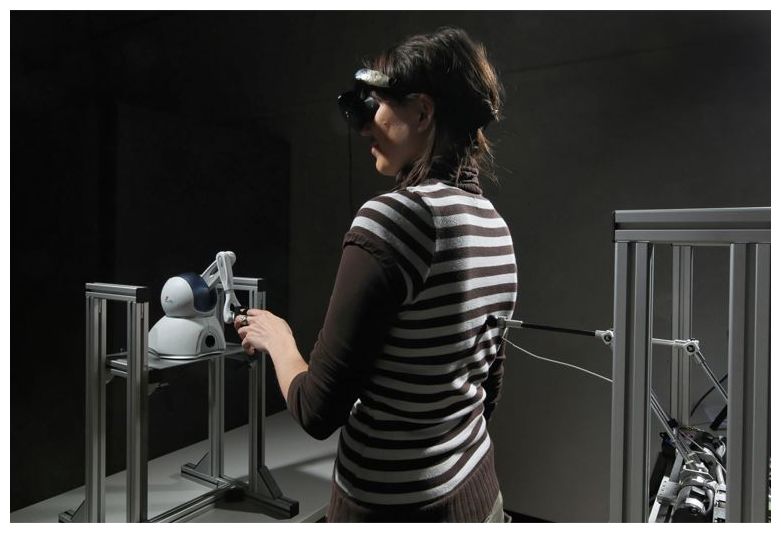
Ghost Simulation
© Alain Herzog/EPFL
In 2006, cognitive neuroscientist Olaf Blanke of the University of Geneva in Switzerland was testing a patient's brain functions before her epilepsy surgery when he noticed something strange. Every time he electrically stimulated the region of her brain responsible for integrating different sensory signals from the body, the patient would look back behind her back as if a person was there, even when she knew full well that no one was actually present.

Now, with the help of robots, Blanke and colleagues have not only found a neurological explanation for this illusion, but also tricked healthy people into sensing "ghosts," they report online today in Current Biology. The study could help explain why schizophrenia patients sometimes hallucinate that aliens control their movements.

"It's very difficult to try to understand the mechanisms involved in something so strange," says cognitive neuroscientist Henrik Ehrsson of the Karolinska Institute in Stockholm, who was not involved with the study. "It's very encouraging, very impressive, the way this team is making science out of this question."

Ghosts and apparitions are a common theme in literature and religion. In real life, patients suffering from schizophrenia and epilepsy sometimes report sensing a presence near them. After studying such cases, Blanke found some striking similarities in how epilepsy patients perceive these eerie "apparitions," he says. Almost all patients said the presence felt like a human being positioned right behind their back, almost touching them, with malicious intentions. Patients with brain damage on the left hemisphere felt the ghost at their right side, and vice versa.