Science of the SpiritS


Bulb

Taking breaks throughout workday can increase productivity

stress, work breaks
How many times do you sit down to get work done and find yourself "working" and yet getting little completed?

Do you set aside big chunks of time to get work done, only to end up feeling like you've barely made a dent in it? Do you have that one task that always seems to get pushed off to the next day? Do you end your workday feeling drained rather than satisfied with what you've accomplished?

This is a sign that you aren't taking enough breaks -- or aren't taking them effectively. We prize this idea of being busy, and see taking a break or getting distracted as a problem.

In reality, rest and relaxation are tools our bodies and minds are trying desperately to get us to use.

Most of us are aware that taking breaks from physical activity is necessary to recuperate and prevent injuries. Taking breaks in our mental work is equally helpful, and can be a great boost to our productivity as well.

Comment:


2 + 2 = 4

Healing sex addiction triggers: Five tools for sobriety

Image
If you are a recovering alcoholic or drug addict with solid support and a lot of motivated willingness to get well, you can make it through the rest of your life without taking another drink or abusing an addictive drug. Similarly, compulsive gamblers can live a full and happy lives without ever re-entering a casino, betting on the stock market, or playing fantasy football. But for those who struggle with addictions to otherwise highly life-affirming activities like eating and sex, recovery can at times be a daily battle. After all, compulsive eaters in recovery must still eat on a regular basis. And recovering sex addicts, even if they've previously had enough sex to populate China, usually still want (and deserve) to have a healthy sexual and intimate life in recovery.

However, as mentioned in a previous posting to this site, triggers toward addictive sex are relatively unavoidable. Recovering sex addicts inevitably run into attractive people, see sexual acts depicted in movies and on TV, spot their friend's Victoria's Secret catalog on the coffee table, etc. To be honest, triggers toward sexual addiction are almost infinite in both number and variety, and there is not much that recovering sex addicts can do about that beyond learning to recognize when they are feeling triggered and, equally importantly, how to respond in healthy rather than addictive ways.

Comment: For more on how how sex, and more importantly the obsessive preoccupation with it can turn into addiction and affect the brain, check out these articles.


Sun

Mental health habits that bring consistency to our lives, promote wellness and resilience

meditation, mental health
Parents, teachers, and doctors regularly encourage young people to establish good physical hygiene habits. Here are just a few: Bathe daily. Eat healthy meals. Brush your teeth at least once a day. Wash your hands after you use the bathroom. Clip your toenails before they get too long. These habits become routine after a while.

Most of us probably were not intentionally taught good mental health hygiene habits. These habits also bring consistency to our lives, promote wellness and resilience, and protect us from becoming overwhelmed by mental illness.

While mental health hygiene habits may vary from person to person, it is important to identify those that work best for us and to integrate them into our day — every day — through reminders and practice until they become a routine that we anticipate with pleasure.

Toys

How old grows young: Preschools in nursing homes provide new life to elderly residents

Image
Aging can have a lot of issues attached to it: The body is no longer at the top of its game and gravity is slowly but surely drawing the body down to its final resting place. We try not to complain, but Bette Davis probably said it best: Old age is no place for sissies.

As we age, there is also bound to be loss as friends and family age and inevitably cross over. What used to be a huge gathering during holidays and special occasions begins to dwindle, and many will suddenly become part of the nearly 50% of elderly people who feel isolated and alone. Then, when coupled with the physical ailments of aging, which are made worse by feelings of loneliness, emotional issues can turn into a disaster and depression can easily set in.

Bulb

Dabrowski's Theory of Positive Disintegration: The awakening of self-awareness

introspection
© DiNo
This is the third in a series of Sunday posts about Kazimierz Dabrowski's Theory of Positive Disintegration, using as a starting point his 1967 book, Personality-Shaping through Positive Disintegration, released in a new edition as paperback and ebook. All otherwise unattributed quotations from Dabrowski in this series are from the 2015 paperback edition. You can also purchase the book as part of a larger collection of Dabrowski's works at Bill Tillier's website PositiveDisintegration.com.

Becoming an Adult

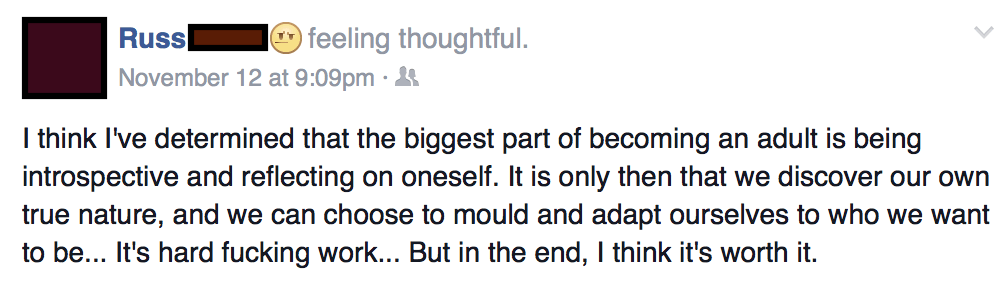
A recent Facebook status by a Millennialgeneration friend caught my attention as I was thinking about this week's topic (he gave his permission to share it here):
tpd tweet

Comment: Previous instalments to this series:


2 + 2 = 4

5-year-old "child savant" speaks several languages, solves algebra & has psychic powers

Image
On top of having some incredible skills in language and mathematics, this genius savant, a 5-year-old boy from Los Angeles, is also said to have psychic powers.

Los Angeles, California resident Ramses Sanguino has been diagnosed with autism. He is also being described as a "child savant" since he is able to solve complex mathematical equations and speak several different foreign languages ever since he was young.

The video posted on YouTube by the boy's mother, Nyx Sanguino, shows Ramses speaking Russian at 13 months old, speaking Japanese at the age of 2 and solving complex algebra now at the age of 5.

Comment: See more: Why scientists deny psychic phenomena


Butterfly

Boost kids physical & mental health with outdoor games

Image
You hear it more and more recently, "kids don't play outside anymore." But with a shift towards being indoors instead of out, engaging with technology instead of nature, and sitting instead of moving, what exactly are kids missing out on? Research shows that children's physical and mental health are both taking a toll. Encouraging outside games for kids is important in promoting their health and well being.

Physical Benefits of Active Play

Exercise is as important for kids as it is for adults. Physical activity is important for kids to have healthy bones, good physical fitness, and low levels of inflammation in the body. One study in children 7 to 11 years old, for example, found that breaking up continuous sitting with only 3 minutes of moderate walking every 30 minutes improved insulin functioning.[1] Plus, being active helps kids socially and academically as well. Read more about some of the benefits of physical activity for kids in Active Body, Active Mind: Why Kids Need Recess.

Comment: More reasons to leave no child inside:


Palette

Characteristic behaviors of highly creative people

creativity, creative people
Creativity works in mysterious and often paradoxical ways. Creative thinking is a stable, defining characteristic in some personalities, but it may also change based on situation and context. Inspiration and ideas often arise seemingly out of nowhere and then fail to show up when we most need them, and creative thinking requires complex cognition yet is completely distinct from the thinking process.

Neuroscience paints a complicated picture of creativity. As scientists now understand it, creativity is far more complex than the right-left brain distinction would have us think (the theory being that left brain = rational and analytical, right brain = creative and emotional). In fact, creativity is thought to involve a number of cognitive processes, neural pathways and emotions, and we still don't have the full picture of how the imaginative mind works.

And psychologically speaking, creative personality types are difficult to pin down, largely because they're complex, paradoxical and tend to avoid habit or routine. And it's not just a stereotype of the "tortured artist" -- artists really may be more complicated people. Research has suggested that creativity involves the coming together of a multitude of traits, behaviors and social influences in a single person.

Comment: Creativity is not magic, and there's no such thing as a creative type. Creativity is not a trait that we inherit in our genes or a blessing bestowed by the angels. It's a skill. Anyone can learn to be creative:


People 2

Surprising ways that shame can be triggered in our lives

shame
© withfriendship
Shame is an insidious emotion that can sabotage our lives, especially when we're unaware of its presence. Shame is like the many-headed mythological hydra. As soon as we lop off one head, two more appear.

We may be unaware of the shame we carry and what triggers it. One way to detect whether shame is contaminating our operating system is if we often get defensive and reactive. Perhaps our partner expresses disappointment that we didn't complete a chore and we immediately think, "Nothing I do is ever enough. I'll never make her happy!" We might defensively respond, "I was just about to do it, you're always on my case!"

Our reactive anger may spring from a fear of losing love and acceptance. We're prey to the fight, flight, freeze response when there is a real or imagined threat to our emotional safety. But another possibility is that a subtle shame is being triggered. Somewhere deep down we might think, "She's right. I did promise to fix the damn faucet and I got distracted by other things." Or, "I'm overwhelmed at work and need time to relax. But if I say this, then I won't appear as the hero I want to be. I'll feel like a failure."

Comment:
The power of vulnerability

Shame is the intensely painful feeling that we are unworthy of love and belonging. The most primitive human emotion we all feel and the one no one wants to talk about. Shame is believing we are flawed and therefore unworthy of acceptance and belonging. It creates feelings of fear, blame and disconnection. It's the fear that something we've done or failed to do, an ideal that we've not lived up to, or a goal that we've not accomplished makes us unworthy of connection. I'm not worthy or good enough for love, belonging, or connection. I'm unlovable. The only people who don't experience shame lack the capacity for empathy and human connection. Here's your choice: Fess up to experiencing shame or admit that you're a sociopath.

[..]

Shame needs three things to grow exponentially: secrecy, silence, and judgment. Shame cannot survive being spoken. It cannot survive empathy. Empathy and shame are on opposite ends of a continuum. Shame results in fear, blame (of self or others), and disconnection. Empathy is cultivated by courage, compassion, and connection, and is the most powerful antidote to shame.
See also: The difficult emotion of shame


Family

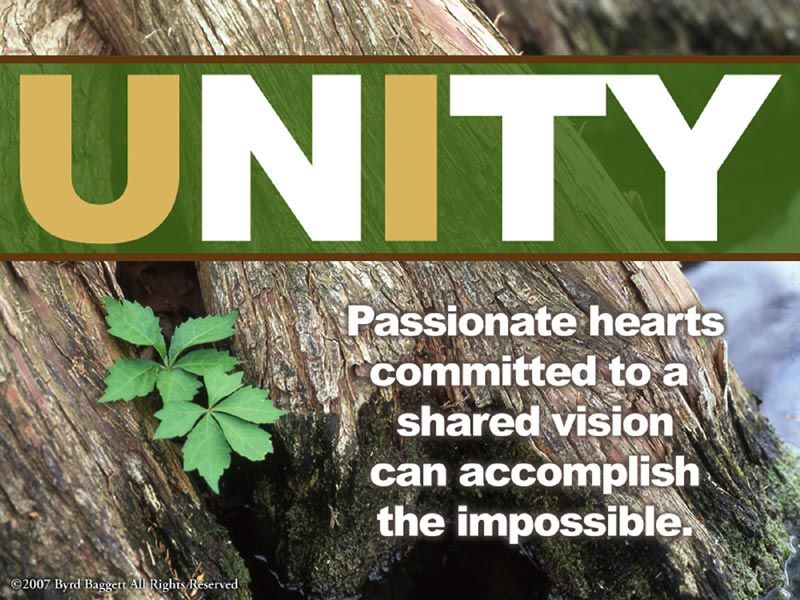
Groups motivated toward benefiting others perform better and are more cooperative

unity, commitment
When team members are motivated toward promoting the benefits of others, they are higher-performing and stay in their teams for a longer period, according to a new study.

Jasmine Hu, assistant professor of management at the University of Notre Dame's Mendoza College of Business, and her colleague Robert Liden of the University of Illinois at Chicago conducted a field study with 67 work teams from six companies in both U.S. and China and a lab study with 124 student teams at Notre Dame.

"Findings from both the field study and lab research showed that the greater motivation to benefit others, the higher the levels of cooperation and viability and the higher the subsequent team performance," Hu said. "These types of teams were also less likely to have members voluntarily leave their teams. Furthermore, we discovered that these positive effects of team motivation to benefit others were stronger the more the tasks required close interaction and higher interdependence among its members."