
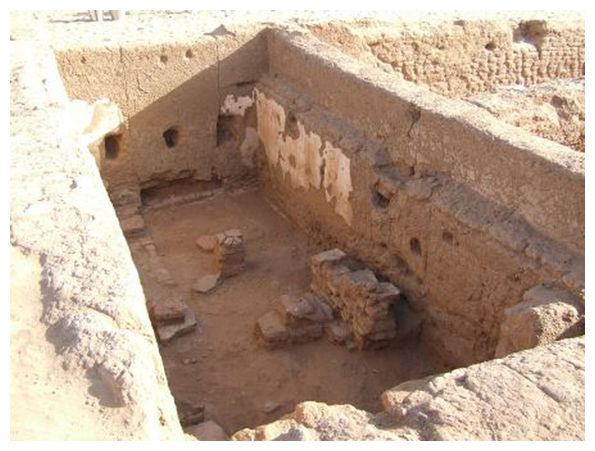
© Photo by Eugene Ball CC Attibution 2.5 GenericArchaeologists have discovered a 1,700-year-old school, with Greek writings on its walls, at the ancient town of Trimithis at the Dakhla Oasis in the western desert of Egypt.
The school - which contains benches that students could sit on to read, or stand on and write on the walls - dates back to a time when the Roman Empire controlled Egypt, and Greek was widely spoken.
In use for less than 20 years, the school structure eventually became part of a large house that contained colorful art, including images of the Olympian gods, the researchers said.
The house and school are located in the ancient town of Trimithis (modern-day Amheida), which is in the Dakhla Oasis, about 200 miles (322 kilometers) west of the Nile River. The house, and some of the art, was first discovered in 1979. In 2001, a new exploration project at Amheida, now sponsored primarily by New York University, led to the discovery of the school, its Greek writings and more art scenes from the house.













Comment: See also:
DNA analysis of Paracas elongated skull finally complete - with incredible results
Elongated human skulls of Peru: Possible evidence of a lost human species?