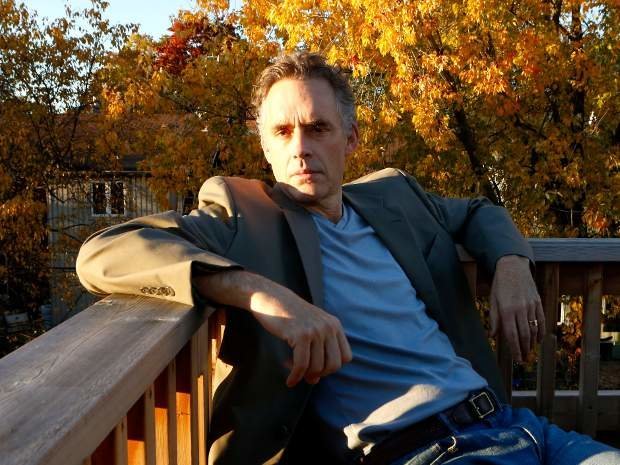
Interview with Dr. Jordan Peterson by Jason Tucker and Jason VandenBeukelCan you give us a brief background of your academic career and your interests?For the first two years of my undergraduate degree I studied Political Science and English Literature. I was very interested in politics, but what I was learning in economics and political science was just not correct. There was too much emphasis placed on the idea that economic interests were the prime motivators for human beings, and that was not obvious to me at all. I was spending a lot of time thinking about the Cold War, and the Cold War was not primarily an economic issue. So I started taking psychology, and I was interested in clinical psychology. I did my PhD under
Dr. Robert Pihl, and I worked on drug abuse, alcoholism, and aggression - there was a heavy biological emphasis. I did my post-doc with Dr. Pihl, and
Maurice Dongier. Then I taught at Harvard for six years, and I've been at the University of Toronto ever since then.
My primary interest has always been the psychology of belief. Partly religious belief, and ideology as a sub-category of religious belief. One of Jung's propositions was that whatever a person values most highly is their god. If people think they are atheistic, it means is they are unconscious of their gods. In a sophisticated religious system, there is a positive and negative polarity. Ideologies simplify that polarity and, in doing so, demonize and oversimplify. I got interested in ideology, in a large part, because I got interested in what happened in Nazi Germany, the Soviet Union, the Cultural Revolution in China, and equivalent occurrences in other places in the world. Mostly I concentrated on Nazi Germany and the Soviet Union. I was particularly interested in what led people to commit atrocities in service of their belief. The motto of the Holocaust Museum in Washington is "we must never forget." I've learned that
you cannot remember what you don't understand. People don't understand the Holocaust, and they don't understand what happened in Russia. I have this course called "Maps of Meaning," which is based on
a book I wrote by the same name, and it outlines these ideas. One of the things that I'm trying to convince my students of is that if they had been in Germany in the 1930s, they would have been Nazis. Everyone thinks "Not me," and that's not right. It was mostly ordinary people who committed the atrocities that characterized Nazi Germany and the Soviet Union.
Part of the reason I got embroiled in this [gender identity] controversy was because of what I know about how things went wrong in the Soviet Union. Many of the doctrines that underlie the legislation that I've been objecting to share structural similarities with the Marxist ideas that drove Soviet Communism. The thing I object to the most was the
insistence that people use these made up words like 'xe' and 'xer' that are the construction of authoritarians. There isn't a hope in hell that I'm going to use their language, because I know where that leads.












Comment: A terrorist group affiliated with the Daesh jihadists might be behind the deadly explosion in the Egyptian capital on Friday, a source in the country's Interior Ministry told RIA Novosti.