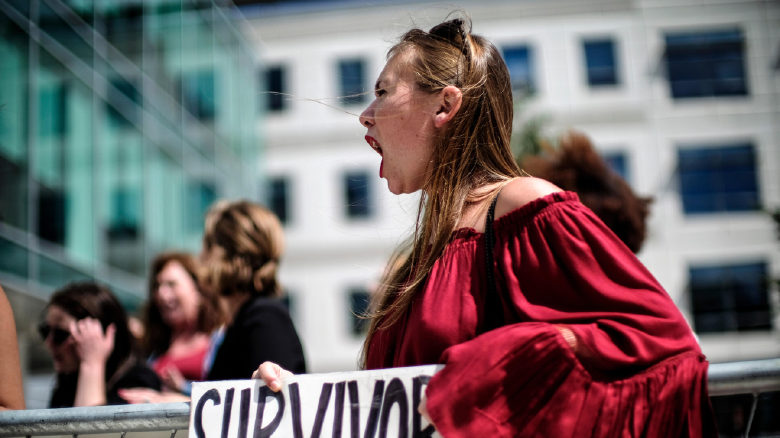
© J. Lawler Duggan/For The Washington Post via Getty ImagesMeghan Downey of Chatham, New Jersey protests as U.S. Education Secretary Betsy DeVos announces changes in federal policy on rules for investigating sexual assault reports on college campuses in Arlington, Virginia, on September 7, 2017.
In November 2014, a female member of Brown University's debate team had oral sex with a male colleague while they watched a movie. Eleven months later, she filed a complaint with Brown, accusing him of sexual assault.
Both parties in the case had credibility issues; he had violated a no-contact order, she had withheld from the university the bulk of their text messages. But the accused student possessed strong exculpatory evidence. He produced the full record of their communications, which included texts from the accuser to him discussing the encounter in a highly positive fashion and referencing a "plan" to have sex again. Further, a friend of the accuser, who saw her shortly after the incident, recalled her raving about her "really hot" experience.
Nonetheless, Brown's disciplinary panel returned a guilty finding by 2-to-1. The decisive vote came from Besenia Rodriguez, the university's associate dean for curriculum.
In subsequent court testimony after the accused sued Brown, Rodriguez admitted that she had not considered the accuser's text messages or other post-incident behavior as having any bearing on the case. The reason, she said, was the hours of training that Brown had provided to prepare her to adjudicate the complaint-training required by the federal government.
Rodriguez was specifically told that the impact of trauma on sexual-assault victims often causes them to behave in counterintuitive ways, such as not being able to recount a consistent set of facts or choosing to communicate with (rather than to avoid) the alleged assailant. "I felt like it couldn't - I couldn't really put myself in her shoes to understand why she was representing it that way," explained Rodriguez, "
so best not to attempt to judge her behavior."

















Comment: Not only are college campuses turning into dens of the ideologically possessed; they are also instituting totalitarian "justice". They must be proud of how far they've come. See also: