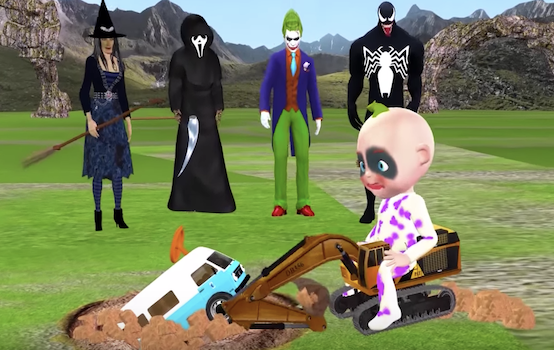
Algorithmic cartoons signal fresh horrors for human culture.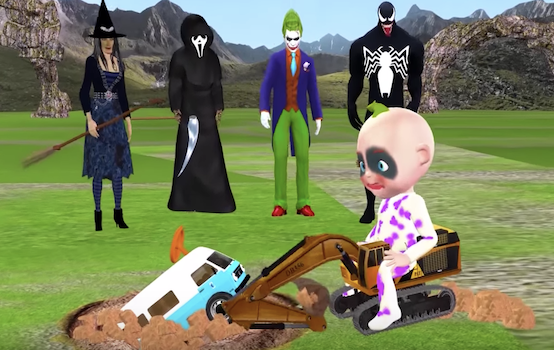
© YouTubeFrom “Superheroes BURIED ALIVE Outdoor Playground Finger Family Song NurseryRhyme Education Learning Video”
As the eminent philosopher Alasdair MacIntyre
recently said in a lecture given at the University of Notre Dame, "The mind is mindless without the imagination." And even though his subject was the grammar of morality, his pithy line prompts us to picture a "mindless mind" completely devoid of imagination. Something the exact opposite of ourselves: an anti-mind as alien in its amorality as it is dizzying in its irrationality. A sort of embodied void. And if with our human brains, constructed as they are to find rhythms and project patterns onto the random, and with our human souls, attuned to resonate with transcendent order, we're unable to envision what an imagination-less non-mind would truly be, we can simply turn to YouTube.
Stories about the horrors of YouTube's algorithm-generated childrens videos are beginning to make the rounds, and they're just as frightening as everyone contends. On his blog earlier this month,
TAC's Rod Dreher
described these videos as "science fiction nightmare come true." Writer and artist James Bridle wrote about them in a long
introductory piece on Medium saying,
"Someone or something or some combination of people and things is using YouTube to systematically frighten, traumatise, and abuse children, automatically and at scale, and it forces me to question my own beliefs about the internet, at every level."




















Comment: